
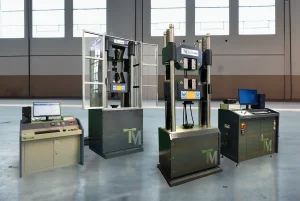
In the fast-advancing world of engineering and manufacturing, the materials used in everything from automobiles to skyscrapers are constantly pushed to their limits. At the heart of ensuring these materials can withstand real-world applications is tensile testing, a process that has become indispensable in modern industry. Tensile testing not only determines a material’s strength and flexibility but also assists in innovation, allowing engineers to develop and validate new, lighter, stronger, and more durable materials than ever before.
As industries continue to develop, materials grow more complex, requiring more advanced and precise testing methods. Today’s tensile testing equipment is at the forefront of this evolution, using cutting-edge technology to provide highly accurate data that informs critical decisions in material selection and product design. This article discusses how key industries—automotive, aerospace, and construction—rely on advanced tensile testing equipment to guarantee their products meet the highest standards of safety and performance, ultimately shaping the future of engineering and construction.
Automotive Industry – Improving Safety and Performance
The automotive industry is in the midst of a transformation, driven by demands for increased safety, efficiency, and sustainability. At the core of this transformation is the extensive use of advanced materials, such as high-strength steels, aluminum alloys, and composites, all of which must undergo rigorous tensile testing to verify their suitability for automotive applications.
Tensile testing is critical in the development and validation of these materials, particularly in the context of lightweight a key strategy for improving fuel efficiency and reducing emissions. By accurately measuring the tensile strength, ductility, and elongation of materials, engineers can select the optimal materials that offer the best combination of strength and weight. For example, advanced high-strength steels (AHSS) are commonly used in car bodies due to their excellent strength-to-weight ratio, which improves crashworthiness while keeping the vehicle lightweight.
In electric vehicles (EVs), the importance of tensile testing is even more pronounced. As automakers strive to increase EV range and efficiency, they are increasingly turning to lightweight materials like aluminum and composites. These materials, while lighter than traditional steel, must still meet stringent safety standards. Tensile testing confirms that these materials can withstand daily stresses and, crucially, provide adequate protection in a collision.
Moreover, tensile testing is not limited to body panels and structural components. It also plays a key role in the development of tires, fasteners, and other critical parts. For instance, tire materials’ tensile strength directly impacts their durability and performance, influencing factors such as traction and wear resistance. By rigorously testing these materials, manufacturers can guarantee that their vehicles not only meet but exceed safety regulations and consumer expectations.
Aerospace Industry – Meeting Extreme Demands
In the aerospace industry, where safety, reliability, and performance are non-negotiable, tensile testing is integral. Aircraft and spacecraft materials must endure extreme conditions, from high-altitude flight’s intense pressures and temperatures to space rigors. Tensile testing confirms that these materials meet the stringent requirements to perform under such demanding conditions.
One of the key materials used in aerospace applications is carbon fiber-reinforced polymer (CFRP), known for its exceptional strength-to-weight ratio. Tensile testing is crucial in validating CFRP’s mechanical properties so that it can withstand stresses encountered during flight without compromising the aircraft’s integrity. This testing helps engineers optimize the material’s properties, such as tensile strength and modulus of elasticity, to maximize performance while minimizing weight.
Titanium alloys are another cornerstone of aerospace engineering, valued for their high strength, low density, and excellent corrosion resistance. Tensile testing of these alloys is necessary in order to verify their ability to withstand extreme forces in components such as turbine blades, airframes, and fasteners. Tensile tests guide titanium alloy selection and processing.
Moreover, tensile testing is vital for the development of high-performance materials designed to push aerospace technology to new heights. Innovations such as high-temperature alloys and advanced composites are subjected to tensile tests to assess their performance under simulated flight conditions. This testing not only helps in material selection but also improves manufacturing processes.
Tensile testing in aerospace has a profound economic impact. With the global aerospace materials market projected to reach $25.80 billion by 2027, the ability to accurately test and validate materials is critical to maintaining competitive advantage and ensuring flight safety. Tensile testing provides the data needed to develop lighter, stronger, and more durable materials, directly impacting fuel efficiency, operational costs, and the overall safety of aerospace vehicles.
Construction Industry – Providing Structural Integrity and Longevity
In the construction industry, the materials used must not only withstand nature’s forces but also maintain their structural integrity for decades. Tensile testing is a critical process that helps verify that the materials used in buildings, bridges, and other infrastructure can withstand stresses throughout their lifespan. By rigorously testing materials such as steel, concrete, and emerging composites, engineers can guarantee that these structures are both safe and durable.
Steel, a fundamental material in construction, undergoes extensive tensile testing to determine its strength and ductility. These properties are crucial for making sure that steel can support loads imposed by buildings and bridges, particularly in regions prone to earthquakes or high winds. Tensile testing provides detailed data on how steel behaves under tension, helping engineers select the right grade of steel for different structural applications. This provides assurance that the material will perform as expected under both normal and extreme conditions.
Concrete, another staple of the construction industry, is also subject to tensile testing, particularly when used in reinforced concrete structures. While concrete is strong in compression, its tensile strength is lower, which is why it is often reinforced with steel. Tensile testing helps determine the effectiveness of this reinforcement, ensuring that the combined material can handle stresses in real-world applications. This testing is particularly important for structures’ long-term durability, as it helps prevent cracking and other forms of failure that could compromise safety.
In addition to traditional materials, tensile testing is increasingly relevant for assessing sustainable materials like green concrete and recycled steel. As the construction industry shifts towards more environmentally friendly practices, the ability to test and validate these materials becomes crucial. Tensile testing confirms that these new materials can meet the same performance standards as their conventional counterparts, providing a path forward for sustainable construction without sacrificing safety or durability.
The Critical Role of Tensile Testing in Modern Industry
Tensile testing is a fundamental process for verifying materials’ safety, performance, and longevity across key industries. In the automotive sector, it helps create vehicles that are not only lighter and more efficient but also safer for passengers. In aerospace, where materials must endure extreme conditions, tensile testing guarantees that every component meets the highest standards of reliability and strength. The construction industry relies on tensile testing to validate the structural integrity of materials used in buildings and infrastructure, making sure they can withstand nature’s forces and the test of time.
For tensile testing to deliver accurate and reliable results, it must be conducted with precision and consistency. This is why the use of advanced tensile testing equipment, such as Universal Testing Machines (UTMs) and precise specimen preparation tools, is crucial. These tools help standardize the testing process, reducing variability and providing certainty that the data collected reflects the true properties of the materials being tested.
