
Laser cutting machines are rapidly emerging as an indispensable tool in modern manufacturing due to their high precision and efficiency. Iconic fashion brands from the US with a strong global presence, like Michael Kors, Tory Burch, Kate Spade, and Ralph Lauren have already integrated laser cutting into their designs, combining technology with aesthetics to create stunning fashion collections.
Since the introduction of advanced laser cutting technology, many companies have overcome the limitations of traditional manufacturing methods. Not only has laser boosted production efficiency and reduced costs, but it has also significantly advanced waste reduction. As an experienced laser practitioner, I will present concrete data and real examples to demonstrate the immense advantages of advanced laser cutting technology in improving production efficiency and controlling costs, achieving a breakthrough over traditional manufacturing techniques.

Ralph Lauren laser cut bag
How Laser Cutting Takes Productivity to the Next Level
Frenetic Cutting Speeds
Laser cutting is significantly faster than traditional mechanical cutting methods, dramatically reducing cutting time. This speed breakthrough allows businesses to respond more flexibly to changes in market demand. In metal cutting, laser cutting speeds can reach up to 40 meters per minute with an acceleration exceeding 1G, while plasma cutting speeds are under 5 meters per minute with an acceleration of about 0.3G. This means that laser cutting is nearly 10 times more efficient than traditional methods, resulting in substantial time savings.
Leap in Processing Precision
Laser cutting achieves precision up to ±0.1 millimeters, which is significantly better than other traditional cutting methods such as water jet cutting, plasma cutting, and mechanical cutting (for example, milling and sawing). The precision of laser cutting makes it especially advantageous in applications requiring high accuracy and complex shapes.
| Cutting Method | Laser Cutting | Water Jet Cutting | Plasma Cutting | Mechanical Cutting (Milling, Sawing) |
| Precision | ±0.1 mm | ±0.5 mm ~ ±1.0 mm | ±1.5 mm ~ ±3.0 mm | ±0.5 mm ~ ±2.0 mm |
Moreover, laser cutting is a non-contact process, reducing errors caused by mechanical wear. In CNC cutting, undesired internal R angles are inevitable at corners due to the limitations of the tool’s cutting path. Laser cutting, on the other hand, allows for precisely controlled sharp corner cuts.
In addition, blades and saw wear out over the course of processing the material, and the theory is that as soon as the process begins, the error will continue to grow over time until they have to be replaced. And the laser, as a beam of light, will not wear out. And the laser resulting error is constant, maintaining consistent processing accuracy at all times.
Laser Cutting Supports Complex Patterns
As consumer demand for personalized products increases, traditional mold manufacturing is increasingly unable to meet the demands of small, variable batches. Laser cutting allows for the precise cutting of complex patterns and details directly from the design, without the need for additional molds, die cutters, or paper patterns. This is a significant advantage of lasers over traditional methods.
Compared to manual operations, laser cutting reduces the labor intensity of tasks, prevents errors from accumulating during multiple manual stages, and ensures consistent product precision. This makes laser cutting indispensable in fields like fashion, leather, paper arts, and particularly for high-value materials and custom designs.
Streamlined Processes to Drive Production Forward
Laser cutting greatly simplifies processing workflows, helping shift labor-intensive industries to technology-driven ones. A classic example is Levi’s denim jeans. After adopting laser-based fading technology (F.L.X.), the number of steps in the fading process was reduced from 18–20 to just 3. This incredible productivity boost means a pair of jeans that once took 20–30 minutes to make can now be completed in 90 seconds. On a larger scale, production cycles have shrunk from months to weeks, sometimes even days. This has significantly reduced mismatches between supply and demand and enhanced product personalization and rapid response to customer needs.
Another great achievement of laser cutting is the ability to perform multiple operations, such as engraving and cutting, in a single pass. Whereas CNC machines require 3–4 tool changes to handle cutting, engraving, drilling, and edge finishing. But as long as the laser machine is set up with the right process and parameters, there is no need to stop and change the cutter head, the laser software will control the machine to do everything automatically – no more need for manual labor to repeat the same boring work hundreds of times. This is all thanks to the integration of multiple processes and a high degree of automation brought about by laser cutters.
Versatility with Multiple Materials
While high-end multifunction CNC machines can process multiple materials with experienced operators, in practice, it’s more common to process one material at a time to ensure quality and efficiency. This approach works well for large-scale production runs.
In contrast, laser machines align more closely with today’s flexible and intelligent production trends. Fiber lasers can handle a wide range of metals, from stainless steel to gold, silver, and copper. CO₂ lasers cut non-metal materials like wood, leather, acrylic, paper, and EVA foam with ease. A single laser machine can switch between different materials by simply adjusting parameters—there’s no need to change tools. This streamlines operations, making laser cutting ideal for flexible production models. This material versatility provides businesses with greater flexibility, meeting the market’s need for product diversification and customization.
How Laser Cutting Reduces Waste and Saves You Money
Nesting and Material Optimization
Traditional material handling methods often struggle with precise nesting, leaving many offcuts unused and turning them into waste. In contrast, laser software-based nested cutting technology maximizes material utilization by optimizing nesting and cutting paths, increasing material utilization in the laser cutting process by more than 10% from the original basis, thereby reducing scrap disposal costs and lowering overall costs.
Actually, laser cutting systems have been used to optimize leather utilization, saving 2% to 4% of materials as early as the 1990s. Today, compared to traditional stamping processes, new laser cutting systems can use over 90% of steel plates, reducing waste by 8%.
Non-Contact Processing Reduces Material Damage
Laser cutting uses fine beams of light to cut materials, impacting only the areas that interact with the beam, minimizing the negative impact on the material’s structure and strength. Instead, traditional mechanical cutting methods exert mechanical stress on materials, which can cause fragile materials—such as glass, ceramics, and acrylics—to develop scratches, deformations, even cracks, affecting material strength and durability.
For thin and flexible materials like paper, fabric, and leather, tool contact can cause deformation, misalignment, and tearing. Laser cutting is a non-contact process that enables the cutting process to be completed quickly without touching the material, avoiding damage due to friction and stress and thus reducing scrap rates. So laser cutting is particularly suited to the processing of delicate and fragile materials, improving the success, quality and longevity of the finished product.
A More Sustainable and Safer Modern Solution
Reducing Chemical Use and Environmental Pollution
Green manufacturing is not only responsible for the environment but also for worker safety. Traditional methods often involve extensive chemical use and water consumption. EDM wire cutting requires cutting coolant, and the electrode wire will also be a large loss, and water jet cutting requires the use of a large amount of water and emery, serious environmental pollution.
Laser cutting can drastically reduce chemical use, lowering environmental pollution and potential harm to workers. In glass processing, laser engraving can replace chemical etching methods, eliminating the need for highly corrosive and harmful hydrofluoric acid. And in the apparel industry, Levi’s has reduced the number of chemicals used in denim post-processing from thousands to just a few dozen, with a focus on avoiding toxic and corrosive chemicals like potassium permanganate, and minimizing worker exposure to dust and particles. While laser cutting does produce smoke, it is easy to collect and filter, ensuring a cleaner production process and helping companies meet sustainability goals.
Low Energy Consumption and Carbon Emissions
Laser cutting efficiency is not only reflected in speed and precision but also in energy consumption. Modern laser cutting equipment has achieved low energy operation, saving 30%-50% of energy compared to traditional mechanical cutting. In some applications, energy savings are even greater. For large-scale industrial manufacturing, this energy advantage translates into significant cost savings while also helping to reduce carbon emissions and align with green manufacturing principles.
High-precision Laser Cutting Solutions Help You Move Forward
To summarize, environmental ideas are not at all incompatible with productivity. But to achieve a balance between environmental goals and efficiency, you may need a high-end laser machine – and if you’ve actually tried it, you know that a low-end machine often has neither, while a high-end laser machine often has both.
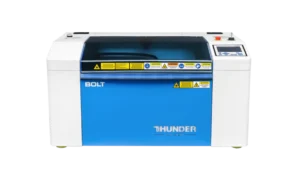
Of the machines I’ve used, there are some that stand out for their sustainability in particular. Even though Thunder Bolt is a compact desktop machine, it still stands above the rest, meticulously fitted with a sturdy housing and a highly efficient exhaust fan, which allows it to maximize the capture and safe emission of particles. The air assist and cooling fans are intelligently controlled to minimize energy consumption.
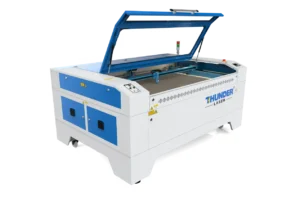
The details of the massive NOVA are equally superb, with silent motors and optimized structural design to minimize noise pollution, allowing operators to focus on their work for long periods of time, thus indirectly enhancing work efficiency. In terms of safety, they feature multiple protection designs, such as warning lights, fire alarms and protective covers, allowing employees to operate the equipment with greater confidence without compromising work efficiency due to safety hazards. In addition, the laser cutting machines are compatible with Lightburn software, which makes computer-controlled nested cutting to save materials easier and more convenient, making them a cost-effective workshop-level laser cutting solution.
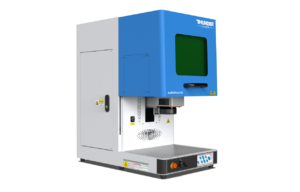
Aurora Lite not only saves you money, but it also shows your customers that you’re committed to the environment and the health of your workers, which is a commitment to the future. Even better, the long durability of this desktop marking machine, along with the use of environmentally friendly materials. It reduces space and cost by more than 50%, and is equipped with a more visible warning light to alert the operator of the machine’s status and avoid potential safety incidents.
Laser Cutting: Paving the Future of Green and Efficient Manufacturing
Laser cutting technology is redefining modern manufacturing standards with its high precision, speed, and material adaptability. Whether for personalized products in fashion or precision machining in industrial manufacturing, laser cutting offers advantages in non-contact processing, minimal error, and high flexibility. This boosts productivity, reduces material waste and results in a higher ROI. Advanced laser equipment like Nova, Thunder Bolt, and Aurora Lite not only help small businesses optimize space and resources but also meet higher precision and complex design needs. The laser engravers and cutters contribute to greener, more sustainable production processes and lower long-term operational costs.
Despite its significant advantages, laser cutting machines do come with an initial investment threshold. Businesses need to perform-cost-benefit analyses based on their production scale and product requirements to ensure that the investment in laser cutters yields sufficient returns. However, It’s important to note that with ongoing technological advancements, laser equipment is becoming smaller and more affordable, which is shortening the payback period for laser cutting technology.
From a long-term investment perspective, the advantages of laser cutting are clear. While the initial investment may be higher than traditional methods, the savings in labor costs, raw material utilization and product quality, combined with its environmentally friendly operation, ensure that laser cutting will remain a vital cornerstone of manufacturing for years to come.
More about Laser Cutters: LASER CUTTER
