
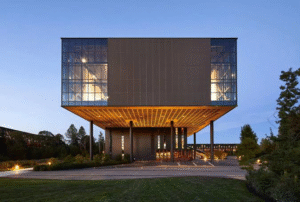
Three powerful forces are converging across the Atlantic: climate-related risk, an affordability crunch, and digital innovation. California’s wildfires, Florida’s hurricanes and Texas’s housing shortage have all exposed weaknesses in traditional suburban construction. At the same time, tighter energy- and carbon-focused regulation is pushing architects towards net-zero performance, while ever-cheaper digital tools – from parametric modelling to intuitive house design software – let small practices iterate new concepts at speed.
California: from fire-prone sprawl to hardened, low-carbon neighbourhoods
The Golden State has moved fastest. In April 2025 it became the first US jurisdiction to fold the 2024 International Wildland-Urban Interface Code into its statewide rules (Title 24, Part 7), making ember-resistant roofs, non-combustible façades and defensible landscaping mandatory for almost every new rural home. Local councils are pairing those rules with incentives for net-zero energy performance and on-site battery storage. Developers now speak of “climate-ready cottages”: compact forms, minimal eaves and façades clad in charred timber or fibre-cement that can shrug off both wildfire and drought-driven heatwaves. Pilot neighbourhoods in the Sierra foothills are already being built to the new template.
Future outlook: Expect the code to spill into retrofits. Insurers – badly burned in the 2023 and 2024 fire seasons – are already demanding upgrades before renewing policies, accelerating a wholesale redesign of older stock.
Texas: the 3D-printed frontier
Everything is bigger in Texas – including the ambition of its construction-tech sector. In Austin, a partnership between ICON and a leading national housebuilder has begun rolling out the world’s largest 3D-printed housing community, delivering 100 single-storey dwellings in concrete-based “layers” that rise at roughly 15 cm per second. The technology slashes both labour and waste, produces monolithic walls with superb thermal mass, and allows serpentine floor plans that would be prohibitively expensive in timber frame.
Future outlook: State legislators are eyeing the model as a quick route to affordable starter homes. If building-code amendments clear the Senate later this year, 3D printers could become as common on Texan sites as concrete mixers by 2027.
Florida: building for the next hurricane
The Sunshine State’s 2024 code cycle tightened wind-load calculations, roof-to-wall anchoring and impact-resistant glazing, while mandating raised floor levels in many coastal counties. Architects now default to aerodynamic hip roofs, elevated piles and flood-resistant concrete podiums. Internal layouts are shifting too: ground floors are often left open for storage or parking, with living spaces one storey up and mechanical kit in the loft to survive storm surge.
Future outlook: Analysts expect Florida’s next update (2027) to require battery-backed solar arrays on most new homes, turning storm-hardiness into full-blown energy autonomy.
Colorado: high-altitude net-zero and mass-timber experimentation
House Bill 22-1362 obliges every county updating its codes after July 2023 to adopt an “electric- and solar-ready” standard, with a full low-energy, low-carbon mandate kicking in from January 2025. That has made heat-pump heating, triple glazing and airtight construction the new normal along the Front Range. Denver developers are also embracing engineered-wood structures: a dozen-storey residential block in RiNo has demonstrated that mass timber can shave 36 % off embodied carbon compared with concrete.
Future outlook: With timber supply chains bedded in and electricity almost entirely wind-powered by 2030, experts tip Colorado to reach true carbon-neutral housing a decade ahead of federal targets.
New York: electrification and adaptive re-use
New York City’s Local Law 154 bars new gas connections in smaller buildings from 2024, with larger sites following by 2027. State-wide legislation extends the all-electric rule to the suburbs from 2026, aligning it with ambitious retrofit-for-rent schemes that turn obsolete office floors into family apartments. The upshot is a renaissance of compact, electric-only kitchens, shared heat-pump boilers and façades pre-fabricated off-site to wrap 70-year-old towers in new high-performance skins.
Future outlook: Consultants predict that by 2035 the majority of New York’s new housing will be conversions, not green-field builds – a trend certain to accelerate the uptake of plug-and-play bathroom pods and digitally modelled retrofit packages.
What links the frontrunners?
Despite their very different climates, the five states share three common catalysts. First, regulation is no longer optional; it sets a floor of performance on energy, resilience and carbon. Second, insurers and mortgage lenders now price risk in real time, nudging buyers towards homes that can prove lower lifetime costs. Third, widespread access to BIM platforms and cloud-based house design software lets architects validate a concept against dozens of code or climate variables in minutes, shrinking the gap between vision and building permit.
The road ahead
Taken together, these shifts sketch a likely future for US house design:
- Form follows hazard: roof profiles and cladding palettes will increasingly mirror local threat maps – fire in the West, wind and water in the Gulf, heat and drought in the High Plains.
- Electrification everywhere: as grid carbon intensity falls, even gas-rich Texas is piloting all-electric subdivisions.
- Factory logic: 3D printing in Texas, mass-timber panels in Colorado and panelised retrofits in New York all point to a supply-chain revolution as profound as the post-war balloon frame.
- Data-rich design: code updates will arrive faster than political cycles; only digitally agile practices will keep pace.
Conclusion
America’s housing landscape is fragmenting into climate- and code-specific micro-markets, each with its own palette of materials, technologies and floor-plan logic. Yet from California’s fire-proof cottages to Texas’s printed courtyards, the common thread is adaptability. The states that have already rewritten the rule-book hint at a future in which durability, carbon thrift and software-enabled customisation are the default, not the exception – a blueprint likely to spread across the Union, then across the globe.
