
The integration of Artificial Intelligence (AI) into customer experience (CX) operations holds transformative potential, promising enhanced personalization, efficiency, and cost reduction. Indeed, according to the Zendesk Customer Experience (CX) Trends Report 2024, a significant 65 percent of CX leaders view AI as a strategic necessity that has made previous CX operations obsolete. AI-powered customer experience leverages technologies like machine learning, chatbots, and digital agents to deliver fast, efficient, personalized, and proactive experiences at scale. This can lead to numerous benefits, including enabling great customer service experiences at scale, providing fast 24/7 support, improving efficiency, delivering hyper-personalized interactions, and reducing operational costs.
However, as businesses embark on this journey, it’s clear that adopting AI in CX involves significant hurdles and ethical complexities. While excitement abounds – nearly all CX leaders in one study were confident AI could improve CX – there is a notable “optimism gap,” with only about three in ten stating AI is often used in CX today. This disparity underscores the challenges organizations face in translating potential into widespread implementation. Let’s delve into some of the critical challenges and ethical considerations that demand careful attention during AI adoption, drawing upon key insights from recent reports and real-world experiences.
The Bedrock of AI: Data Quality, Accessibility, and Integration
At the heart of effective AI lies data. Predictive AI and Machine Learning (ML) algorithms rely heavily on analyzing vast amounts of historical data to identify patterns and forecast future outcomes. To understand customers and tailor interactions through hyper-personalization, AI needs access to extensive customer data, including behavior, purchase history, preferences, and even unstructured data like sentiment from interactions.
Yet, securing high-quality, accessible, and integrated data proves a substantial challenge. Many businesses struggle to achieve a comprehensive, 360-degree view of the customer across disparate systems. Integrating data from multiple sources – online, in-store, mobile, and social media – is crucial for omnichannel support and a complete customer profile. While over 90 percent of CX teams report having a strategy to centralize service, sales, and marketing data, highlighting the recognition of this need, the reality of data integration projects remains complex. Sixty-three percent of CX leaders plan to invest in data integration and enrichment tools, with another 28 percent wanting to but lacking the resources. This underscores that while the ambition is there, the technical and resource challenges are real.
Moreover, maintaining accurate and relevant knowledge bases, which autonomous AI agents often rely on, has been a long-term challenge. Although confidence in knowledge base accuracy seems relatively high now, with only 6 percent rating theirs as “not at all accurate”, GenAI tools are seen as crucial for ongoing optimization. Data quality and accessibility are fundamental prerequisites; without them, even the most sophisticated AI models will struggle to deliver accurate or valuable insights.
Implementation Complexity and Cost: The Practical Hurdles
Bringing an AI-powered system into an existing customer service infrastructure is a complex endeavor. Integrating AI seamlessly requires aligning new technologies with legacy systems, which can be both technically demanding and costly. Scaling AI from pilot projects to widespread deployment demands not just technological integration but often significant organizational changes. This involves defining clear objectives, assessing data readiness, building or acquiring necessary skills, selecting appropriate tools, and fostering a data-driven culture. Companies like Holcim experimenting with GenAI for cement ordering through WhatsApp faced challenges related to the novelty of the technology and the need for expertise. The effort required can be substantial; one perspective suggests that in successful digital transformations, only 10% of the effort is about the technology foundation, while 20% is data and a considerable 70% involves people and organizational change. The expense associated with AI implementation is also a cited factor slowing down adoption.
The Human Element: Skills Gap and Employee Concerns
AI adoption necessitates new skills within the workforce. Companies need data scientists, ML engineers, and AI experts to build, manage, and optimize AI systems. Forty-one percent of CX teams plan to actively hire data science and AI expertise. However, finding and retaining these highly sought-after talents in a squeezed labor market is challenging.
Beyond the technical skills, there’s the critical need for employee buy-in. AI tools, particularly those used for monitoring agent performance or automating tasks, can raise concerns among the workforce. Employees may worry about being replaced or whether AI tools are used for surveillance rather than support. A 2023 survey found that employees viewed employers as significantly less empathetic when AI tools were offered. Addressing these fears requires education on data rights, transparency regarding AI’s purpose, and actively involving employees in the development of AI solutions.
Ethical Considerations: Trust, Bias, and Transparency
Perhaps the most significant challenges lie in the ethical domain, particularly concerning customer trust and the responsible use of AI. Maintaining customer trust is paramount. Customers may be skeptical about AI-powered interactions and the accuracy of the solutions provided.
A major fear among CX professionals is inaccurate AI, with 45 percent worrying about AI applications delivering incorrect insights. Real-world examples highlight this risk: an AI Agent developed for New York City provided illegal advice to small business owners, and a delivery company’s AI swore at a customer and wrote a negative poem about the company. These instances can cause significant organizational reputation damage, a concern shared by 37 percent of respondents in one survey.
AI models are trained on data, and if that data is biased, the AI will perpetuate and even amplify those biases. Ensuring fairness and avoiding discrimination in AI decision-making is crucial. Industry discussions consistently emphasize the need for guardrails and ethical AI practices.
Furthermore, there’s the concern about losing the “human touch.” While AI excels at efficiency and handling routine tasks, customers often still expect human engagement and empathy, particularly for complex or sensitive issues. CX leaders recognize the potential conflict between efficiency gains via automation and the need to maintain human connection and trust. This is why blending human and virtual agents is increasingly considered the best approach. Transparency about when a customer is interacting with AI versus a human is also vital for building trust.
Finally, the potential for job losses due to automation is a societal and organizational concern. While surprisingly only 31 percent of businesses explicitly fear job losses in one survey, the potential impact on the workforce is undeniable, whether through direct replacement or by making roles more complex. Alleviating these fears through education and demonstrating how AI can enhance, rather than replace, human roles is important.
Conclusion
It’s clear that while AI offers immense opportunities to reinvent customer experience and drive business growth, its adoption is a complex undertaking fraught with challenges and ethical considerations. From the fundamental need for high-quality, integrated data and the technical complexities of implementation, to addressing the skills gap, ensuring employee buy-in, and safeguarding customer trust through responsible, transparent, and unbiased AI use, the hurdles are significant.
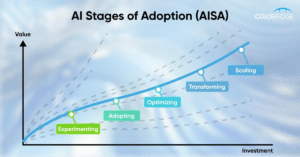
However, the market is moving forward; almost every organization has reportedly kickstarted its AI journey in CX. Successful implementation requires a strategic, phased approach that prioritizes not just technological deployment but also robust data strategies, talent development, and a deep commitment to ethical AI practices and maintaining the crucial human element. For organizations willing to thoughtfully navigate these challenges, the potential to unlock value, build deeper customer relationships, and secure a competitive edge in the age of AI remains vast. The journey ahead is exciting, but it demands careful consideration of both the promise and the potential pitfalls.
Navigate Your AI Journey with Confidence: Colobridge GmbH
Embarking on AI adoption in customer experience presents both remarkable opportunities and notable challenges. Colobridge GmbH, a dedicated German-Ukrainian company, possesses deep expertise in AI/ML and advanced cloud solutions. We are committed to helping your business strategically navigate the complexities of AI implementation, from ensuring data readiness to addressing ethical considerations and fostering organizational buy-in. Let our tailored services empower you to harness the transformative potential of AI responsibly and effectively, turning challenges into stepping stones for innovation and enhanced customer loyalty.
