
Hiring a Fractional CMO can be one of the smartest decisions your business makes—especially if you’re growing quickly but not yet ready for a full-time marketing executive. However, not all fractional CMO services are created equal.
Some provide high-level strategy but little execution support. Others may lack experience in your specific industry. The challenge is identifying a partner who aligns with your goals, team structure, and growth stage.
This guide will walk you through the key factors to consider when choosing the right fractional CMO services—and how to avoid costly mistakes.
What Is a Fractional CMO?
A fractional CMO is a senior-level marketing executive who works with your company on a part-time basis. Typically contracted for 5 to 20 hours per week, they provide executive leadership, strategic direction, and growth planning—without the cost of a full-time hire.
Their responsibilities may include:
- Developing brand positioning and messaging
- Designing go-to-market strategies
- Leading demand generation and acquisition planning
- Setting up analytics and performance dashboards
- Coaching internal team members or hiring new talent
- Aligning marketing with sales and product teams
Fractional CMOs may work independently or as part of an agency or consulting group.
Why the Right Fit Matters
Hiring the wrong fractional CMO can result in wasted time, poor execution, and confusion within your team.
The right one, however, will accelerate your growth, align your marketing with business goals, and create scalable systems. Their impact should be visible within the first 30 to 90 days.
Your goal is to find a leader who doesn’t just understand marketing, but who can lead, align, and deliver results within limited hours and budget.
How to Choose the Right Fractional CMO Services
1. Define What You Need
Start by identifying your business challenges. Do you need help with strategy, team leadership, execution planning, or all three?
Key questions to consider:
- Are you looking for a strategist, a hands-on operator, or both?
- Do you have a team that needs guidance or are you starting from scratch?
- Is this a short-term engagement or a long-term relationship?
Having clarity upfront helps you filter out candidates who aren’t a match for your goals.
2. Look for Industry Experience
While strong marketers can adapt across verticals, experience in your industry can reduce onboarding time and improve results.
For example:
- A SaaS company may need someone with experience in product-led growth and retention strategy.
- A B2B firm might require account-based marketing or sales alignment expertise.
- An eCommerce brand may need a leader who understands performance marketing and customer lifecycle management.
Review their previous clients and case studies to assess fit.
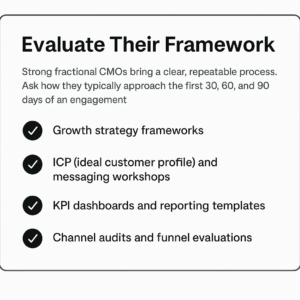
3. Evaluate Their Framework
4. Assess Communication and Leadership Skills
Your fractional CMO will likely interface with executives, sales leaders, product managers, and marketers. They need strong communication and leadership abilities to align teams and drive initiatives forward.
Consider the following:
- Are they clear and confident in articulating ideas?
- Do they listen and ask thoughtful questions?
- Can they challenge assumptions without creating friction?
- Have they worked in hybrid or remote environments?
A CMO who can’t lead cross-functional discussions will struggle to make a meaningful impact.
5. Clarify Availability and Workload
Not all fractional CMOs offer the same level of availability. Some may only be available 5–10 hours per week, while others commit to two or three full days.
Clarify:
- Weekly hour commitments
- Communication expectations (email, Slack, meetings)
- Turnaround time for deliverables
- How many other clients they currently support
You don’t want to be one of ten clients fighting for limited attention.
6. Ask for Results and Case Studies
Top-tier fractional CMOs can speak confidently about past successes, even if under NDA.
Ask for examples such as:
- Improvements in lead quality or volume
- Increases in conversion rates
- Reductions in customer acquisition cost
- Growth in website traffic or demo bookings
- Examples of successful GTM plans
If they can’t offer concrete results or speak in metrics, that’s a warning sign.
7. Understand Pricing and Scope
Pricing can vary depending on the CMO’s experience and the depth of the engagement.
Typical rates:
- $5,000–$8,000/month for light strategic guidance
- $10,000–$15,000/month for more hands-on involvement
Be sure to clarify:
- Scope of work included
- Whether they offer execution or just strategy
- Use of freelancers or agencies for additional services
- Reporting and meeting cadence
Avoid surprises by getting everything in writing before you begin.
Mistakes to Avoid
- Hiring someone too junior: A fractional CMO should bring 10–15+ years of experience, ideally including VP or C-level roles.
- Expecting full-time output: Fractional CMOs are not in-house marketers—they are part-time leaders focused on strategy and alignment.
- Skipping onboarding: Even though they are part-time, they need full access to your data, team, and tools to be effective.
- Failing to define KPIs: Agree on specific performance goals before the engagement begins.
Final Thoughts
Choosing the right fractional CMO service is about more than finding a marketer with a nice resume. It’s about finding a strategic partner who can lead your growth efforts, align cross-functional teams, and deliver tangible outcomes.
To recap:
- Start with a clear understanding of your needs
- Prioritize industry experience and a structured approach
- Look for strong leadership and communication skills
- Set clear expectations around time, scope, and goals
When chosen carefully, a fractional CMO can bring executive-level leadership at a fraction of the cost—helping you move faster, smarter, and more efficiently.
