
Although the shift to electric vehicles has become a popular trend, many people still worry about charging speeds. The demand for fast EV charging is growing, but higher charging power tends to cause equipment to overheat. Heat dissipation has become a key factor in improving charging speeds. If temperatures cannot be effectively controlled, both charging efficiency and safety will be affected.
Currently, EV charging stations primarily use two EV cooling systems: liquid cooling vs air cooling. What’s the difference between them? This blog will explain their distinctions in terms of efficiency, noise, lifespan, and cost to help you better transition into the EV charging business.
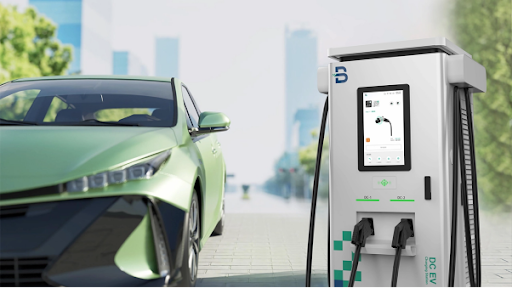
Principles of Liquid Cooling vs Air Cooling EV Chargers
Liquid cooling vs air cooling, as the names suggest, refer to the cooling methods of charging stations, whether they use coolant or natural airflow for heat dissipation.
What is a Liquid Cooling Charging Station?
Liquid cooling charging stations dissipate heat through a built-in coolant circulation system (usually water-glycol mixture). When the charger operates, the coolant circulates through internal pipes, absorbing heat generated by charging modules and cables.
After passing through the radiator to cool down, it cycles again to maintain stable operation. This technology offers high heat dissipation efficiency and low noise, which is often seen in high-power ultra-fast chargers.
What is an Air Cooling Charging Station?
Air cooling charging stations rely on fans and natural airflow for heat dissipation. Internal fans blow air onto heat-generating components during operation, such as electronic parts and cables, with the heat being dissipated through ventilation holes.
Their structure is simple and cost-effective, though with relatively weaker cooling efficiency, making them commonly used in AC power charging stations.
Liquid Cooling Vs. Air Cooling EV Chargers
Is liquid cooling better than fan cooling? Here is a detailed analysis in terms of charging efficiency, noise level, lifespan, and cost.
Charging Efficiency
Liquid cooling charging stations use coolant for active heat dissipation, which can more efficiently remove the heat during high-power charging and maintain the temperature within a stable range. This prevents power reduction caused by overheating, thereby sustaining high-power output for extended periods.
Air cooling charging stations rely on fans and airflow for passive heat dissipation, which removes heat slowly. After charging for some time, their efficiency is forced to decrease as temperatures rise. Just like our smartphones, the hotter the back cover gets, the slower the charging speed becomes.
Noise Level
Liquid cooling charging stations typically operate at noise levels close to ambient background sound, as they utilise both coolant and low-speed fans.
In contrast, air cooling charging stations incorporate multiple high-speed small fans, resulting in noticeable noise. Most charging point operators choose to install them in open spaces, such as parking lots.
Lifespan
Liquid cooling vs air cooling, which has a longer lifespan? It actually depends on brands, models, and costs. If the quality is the same, after long-term operation, liquid cooling chargers significantly reduce electronic component ageing thanks to their temperature-controlled operating environment.
In contrast, the high-temperature working conditions of air cooling chargers may accelerate material degradation, requiring more frequent maintenance.
Cost
The initial installation cost of liquid cooling systems is relatively high due to their more complex structure, as well as the need for subsequent maintenance, such as coolant replacement and cooling pipeline cleaning. However, in terms of the charger’s full life cycle, its lower maintenance frequency and longer service life result in a better long-term return on investment.
Air cooling systems feature a simple structure and low purchase costs, but they still require regular cleaning and maintenance, and their service life is shorter compared to liquid cooling systems.
Which to Choose? Liquid Cooling vs Air Cooling System
Overall, choosing between a “liquid cool vs air cool” system depends on where you plan to install it and your budget.
When to Choose Liquid Cooling Chargers?
Liquid cooling modules are primarily used in high-power charging stations, such as 360kW products, suitable for highway service areas, commercial centres, and electric truck charging stations. They are also recommended for noise-sensitive areas like hospitals and hotels, as they produce minimal environmental noise.
Additionally, liquid cooling systems offer superior sealing performance, with excellent dustproof and waterproof capabilities, ideal for high-humidity, dusty, or high-temperature environments.
When to Choose Air Cooling Chargers?
The air cooling module, due to its limited heat-dissipation capability, is more suitable for charging needs with medium and low power ranging from 3.7kW to 150kW. This type of charging station is commonly seen in homes, communities, office parks, retail stores and some public parking lots. Its low price facilitates rapid deployment when the budget is limited.
In addition, at locations insensitive to noise and in dry and low-dust environments, such as underground parking lots, the frequency of maintenance can be reduced.
Find Liquid Cooling and Air Cooling Options from EVB Charger
EVB provides you with flexible charging solutions with different EV cooling systems, covering liquid cooling and air cooling systems to meet diverse scenario needs. What is worth mentioning is the EVB 2 Guns DC EV Charger with Liquid Cooling, featuring:
- Smart liquid-cooling technology makes the charging cable 40% lighter and thinner.
- IP55 rating and resistance to high temperatures, cold, humidity, dust, and internal pressure.
- Supports integrated battery energy storage systems, ensuring stable charging even during grid fluctuations or peak hours.
- Allows charging a Tesla with a 300 km range in just 10 minutes.
All EVB charging stations are certified with international standards, such as CE, CB, UKCA, etc., guaranteeing product quality, safety, and performance. EVB also provides charging station operators with one-stop services from purchase to installation. Contact them for a tailored “air cooling vs liquid cooling” charging business solution.
FAQs
Are liquid cooling stations prone to leakage?
No, high-quality charging stations adopt rigorous sealing technology, with the coolant circulation system undergoing stringent pressure tests. Under normal usage, leaks are very rare. Even in unexpected situations, the system will automatically shut down to prevent safety incidents for liquid cooled battery electric car. We recommend regular coolant inspections to ensure dual-layer protection.
Do air cooling stations perform better in winter?
It depends on the ambient temperature. The chemical reactions inside the EV battery slow down in cold environments, which consequently reduces the charging speed. Air cooling chargers are insufficient to heat the battery to its optimal temperature.
Do home charging stations need liquid cooling?
Generally not needed. Home charging typically operates at 7kW-22kW power levels, generating far less heat than ultra-fast charging stations, making the air EV cooling system sufficient to meet the requirements.
