
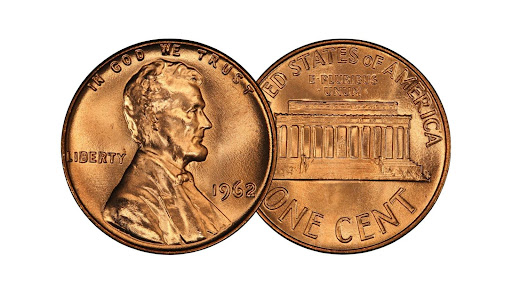
Discovering a 1962 penny error in your collection could mean finding a coin worth significantly more than face value. While 1962 pennies don’t have major famous errors like some other years, several collectible varieties exist that numismatists actively seek.
Accurate identification is crucial for coin collectors to avoid mistaking common damage for valuable mint errors. Professional tools like CoinKnow can help you identify these errors instantly, provide professional grading, and determine accurate market values.
Rare 1962 Penny Error List & Coin Value
1. 1962-D Penny Repunched Mint Mark Error
The repunched mint mark (RPM) is one of the most collectible 1962-specific errors, occurring exclusively on Denver-minted pennies. This error happened when mint workers manually punched the “D” mint mark onto working dies, sometimes requiring multiple strikes to correct positioning or angle issues.
You’ll see traces of the original “D” underneath or beside the final mint mark when examining the area below the date with magnification. The doubled mint mark appears as a shadow image, slight rotation, or directional shift of the “D.”
Values for 1962-D repunched mint marks typically range from $3 to $10, depending on the specific variety and how pronounced the repunching appears. Stronger, more visible repunching commands higher prices among variety collectors.
CoinKnow coin identifier takes the guesswork out of error coin discovery with AI-driven identification, professional-grade grading, and up-to-date market prices. Make informed decisions about professional authentication with confidence.
2. 1962 Penny Doubled Die Error
Minor doubled die varieties exist on 1962 pennies, though no major doubled dies have been discovered for this year. These errors occur during the die-making process when the hub strikes the die multiple times with slight misalignment.
Doubling typically appears subtly within the lettering and numerals rather than as dramatic separation. Check “LIBERTY,” “IN GOD WE TRUST,” and the date carefully under magnification for any signs of doubled images or thickened letters.
These minor 1962 doubled die pennies trade for $5 to $20 depending on the strength and location of the doubling. Coins with clearer, more visible doubling naturally command premium prices.
Need help identifying this error and checking its value? CoinKnow offers instant AI-powered identification, professional grading, and real-time market valuations through their advanced coin value app.
3. 1962 Penny DDR FS-801 Error
The 1962 DDR FS-801 represents a cataloged doubled die reverse variety listed in the Fivaz-Stanton reference guide. This error shows visible doubling on reverse design elements, particularly around the Lincoln Memorial building.
Look for doubling on inscriptions like “ONE CENT,” “UNITED STATES OF AMERICA,” and “E PLURIBUS UNUM” using magnification. The doubling creates a slightly thickened or shadowed appearance on these reverse elements.
Values vary based on the strength and clarity of the doubling visible on individual specimens. Well-struck examples with clear doubling command higher prices than weakly doubled coins.
Need help identifying this error and checking its value? CoinKnow offers instant AI-powered identification, professional grading, and real-time market valuations through their reliable coin value app.
4. 1962 Penny BIE Error
The BIE error gets its name from a vertical die crack appearing between the “B” and “E” in “LIBERTY,” creating what looks like the letter “I.” This die break error is unique to Lincoln cents and can occur on 1962 pennies from either Philadelphia or Denver.
Examine the word “LIBERTY” closely on the obverse—you’re looking for a raised vertical line between the “B” and “E.” The “I” appearance results from metal filling a crack in the die during striking.
Most 1962 BIE pennies trade for $5 to $10, with values increasing when the “I” is bold and clearly visible. Stronger, more pronounced BIE errors naturally attract more collector interest.
Need help identifying this error and checking its value? CoinKnow offers instant AI-powered identification, professional grading, and real-time market valuations through their trusted coin value app.
5. 1962 Penny Off-Center Strike Error
Off-center strikes happen when the coin blank isn’t properly aligned during the striking process. While not specific to 1962, these dramatic errors occur across all dates and remain highly collectible.
The resulting penny shows part of the design missing with a curved blank area visible. Values depend heavily on the percentage off-center and whether the date remains visible—without a visible date, value drops significantly.
Expect to pay $15 to $50 for minor 5-10% off-center errors, while dramatic 30-50% off-center strikes with visible dates can reach $100 to $300. The most valuable examples show significant misalignment while retaining the date.
Need help identifying this error and checking its value? CoinKnow offers instant AI-powered identification, professional grading, and real-time market valuations through their expert coin value app.
6. 1962 Penny Wrong Planchet Error
Wrong planchet errors occur when a penny design is accidentally struck on a blank intended for a different denomination. The most valuable 1962 examples involve strikes on dime planchets or foreign coin planchets.
These coins feel wrong immediately—different weight, potentially different color if struck on silver, and incorrect diameter. A 1962 penny on a dime planchet will be noticeably smaller and might have reeded edges.
Values for wrong planchet errors range from $500 to $2,000+ depending on the planchet type and strike quality. Authentication through professional grading services is essential due to high values and counterfeit potential.
Need help identifying this error and checking its value? CoinKnow offers instant AI-powered identification, professional grading, and real-time market valuations through their professional coin value app.
How Much is 1962 Penny Worth? Coin Identifier I Recommended
Finding and authenticating 1962 penny errors becomes straightforward with the right identification tools. Modern coin value apps use advanced technology to help collectors quickly determine what they’ve found and its current market worth.
CoinKnow delivers exceptional grading accuracy within a 2-point range on the Sheldon Scale, tighter than any competing app. It automatically detects rare varieties and errors including doubled dies and repunched mint marks, while offering exclusive features like copper color designation detection (RD/RB/BN). The app provides daily free scans with comprehensive collection management tools, making it ideal for both beginning collectors and serious numismatists seeking professional-grade analysis without the wait or expense of traditional grading services.
CoinValueChecker stands out by offering comprehensive market intelligence alongside error detection capabilities. As one of only two apps providing automatic rare error detection, it identifies doubled dies, repunched mint marks, and die breaks efficiently. The platform includes valuable trend analysis, auction monitoring, price tracking, and collector leaderboards, giving users both identification power and sophisticated market insights for making informed buying and selling decisions in the numismatic marketplace.
