
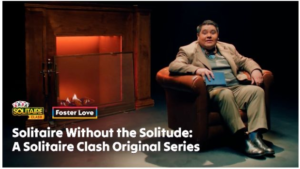
Solitaire hasn’t always been lively.
For much of its history, the game was defined by quiet simplicity: a single deck, one player, and long moments of stillness. It was often associated with solitude — something people played when they wanted to be alone. Solitaire Clash reimagines that experience, turning a traditionally quiet pastime into something fast-paced, social, and engaging, while still preserving the familiar framework that made Solitaire a classic.
That transformation is at the heart of Solitaire Without the Solitude, a three-episode mockumentary-style video series hosted by creator Leo González. Playing an unexpectedly intense narrator, Leo guides viewers through Solitaire’s fictionalized past and its very real present. Using humor and exaggeration, the series explores how Solitaire evolved from an isolated activity into a shared experience. The historical accuracy may be intentionally questionable, but the message is clear: Solitaire didn’t fade away — it evolved.
Exploring the Meaning Behind Leo González’s Series
Leo González brings more than performance to the project. Known for treating everyday moments with documentary-level gravity, his work feels sincere rather than staged. That authenticity carries into the campaign itself. Leo’s personal connection to foster care, rooted in his family’s history, influenced both his perspective and his involvement. His lived experience helped inspire a meaningful partnership between AviaGames and Foster Love, ensuring the project was driven by empathy rather than seasonal promotion.
That partnership led to the Solitaire Clash Christmas Wonderland Wishes Charity Event, created to support foster youth and families during the holiday season. The initiative went beyond promoting a game, focusing instead on creating real-world impact. It centered on care, awareness, and community — values that aligned naturally with Leo’s story and the broader themes of the series.
A Thoughtful Take on the “History” of Solitaire
The mockumentary unfolds without direct explanation or instruction. Directed by Amir Farhang, an Iranian-American filmmaker known for narrative-focused branded storytelling, the series uses comedy to mirror familiar cultural moments. The first episode jokingly suggests Solitaire began in an 18th-century French prison, leaning fully into dramatic absurdity. The second shifts to 1990s office life, where Solitaire becomes a quiet symbol of burnout and passive resistance. The final episode takes place during an awkward family holiday dinner, where Solitaire serves as a subtle escape when conversation runs dry.
How the Story Evolves Naturally
Throughout all three episodes, Solitaire repeatedly refuses to stay a solitary activity — and that’s intentional. Rather than reinventing the game, the series highlights how Solitaire has always appeared during moments of discomfort or silence. Solitaire Clash simply removes the isolation, creating a shared experience that helps people stay connected when situations feel strained.
Solitaire Minus the Solitude — Still the Same Idea
As Amir Farhang notes, Solitaire was long defined by playing alone. Solitaire Without the Solitude challenges that assumption, showing how a solitary ritual can become interactive and inclusive. Whether audiences interpret it as satire, social commentary, or pure entertainment is up to them.
Watch from the beginning. The rest unfolds on its own.
