
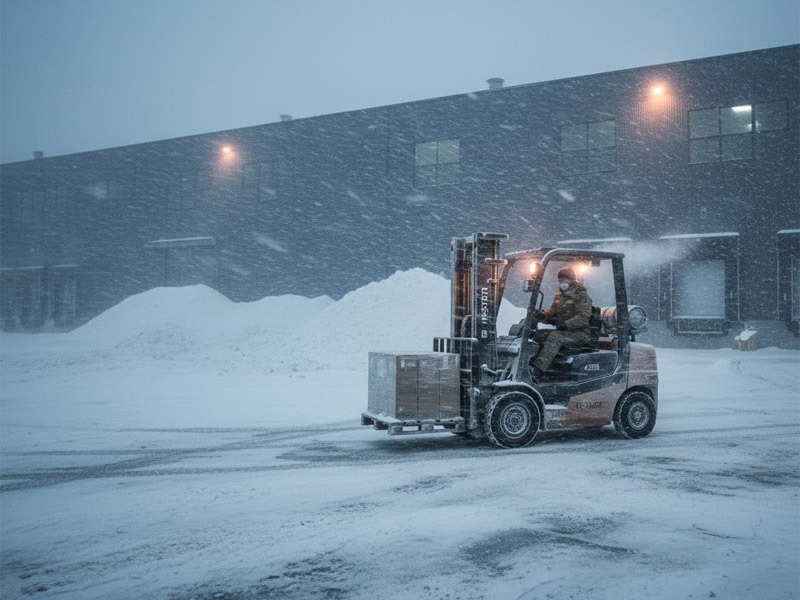
The material handling industry often focuses on standard warehouse operations, but a significant segment of forklift fleets operates in conditions that would render conventional equipment inoperable or dangerous. From Arctic-cold freezers to volatile chemical plants, these extreme environments demand radical engineering adaptations that transform basic material handling equipment into highly specialized machines. Understanding the specialized components required for these applications—particularly when sourcing Hyster forklift parts and other manufacturer-specific elements—is crucial for maintaining reliable operations in challenging conditions.
Cold Storage: Battling the Deep Freeze
Cold storage facilities operating at temperatures as low as -40°F present unique challenges that affect every component of a forklift. At these temperatures, standard hydraulic fluids thicken into molasses-like consistency, lubricants crystallize, and steel becomes brittle. Battery performance deteriorates dramatically, with lead-acid batteries losing up to 50% of their capacity in extreme cold.
Manufacturers address these challenges through comprehensive cold-hardening processes. Specialized synthetic hydraulic fluids maintain viscosity across extreme temperature ranges, while Arctic-grade lubricants prevent freezing in joints and moving parts. Electric forklifts designed for freezer service feature insulated battery compartments with heating elements that maintain optimal operating temperatures, though this creates the ironic situation of running heaters in a deep freeze.
When maintaining cold storage fleets, sourcing high quality Hyster forklift parts designed specifically for freezer applications becomes critical. Generic replacement components may use materials unsuitable for extreme temperatures, leading to premature failure. Cold-rated hydraulic seals, low-temperature electrical components, and specially formulated brake pads represent just a few of the temperature-specific parts that differ substantially from standard warehouse specifications.
Metal selection becomes critical in cold environments. Standard steel can experience cold-induced brittleness, increasing the risk of catastrophic failure under load. Engineers specify impact-tested metals and alloys that maintain ductility at extreme temperatures. Even seemingly minor components like hydraulic hoses require special attention—standard rubber compounds crack and fail in deep cold, necessitating specially formulated materials that remain flexible.
The human factor complicates cold storage operations further. Operators cannot spend extended periods in extreme cold, leading to frequent entries and exits between ambient and freezer zones. This creates condensation issues as warm, moist air meets cold metal surfaces, leading to dangerous ice accumulation on controls and viewing windows. Advanced cold storage forklifts incorporate heated operator compartments and anti-condensation treatments on critical surfaces.
Clean Room Environments: Precision and Purity
Pharmaceutical manufacturing and semiconductor fabrication facilities demand contamination-free environments where a single particle can ruin million-dollar production runs. Forklifts for these clean rooms undergo transformations that would make them unrecognizable to conventional operators.
Every surface that might shed particles receives special treatment. Standard paint gives way to electropolished stainless steel or specialized non-shedding coatings. Pneumatic tires—which constantly shed rubber particles—are replaced with polyurethane or other non-marking, non-shedding alternatives. Even the hydraulic systems are redesigned to eliminate any possibility of fluid leaks that could contaminate sterile environments.
Clean room forklifts often operate on sealed electrical systems, as internal combustion engines would introduce unacceptable levels of particulate and gaseous contamination. The electrical components themselves are frequently enclosed in sealed housings filled with inert gases to prevent any outgassing or particle generation. Some ultra-clean applications require equipment constructed entirely from 316L stainless steel with all crevices and joints designed for complete washdown capability.
Maintenance personnel working with clean room equipment must understand that even replacement parts require special handling. Hyster forklift parts intended for clean room service arrive in sealed, contamination-free packaging and often require installation in controlled environments to maintain certification standards.
Explosive Atmospheres: Engineering Against Catastrophe
Chemical plants, grain elevators, paint facilities, and munitions storage areas present perhaps the most demanding environment for material handling equipment. In these settings, a single spark can trigger devastating explosions. Equipment operating in these zones must meet rigorous explosion-proof certifications, with every component designed to eliminate ignition sources.
Explosion-proof forklifts feature sealed electrical systems where any potential arc or spark occurs within specially designed enclosures capable of containing an internal explosion without allowing it to propagate to the surrounding atmosphere. Motors, switches, and connections are housed in heavy cast metal enclosures with flame-arresting gaps that cool expanding gases below ignition temperature.
These machines operate under strict temperature limitations, as hot surfaces can ignite flammable atmospheres. Exhaust systems on internal combustion models route gases through water-cooled manifolds and spark arrestors. Many facilities mandate electric-only equipment to eliminate combustion risks entirely, though this creates challenges in obtaining sufficient runtime from battery systems that cannot be quickly swapped in hazardous zones.
Material selection extends beyond sparking concerns. Certain metals can create thermite reactions or act as catalysts in specific chemical environments. Engineers must carefully analyze the facility’s chemical inventory to specify compatible materials—what works in one chemical plant may be dangerously inappropriate in another.
High-Altitude Operations: Thin Air Challenges
Mining operations, mountain distribution centers, and high-altitude manufacturing facilities encounter a less dramatic but equally significant challenge: reduced air density. At elevations above 8,000 feet, internal combustion engines lose approximately 3% of their power for every 1,000 feet of elevation gain due to reduced oxygen availability.
Manufacturers address altitude performance through turbocharged or supercharged engines that compensate for thin air, though these add complexity and maintenance requirements. Fuel mixture systems require recalibration to prevent running too rich or too lean. Cooling systems, which rely on air density for heat dissipation, often need capacity increases to prevent overheating.
Electric forklifts avoid combustion-related altitude issues but face their own challenges. Reduced air density decreases cooling efficiency for motors and controllers, potentially requiring derating or enhanced cooling systems to prevent thermal shutdown.
These extreme environment adaptations represent significant engineering achievements, transforming commodity equipment into specialized tools capable of operating reliably where standard machines would fail within hours—or minutes. Success in these applications depends not only on initial equipment selection but on ongoing commitment to using properly specified replacement components matched to environmental demands
