
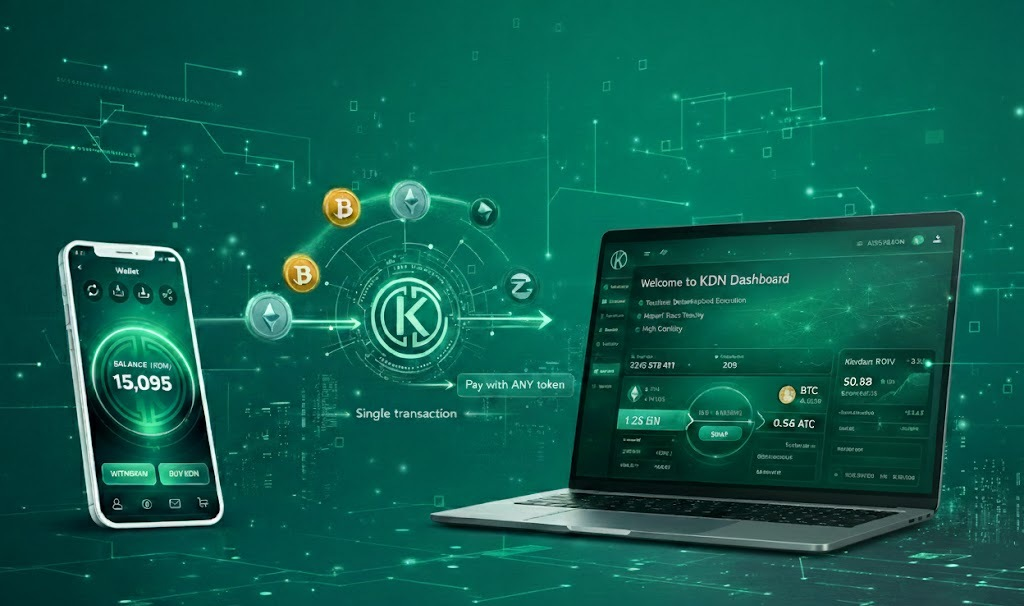
The digital asset market is currently undergoing its most significant structural shift in a decade. We are witnessing the end of the “Speculative Era” and the beginning of the “Utility Super-Cycle.” In this new environment, capital is no longer chasing theoretical roadmaps; it is aggressively consolidating into Operational Infrastructure.
At the forefront of this capital rotation is Kradven (KDN). Data from early-stage venture trackers confirms that the protocol is now hours away from hitting its $55 million funding hard cap. This is not just a fundraising milestone; it is a market mandate. It signals that sophisticated liquidity has identified the “missing link” in the global payment stack and is moving to secure ownership of the network before public price discovery begins.
The “Silent Crisis” of 2026: Fragmented Liquidity
For the past five years, the blockchain industry has built faster roads but failed to build the bridges. We have high-speed networks that remain isolated islands of value. Moving capital from a digital wallet to a real-world merchant terminal remains a slow, expensive, and tax-heavy friction point.
Kradven has solved this $19 trillion friction with the deployment of the Dynamic Reserve Warehouse (DRW).
The DRW is the industry’s first Universal Settlement Engine. It does not compete with existing blockchains; it unifies them.
- The Innovation: By utilizing a non-custodial, high-velocity reserve system, Kradven allows for Atomic Merchant Settlements.
- The Reality: A customer can pay in any supported digital asset, and the merchant receives instant settlement in their local fiat or stable currency.
- The Impact: This effectively removes the “Volatility Risk” that has kept 99% of global enterprise off-chain. It is the “Invisible Infrastructure” that allows the legacy economy to finally run on decentralized rails.
Engineering Scarcity: The “Supply Squeeze” Math
While many projects rely on inflationary rewards to attract users, Kradven has engineered a token model based on Deflationary Velocity. The KDN token is the functional fuel of the DRW, and its value proposition is mathematically tied to the volume of the network.
This is the “Velocity-Based Burn” mechanism that has institutional desks rushing to fill the final allocation:
- Transaction Burn: Every time a settlement is processed through the DRW, a fraction of the KDN utilized is permanently removed from the circulating supply.
- Liquidity Lock-Up: As the network scales, institutional market makers are required to stake KDN to facilitate the “Reserve Pipes.” This creates a “forced scarcity” where supply is locked away just as demand from global commerce accelerates.
- The Result: A shrinking supply meets an expanding utility demand. This is the classic economic formula for a “Super-Cycle Squeeze.”
The $55M Moat: Why Size Matters
In the world of decentralized finance infrastructure, the $55 million funding threshold is the “Golden Ratio.” Achieving this level of capital backing before a public listing provides a project with the “Liquidity Moat” necessary to dominate.
- Escape Velocity: It ensures the protocol can fund global integration partnerships without selling tokens to cover costs.
- Market Stability: It creates a deep liquidity floor that protects early contributors from the volatility typical of smaller, under-capitalized launches.
- Tier-1 Leverage: It provides the leverage needed to secure listings on the world’s most liquid exchanges immediately upon launch.
Radical Transparency: The “Audit Armor”
In a market sector often plagued by opacity, Kradven has established a new standard for Radical Transparency.
- CertiK Verified: The protocol’s smart contracts have completed comprehensive Tier-1 security audits, ensuring the DRW is shielded against the vulnerabilities that have plagued earlier cross-chain attempts.
- Non-Custodial Sovereignty: Kradven operates on a “No-Keys-Held” philosophy. It is a pure, backend infrastructure layer that never takes possession of user assets, eliminating counterparty risk.
The Final Allocation: The Window is Closing
As of this morning, the final 2% of the strategic allocation is being absorbed. The “Strategic Vacuum” that occurs between a presale sell-out and a public listing is fast approaching.
For investors, the binary choice is clear:
- Wait for the public listing and chase the price as the “Supply Squeeze” kicks in.
- Secure a position now, at the Foundational Entry level, alongside the institutional capital that has already vetted the technology.
The “Great Filter” has arrived. The era of “Ghost Chains” is over. Kradven is the infrastructure.
