
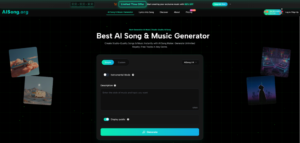
In the creative industries, the “blank page” is the enemy of productivity. For songwriters, game developers, and content producers, the pressure to create something original often leads to paralysis. The AI Song Generator addresses this psychological hurdle by fundamentally changing the starting point of the creative process. Rather than staring at silence and waiting for inspiration, creators can now use AI to generate a “zero draft”—a rough, malleable block of audio clay. This shift moves the workflow from “creation from nothing” to “curation and refinement,” a process that is significantly less cognitively taxing and far more efficient for modern production schedules.
Redefining The Role Of Audio In The Ideation Phase
Traditionally, music is the final layer added to a project because it is the most difficult to change. A video is edited, and then a composer is hired. Generative audio inverts this timeline. Because music can now be produced in seconds, it can be introduced at the brainstorming stage. A game designer can generate ten different “boss battle” themes to see which tempo fits the gameplay mechanics before a single pixel is animated. This allows the audio to inform the visual pacing, rather than merely reacting to it.
Utilizing The Generator As An Infinite Idea Machine
The primary value here is volume. A human composer might sketch three ideas in a day; AI Music Generator can generate three hundred. Most will be discarded, but the “throwaway” nature of the output is a feature, not a bug. It frees the creator from the sunk-cost fallacy. If a generated track doesn’t fit, it can be deleted without regret. This rapid cycling of ideas helps creators hone in on exactly what they want by quickly identifying what they don’t want.
Overcoming The Perfectionism Trap With Iterative Prompts
Perfectionism often stems from the fear of executing a bad idea. With AI generation, the execution cost is near zero. This encourages risk-taking. A user can request a “polka-dot dubstep track” just to see if it works. This low-stakes environment fosters a playful approach to creativity, often leading to unexpected and innovative results that a human, guarding their time and reputation, might never attempt.
Establishing A Linear Workflow For Asset Generation
To maximize efficiency, the interaction with the platform should be treated as a manufacturing pipeline rather than an artistic ritual. The steps are designed to be mechanical and repeatable.
Step 1: Inputting The Narrative Or Structural Parameters
The workflow begins with a descriptive brief. Instead of musical notation, the user inputs the narrative intent. “Background music for a tech review, upbeat, neutral emotion.” This sets the parameters for the prototype.
Step 2: Rapid Generation And Variant Testing
The AI processes the request. In a prototyping workflow, it is advisable to run the same prompt multiple times. The neural network will generate different variations of the same theme. This provides a spectrum of options derived from a single concept.
Step 3: Selection And Integration
The final step is downloading the most promising candidate. Because the file is MP3 and royalty-free, it can be immediately dropped into a timeline as a placeholder or final asset. This keeps the momentum of the project moving forward.
Comparing Linear Composition With Generative Iteration
The following table highlights the operational differences between writing music linearly versus generating it iteratively.
| Operational Metric | Linear Composition | AI Song Maker |
| Starting State | Silence | Generated Draft |
| Primary Bottleneck | Technical Execution | Selection/Curation |
| Revision Cost | High (Re-recording) | Low (Re-prompting) |
| Volume of Output | Low | High |
| Creative Focus | Note-by-note detail | High-level vibe/mood |
| Failure Penalty | High (Time lost) | Zero |
Moving From Audio Placeholder To Final Asset
A common workflow in video production is “temp love,” where an editor falls in love with a copyrighted placeholder track that they cannot afford to license. AI generation eliminates this issue. The “temp” track is the final track. Because the user owns the commercial rights to the generated audio, there is no need to find a “sound-alike” later. The prototype transitions seamlessly into the final product.
Supporting The “Fail Fast” Philosophy In Content Creation
Modern content strategies rely on speed. The ability to “fail fast”—to quickly identify that a direction isn’t working and pivot—is crucial. By reducing the music production cycle to minutes, the AI allows creators to fail fast in the audio department. They can test a somber tone, realize it clashes with the visual, and switch to an energetic tone in the time it takes to render a preview. This agility is the true power of the tool, far beyond the novelty of the technology itself.
