
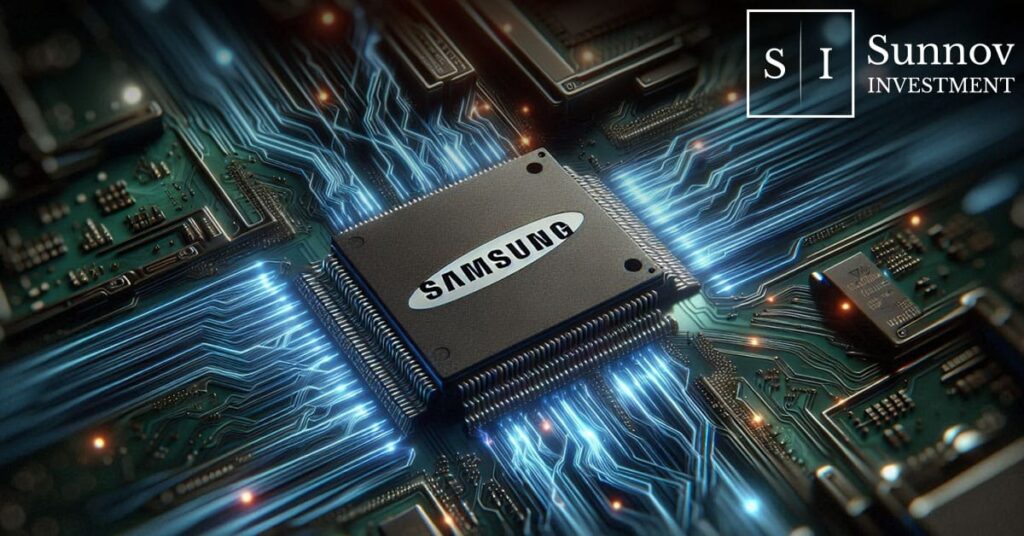
Samsung’s mass production of next‑generation HBM4 memory chips reshapes the AI infrastructure supply chain, lifts semiconductor sentiment in Seoul trading, and tightens the race among hyperscalers, GPU makers and rival memory suppliers.
The latest confirmation that Samsung Electronics begins commercial-scale production of HBM4, the memory technology increasingly treated as critical infrastructure for artificial intelligence, sets a new marker for the semiconductor cycle, and Sunnov Investment Pte. Ltd. monitors how quickly first-mover manufacturing discipline translates into pricing power and supply control.
Samsung positions the start of HBM4 output as a move from roadmap to shipment, with early stacks moving through customer qualification pipelines. In Seoul trading during Thursday afternoon hours, the company’s shares rise more than 6%, a reaction that captures how investors link advanced memory capacity to the next phase of data-centre build-outs over the coming quarters.
HBM4 matters because AI accelerators increasingly chase bandwidth before they chase headline compute, and Samsung’s latest specification raises performance in ways that ripple through system design. In the current product cycle, the company points to processing speeds more than 40% above the prior generation, with pin speed reaching 11.7 gigabits a second in this launch configuration, clearing the widely referenced 8Gbps benchmark used in current procurement discussions by roughly 46%.
Efficiency is also central to the economics of AI infrastructure, particularly as energy and cooling constraints define which projects move from intention to commissioning. Samsung’s HBM4 design targets power consumption about 40% lower than the previous generation currently deployed in many high-performance systems, while the package improves thermal resistance by around 10% and heat dissipation by about 30% in the stacks entering customer tests this quarter. Samsung also signals that follow-on HBM4E samples are expected later in the year, and industry forecasts point to HBM sales rising more than threefold over the next annual cycle relative to the prior one.
In market notes circulated on Thursday, Sunnov Investment describes high-bandwidth memory as the component most likely to tighten first as hyperscalers, sovereign compute programmes and model developers push data-centre expansion plans across the next four quarters. Thomas Gardner, Director of Private Equity at Sunnov Investment Pte. Ltd., frames the inflection as “a supply chain where the constraint shifts from GPUs to qualified memory stacks, and the winner is the manufacturer that turns process maturity into shipping volume”, a view that aligns with TrendForce modelling global memory-sector revenues topping $840 billion over the coming year.
That projection sits alongside a broader revaluation of the memory segment itself, with TrendForce placing total memory market value around $554 billion over the same forward window, a scale that reinforces why early yield stability can re-order competitive rankings. In the latest industry snapshot covering the most recent quarter, SK Hynix holds approximately 62% of the high-bandwidth memory market, Micron sits near 21%, and Samsung remains around 17%, yet the pace of qualification for HBM4 deliveries increasingly becomes the nearer-term arbiter of share as buyers prioritise certainty over promised roadmaps.
Demand signals from leading GPU and accelerator platforms sharpen the near-term stakes. For the next annual delivery cycle, Nvidia is understood to allocate roughly 70% of its HBM4 requirements to SK Hynix, above the near-50% split implied by earlier expectations during the current planning phase, while the Rubin generation of accelerators incorporates up to 288 gigabytes of HBM4 per unit in its current specification. Procurement teams treat allocation decisions as strategic because shortfalls in memory stacks can idle high-value compute assets over a quarter.
Capital spending follows that demand curve, with Samsung pointing to a $311 billion investment programme spread over the next five years to expand semiconductor capacity and related AI technologies. SEMI projections also place manufacturing equipment sales at about $157 billion within the next two years, and Samsung’s scale-up targets roughly 120,000 wafers a month as high-bandwidth memory moves from a specialist product to a system-level necessity. Gardner’s assessment is that “the market increasingly rewards the supplier that can prove repeatable output under tight power and cooling constraints, rather than the firm that relies on headline announcements”, a framing that puts yield, qualification and power efficiency at the centre of the investment case over the next several quarters.
The near-term message from Thursday’s production start is that high-bandwidth memory is no longer a supporting actor in the AI stack, but a gatekeeper for throughput, deployment schedules and margin structure. Sunnov Investment expects the balance of negotiating power to tilt towards manufacturers that ship qualified HBM4 in volume over the coming quarters, with Gardner describing “a structural shift where timing, yield and scale decide pricing leverage more than incremental spec gains”.
About Sunnov Investment
• A Singapore‑based investment manager founded in 2012, serving accredited investors, foundations and endowments globally with long‑only equity strategies complemented by long/short equity, global macro, event‑driven and systematic mandates, alongside structured routes for eligible retail participation.
Media Contact
Contact Person: Deng Hui
Company: Sunnov Investment Pte. Ltd.
Email: d.hui@sunnov.com
Website: https://sunnov.com
Address: 60 Paya Lebar Road, Paya Lebar Square, Singapore 409051
