
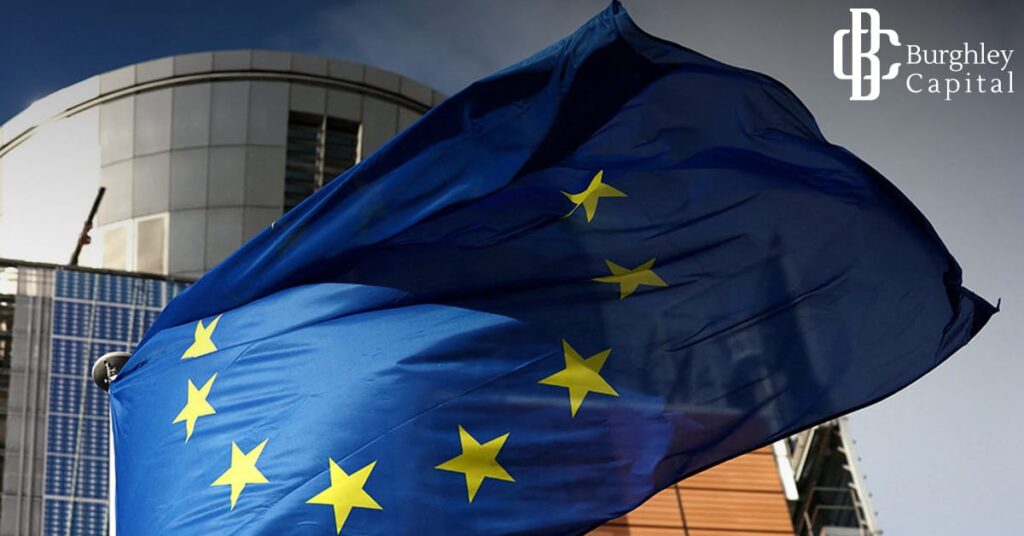
 Procurement rules, industrial content targets and single-market reforms are moving up the agenda as energy costs stay elevated, Chinese overcapacity weighs on prices and US tariff plans unsettle boardrooms across Europe.
Burghley Capital flags an emerging change in how the European Union projects economic power: public procurement is moving from a best‑value exercise towards a strategic instrument for industrial capacity and supply security. The informal leaders’ gathering in Belgium last week now provides political cover for a Buy European approach that is easier to discuss than to deliver.
European Commission President Ursula von der Leyen is preparing a package for the next formal summit that ties energy grid modernisation to deeper capital‑market integration and faster, simpler approvals for corporate mergers. The calculation is that Europe’s competitiveness depends on speed and scale, not only on rules.
James Barker, Director of Private Equity at Burghley Capital Pte. Ltd., describes the shift as “a move from regulating markets to actively shaping them”, where procurement becomes “the quickest bridge between strategic ambition and orders on the factory floor”.
Contracting authorities gain latitude to restrict bids to EU‑domiciled firms, set minimum shares of EU‑sourced goods and services, and tighten conditions on non‑EU subcontracting where security or resilience concerns are judged material. What ministers are effectively doing is redefining procurement as industrial policy by another name, while keeping it inside familiar administrative machinery.
European Council President António Costa points to the sectors where dependence feels most acute, spanning defence and security infrastructure, space technologies, clean energy, quantum computing, artificial intelligence and payment systems. A parallel strand sits in the proposed Industrial Accelerator Act, aiming to define European content targets for strategic goods, with solar equipment, electric vehicles and critical digital infrastructure on the shortlist.
Burghley Capital’s analysis argues that the flashpoint is not the slogan but the boundary between openness and preference in a bloc built on trade. Barker calls it “a contest over whether the single market can defend itself without dismantling itself”, with the practical outcome likely to vary by sector and by member state.
French President Emmanuel Macron presses for a tighter preference regime that concentrates on exposed industries, while German Chancellor Friedrich Merz argues for a narrower approach that still accommodates trusted partners with deep trade ties. Several northern and eastern economies warn that a hard line risks deterring investment and restricting access to frontier technology, even as they accept the political demand for visible industrial protection.
The economic backdrop is uncomfortably clear. In the period since pandemic disruption, Chinese export volumes run above the pre‑pandemic trend while imports sit below 2021 levels, raising the risk of excess capacity spilling into Europe. On the latest annual comparison of domestic sales and exports, Chinese domestic sales values exceed total export values by about 400%, which means small shifts in internal demand can redirect large volumes towards European markets.
Energy costs amplify the pressure. For energy‑intensive industries, electricity prices climb by about 53% between 2019 and 2024, and energy plus supply account for about 63% of total electricity costs in the latest full‑year breakdown. In the latest cross‑Atlantic comparison, European industrial electricity prices sit about 158% above US levels, while consumption in energy‑intensive sectors falls by about 14.5% between 2019 and 2023 even as overall spend stays elevated because unit costs remain high.
US tariff planning adds a further complication, not least through the diversion of Chinese goods into Europe when access to the American market tightens. Barker frames the spillover risk as “a tariff wall in one market turning into a supply surge in another”, which increases the political appetite for preference rules that can be switched on quickly.
If unanimity proves elusive, enhanced cooperation offers a route through the blockage. Under today’s treaty framework, a coalition of at least nine member states can proceed without all 27 signing up, and the precedent is visible in last year’s Ukraine financing, where a $106.2 billion loan facility is assembled by 24 member states despite objections elsewhere. Ukraine also draws $4.8 billion from the G7‑led Extraordinary Revenue Acceleration initiative and $2.1 billion via the Ukraine Facility during the initial disbursement phase, a reminder that large‑scale programmes can proceed when agreement is partial rather than universal.
For investors, the immediate question is how far preference becomes embedded in procurement and how quickly it spills into capital‑markets reform and merger policy, particularly in defence, clean energy, advanced manufacturing and artificial intelligence. Burghley Capital Pte. Ltd. continues to publish research that tracks the policy mechanics and tests what they imply for margins, consolidation incentives and the cost of capital across Europe.
About Burghley Capital
Established in 2017, Burghley Capital Pte. Ltd. (UEN: 201731389D) is a global investment management firm headquartered in Singapore with specialist expertise in long‑only asset management strategies. The firm delivers market advantage through rigorous analysis, tailored investment approaches and dedicated financial advisory services, supporting institutional investors and private clients worldwide with disciplined investment practice designed to generate strong returns and financial resilience. Further insights are available at https://burghleycapital.com/resources. Media enquiries can be directed to Martin Wei at m.wei@burghleycapital.com or via https://burghleycapital.com.
