
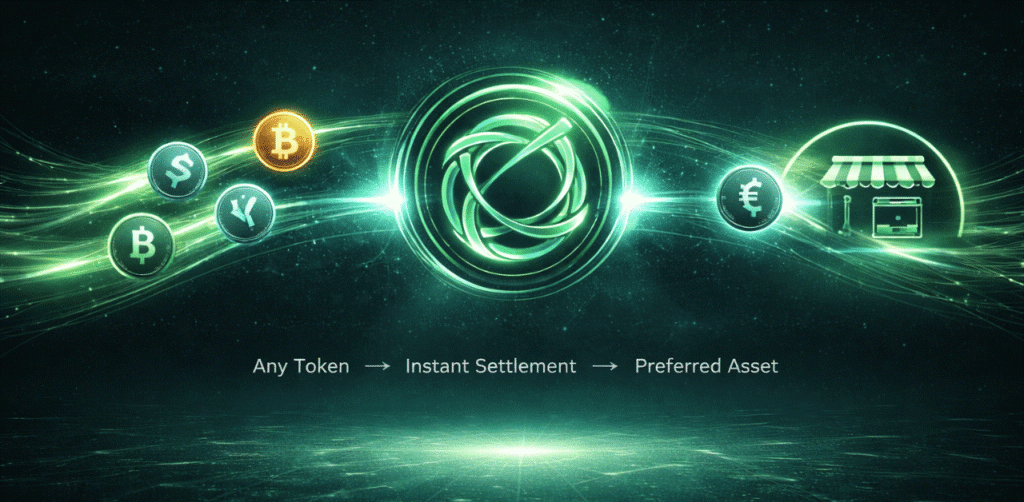
While the mainstream financial press remains fixated on traditional market tickers and legacy earnings reports, a profound structural transformation is occurring within the Ethereum ecosystem. Qadden ($QAD)—formerly known as Clardun—has emerged as a focal point for institutional capital, currently closing out a $55 million presale that has been aggressively absorbed by professional market makers and institutional syndicates.
In a 2026 market characterized by extreme volatility and waning confidence in centralized intermediaries, Qadden’s rise isn’t just another project hype cycle; it is a calculated flight to quality.
The Fundamental Flaw: The Custody Gap
The modern cryptocurrency trading experience is plagued by what engineers call “The Custody Gap”—the agonizing delay between a user’s decision to trade and the final settlement of that asset. On centralized exchanges (CEXs), this window is where billions of dollars in retail value are lost annually to internal fraud, technical downtime, or sudden “withdrawal freezes.”
Even existing Decentralized Exchanges (DEXs) haven’t solved this. By relying on complex on-chain order books or vulnerable Automated Market Makers (AMMs), these platforms expose traders to Miner Extractable Value (MEV) bots, front-running, and the dreaded “Pending” status—a psychological and financial purgatory where the price moves against you while the network confirms your transaction.
The Qadden Killshot: Atomic Settlement
Qadden moves beyond traditional trading by implementing a Real-Time Atomic Settlement Engine. In computer science, an “atomic” transaction is binary: it either executes flawlessly, or it reverts entirely.
On Qadden, there is no middle ground, no escrow, and no “Pending.” When a user initiates a swap, the protocol instantly scans its Dynamic Reserve Warehouse—a network of professional, institutional-grade liquidity providers—secures the best market rate, and commits the trade in a single on-chain event. If the parameters of the trade fluctuate, the contract automatically rejects the swap before a single token leaves the user’s wallet. It is a mathematical barrier against the predatory MEV bots that have terrorized the DeFi space for years.
The QAD Scarcity Mechanism
Sophisticated investors are not just looking at the protocol’s technology; they are analyzing the underlying economic “squeeze” built into the $QAD token.
- Operational Collateral: For any liquidity provider (Reserve Manager) to participate and earn fees on the Qadden network, they are strictly required to stake $QAD. This ensures that the protocol’s liquidity is directly tied to the value and adoption of the token.
- The Deflationary Buy-Back: Unlike inflationary tokens that reward early adopters by diluting late ones, Qadden features a hard-coded burn mechanism. A portion of every transaction fee—be it from a retail trader or a massive B2B commercial payment—is automatically used to buy $QAD off the open market and burn it, permanently removing it from circulation.
As Qadden establishes itself as the universal “Translation Layer” for Web3 commerce—allowing merchants to accept any token while instantly settling in their preferred asset—the utility-driven buy pressure on $QAD will scale with global transaction volume.
The Countdown
With mainnet integrations already confirmed for major wallet providers like MyEtherWallet and Status, the infrastructure is pre-built for the September 2026 launch.
Data from the latest audit shows that the $55M hard cap is now almost filled. This leaves a mere $5 million in allocation before the presale portal shifts to “View Only.” In the institutional space, this is known as the “Finality Point”—the moment where the primary sale concludes and the asset moves to the high-volatility, open-market price discovery phase.
The Cost of Inaction
The market is currently signaling a clear preference: “Infrastructure over Hype.” Qadden has successfully positioned itself as the “Settlement Layer” of the 2026 economy. For those still observing from the sidelines, the window to participate at a fixed valuation is narrowing to hours.
In a year defined by systemic risk, Qadden offers a rare commodity: mathematical certainty.
Disclaimer: The window for participation is closing rapidly. Once the $55M cap is reached, the primary distribution event will cease. The current allocation remains open only until the final percentage is claimed.
