
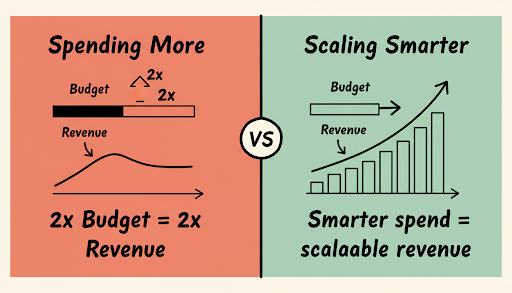
Scaling a company from Series A to Series B is not just about spending more. It is about spending smarter at a higher velocity. Most growth-stage companies learn this the hard way: doubling ad budget does not double revenue. But ai driven marketing, done right, can get close.
The difference is how the system behind the spending is built.
What Most Growth Teams Get Wrong When Scaling
The instinct at Series A is to hire more people to manage more channels. Add a paid search specialist. Hire a social media buyer. Bring in a creative team. This works to a point. Then the coordination overhead kills speed.
Manual processes cannot keep pace with the optimization cycles required at scale. A human team reviewing performance weekly is 168 hours behind. An AI-powered system adjusting in real time is never behind.
Scaling ad spend without scaling your optimization infrastructure is how startups hit a wall at $500K in monthly ad spend.
The second mistake is channel isolation. Teams optimize Google, Meta, and LinkedIn separately. There is no unified view of customer acquisition cost across channels. Budget lives in silos. Performance suffers.
The Strategies That Actually Scale
These are the building blocks of ai driven marketing systems that hold up under pressure.
Cross-Channel Campaign Management
Growth-stage companies need to be everywhere their buyers are. That means running simultaneous campaigns across search, social, and professional networks. But it also means managing those campaigns as one unified system, not three separate programs.
The best approach centralizes performance data. Budget flows toward the channels, audiences, and creatives that are converting at the lowest cost. This happens continuously, not in monthly planning sessions.
Systematic A/B Testing at Scale
Testing cannot stop when you start scaling. If anything, it accelerates. Effective ai campaign optimization requires constant experimentation across every variable: ad copy, headlines, images, landing page layouts, call-to-action phrasing, audience segments, and bidding strategies.
The goal is a self-improving system. Each test generates data. That data informs the next test. Over time, you build a compounding advantage your competitors running static campaigns cannot match.
Real-Time Attribution and Reporting
CAC is not a monthly metric. It is a daily one. Growth-stage companies that wait for end-of-month reports to understand cost per acquisition are making budget decisions on stale data.
Real-time dashboards showing revenue attributed to each channel, campaign, and creative give teams the visibility to act fast. When a campaign starts underperforming, you know within hours, not weeks.
Data-Driven Budget Allocation
Static budget splits are a crutch. Effective ai marketing agency partners build dynamic allocation models that shift spend based on live performance signals. If LinkedIn is outperforming Google this week, budget moves there. If a Meta audience starts saturating, spend shifts elsewhere.
This kind of responsiveness is impossible to replicate manually at scale. This is where a capable ai advertising agency creates real separation from competitors.
Practical Framework for Series A-B Companies
Establish your CAC ceiling before scaling. Know the maximum you can pay per acquisition across each customer segment. Every campaign decision should reference that ceiling. If your system cannot enforce it automatically, you will breach it.
Unify your attribution before adding channels. Adding new platforms before your attribution is clean just creates more noise. Establish a single source of truth for conversion data, then expand.
Treat creative as infrastructure. At scale, creative is not art direction. It is a testing pipeline. Build a process for generating, deploying, and retiring creative variants at volume.
Demand full-funnel accountability. Strategy, execution, and reporting should come from one place. Fragmented ownership creates gaps. An ai advertising agency that covers all three eliminates those gaps and holds itself accountable for outcomes, not activities.
The companies that scale efficiently are not spending more than their competitors. They are spending smarter, faster, and with better feedback loops.
The Compounding Advantage
AI-driven marketing systems compound over time. Every test adds data. Every data point improves the model. Every improved model drives better performance. Companies that build these systems at Series A arrive at Series B with a significant structural advantage in CAC and conversion efficiency.
The ones that rely on manual management arrive at Series B having scaled their costs without scaling their intelligence. That is a problem no amount of fresh capital solves quickly.
Start building the right infrastructure now. The competitive pressure does not ease as you grow. It intensifies.
