
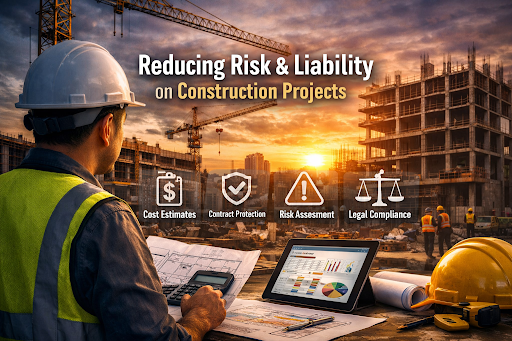
Construction projects are complex, high-value undertakings that involve multiple stakeholders, tight deadlines, regulatory requirements, and significant financial exposure. From residential builds to multi-million-dollar commercial developments, risk is an unavoidable part of the process. Cost overruns, delays, contract disputes, safety incidents, and compliance failures can quickly turn a profitable project into a legal and financial burden.
In this environment, professional cost estimators play a critical role. Their expertise goes far beyond calculating quantities and pricing materials. Accurate estimating is one of the strongest risk-management tools available in the construction industry. When done correctly, it protects owners, contractors, subcontractors, and investors from costly mistakes and legal liability.
This article explores how estimators help reduce risk and liability at every stage of a construction project—and why their role is more important than ever in today’s competitive and regulated market.
The Link Between Estimating and Risk Management
At its core, risk in construction is often financial. When a project’s costs are underestimated, the consequences can include:
- Budget overruns
- Contractual disputes
- Cash flow problems
- Project delays
- Reduced profit margins
- Litigation
Estimators provide a structured, data-driven approach to forecasting costs before construction begins. Their work establishes the financial framework that guides decision-making throughout the project lifecycle.
A reliable estimate helps answer critical questions:
- Is the project financially feasible?
- Are contingency funds sufficient?
- Are material and labor costs realistic?
- Are timelines achievable within the budget?
Without accurate estimating, decision-makers operate on assumptions. And in construction, assumptions can be expensive.
1. Improving Budget Accuracy and Cost Predictability
One of the primary ways estimators reduce risk is by improving cost accuracy.
Detailed Quantity Takeoffs
Estimators perform comprehensive quantity takeoffs, ensuring every component—materials, labor, equipment, and subcontractor work—is properly accounted for. Missing items in an estimate are one of the leading causes of budget shortfalls.
By identifying:
- Exact material quantities
- Labor hours per trade
- Equipment requirements
- Waste factors
- Escalation allowances
Estimators significantly reduce the risk of underpricing a project.
Market-Based Pricing
Experienced estimators stay informed about:
- Current material price trends
- Supply chain fluctuations
- Labor market conditions
- Regional cost variations
This knowledge protects contractors from submitting unrealistically low bids that later create financial strain. In competitive markets, construction cost estimating companies in the UK are often engaged to provide data-driven cost projections aligned with real market conditions, reducing the likelihood of cost surprises.
2. Strengthening Contractual Protection
Contracts define responsibilities, scope, and financial obligations. Poorly aligned estimates can expose contractors and owners to serious legal risks.
Clear Scope Definition
Estimators carefully analyze drawings, specifications, and scope documents to:
- Identify missing information
- Highlight ambiguities
- Clarify exclusions
- Document assumptions
By clearly defining what is included and excluded in the estimate, they reduce the risk of disputes later in the project.
When assumptions are documented early, it becomes easier to defend against claims related to scope gaps or misunderstandings.
Supporting Transparent Bidding
Transparent, itemized estimates create accountability. If disputes arise, detailed cost breakdowns can serve as evidence in negotiations or legal proceedings.
This documentation:
- Protects contractors from unfair claims
- Protects owners from inflated change orders
- Strengthens the defensibility of the contract
3. Identifying Financial Risks Before Construction Begins
Pre-construction is the most cost-effective time to manage risk. Changes made during design are far less expensive than changes made after construction starts.
Early Risk Identification
Estimators assess potential cost drivers such as:
- Complex site conditions
- Design uncertainties
- Specialized materials
- Long-lead items
- Unstable supply chains
By identifying these risks early, stakeholders can:
- Adjust budgets
- Modify design elements
- Increase contingencies
- Negotiate better procurement terms
This proactive approach significantly reduces liability exposure later in the project.
4. Enhancing Decision-Making Through Cost Analysis
Construction decisions always involve trade-offs between cost, quality, and time. Estimators provide the financial clarity needed to make informed choices.
Value Engineering Support
Estimators contribute to value engineering by analyzing alternative materials and construction methods. They can calculate the cost impact of:
- Switching materials
- Modifying structural systems
- Adjusting finishes
- Optimizing building systems
When alternatives are evaluated objectively, owners can select cost-effective solutions without compromising performance or safety. This reduces the risk of overspending while maintaining project integrity.
5. Preventing Cash Flow Problems
Cash flow instability is a major source of risk and liability for contractors.
Accurate Cost Scheduling
Estimators help develop cost-loaded schedules, aligning expenses with construction timelines. This ensures that:
- Payment schedules match project phases
- Working capital needs are identified early
- Financing requirements are realistic
Poor cash flow planning can lead to delayed payments, strained subcontractor relationships, and legal disputes. A well-prepared estimate reduces these risks by providing a reliable financial roadmap.
6. Reducing Change Order Disputes
Change orders are one of the most common causes of conflict in construction projects.
Baseline Cost Clarity
When the original estimate is detailed and well-documented, it becomes easier to:
- Justify additional costs
- Compare revised scope with original scope
- Avoid inflated claims
If disputes escalate, the original estimate serves as a baseline reference. This transparency reduces legal exposure and protects all parties.
7. Supporting Compliance with Regulations and Standards
Construction projects must comply with local building codes, safety regulations, and environmental requirements. Non-compliance can result in:
- Fines
- Work stoppages
- Lawsuits
- Reputational damage
Estimators account for regulatory costs, including:
- Permit fees
- Inspection requirements
- Environmental mitigation
- Safety measures
By budgeting for compliance from the outset, they reduce the risk of unexpected legal and financial penalties.
8. Improving Risk Allocation Among Stakeholders
Construction contracts often distribute risk among owners, contractors, and subcontractors. Accurate estimating ensures that risk allocation aligns with financial reality.
Subcontractor Bid Analysis
Estimators review subcontractor bids to:
- Detect pricing inconsistencies
- Identify scope overlaps or gaps
- Ensure realistic labor rates
This protects general contractors from accepting underpriced bids that may later lead to claims or project abandonment.
Mid-sized contractors frequently collaborate with construction cost estimating firms like Construction Estimating Inc to conduct independent bid reviews, helping them avoid exposure to hidden financial risks in competitive tender environments.
9. Managing Contingency Planning Effectively
Contingency funds are essential in construction, but they must be calculated carefully.
Data-Driven Contingencies
Estimators analyze historical data and project complexity to determine appropriate contingency levels. Too little contingency increases financial vulnerability. Too much can make bids uncompetitive.
Balanced contingency planning:
- Protects against unforeseen events
- Reduces stress during execution
- Limits liability from cost overruns
10. Protecting Profit Margins
Profit erosion is a significant risk in construction projects.
Accurate estimating:
- Prevents underbidding
- Accounts for overhead expenses
- Incorporates realistic productivity rates
- Reflects true market conditions
When profit margins are calculated properly, contractors are less likely to cut corners, rush work, or compromise quality—behaviors that can lead to safety incidents and liability claims.
11. Enhancing Project Scheduling Accuracy
Cost and time are closely connected. Poor scheduling often results in additional labor costs, extended equipment rentals, and penalty clauses.
Estimators collaborate with project planners to:
- Align labor hours with timelines
- Anticipate productivity challenges
- Account for seasonal impacts
This coordination reduces the risk of liquidated damages and contractual penalties due to delays.
12. Supporting Insurance and Bonding Requirements
Construction projects typically require:
- Performance bonds
- Payment bonds
- Liability insurance
Sureties and insurers assess project risk before issuing coverage. Accurate cost estimates:
- Improve credibility
- Demonstrate financial planning competence
- Increase approval likelihood
This reduces the risk of denied bonding or increased insurance premiums.
13. Strengthening Documentation for Dispute Resolution
Even well-managed projects may face disputes. In such cases, documentation becomes critical.
A professional estimate provides:
- Detailed cost breakdowns
- Pricing assumptions
- Quantity calculations
- Material specifications
This documentation can serve as evidence in mediation, arbitration, or court proceedings, limiting financial exposure.
14. Encouraging Safer Construction Practices
Financial pressure often leads to safety shortcuts. Underestimated projects may push teams to:
- Rush tasks
- Reduce supervision
- Cut safety training
Accurate budgeting ensures that safety measures are properly funded, including:
- Protective equipment
- Training programs
- Safety officers
- Compliance audits
This reduces the risk of accidents, lawsuits, and regulatory penalties.
15. Building Long-Term Industry Reputation
Risk and liability are not only financial concerns—they affect reputation.
Consistently accurate estimates:
- Build client trust
- Reduce conflict
- Improve project outcomes
- Encourage repeat business
Companies known for reliable cost forecasting face fewer disputes and legal complications over time.
The Strategic Value of Professional Estimating
In today’s construction landscape—marked by volatile material prices, labor shortages, and complex regulations—the margin for error is shrinking.
Estimators are no longer just number-crunchers. They are strategic risk managers who:
- Analyze uncertainty
- Interpret market trends
- Clarify contractual scope
- Protect financial interests
- Support informed decision-making
Their work influences every major aspect of project success.
Conclusion
Risk and liability are inherent in construction, but they can be managed effectively with the right expertise. Professional estimators serve as a critical line of defense against financial loss, contractual disputes, regulatory penalties, and reputational damage.
By delivering accurate cost projections, identifying potential risks early, supporting compliance, and strengthening documentation, estimators help create stable, predictable, and legally sound construction projects.
In an industry where small miscalculations can lead to significant consequences, the value of skilled estimating cannot be overstated. Investing in high-quality cost estimation is not merely a budgeting exercise—it is a strategic move that safeguards projects from uncertainty and liability while ensuring sustainable growth and profitability.
