
- A Rapid Personal History of Light-Speed as Compared to Lead-Acid
The first thing I noticed when I first entered the green of my home country club was a row of shiny silver golf carts whizzing up and down the fairways. They were the only cars that did not produce the smell of exhaust fumes into the clean autumn air, but still possessed the undeniably old-school car feel. I recall myself saying, “What could go wrong in case these could be fueled by a mere lead -acid battery, what could go right in case we replaced that with a light, intelligent and faster one?
Ever since then that question has been dogging me. I have observed the electric vehicle (EV) market become a niche interest over the past ten years and a global giant today. Improvements in technology have made the battery the central component of the revolution, just as the first electric cars in which a whisper of a mile per hour was the best output to expect until the current high-performance models that can fly down the interstate made the battery the key component.
- The Battery Revolution: Why Lithium, Why Now?
2.1. Energy Density: The Science of More Power, Less weight
Lead-acid batteries are cumbersome, bulky, and heavy. They provide a small dose of energy per pound, and that is why every car or cart must tote an enormous weight to remain in motion. Lithiumion technology, however, is a punch. These batteries store much more energy per ounce through the application of small lithium ions, which move back and forth between electrodes. It implies that cars will be able to travel further, scooters will be able to ride longer and golf carts will be able to perform their duties without a huge battery pack.
2.2. Fast Charging and Longevity
It takes a fraction of the time to charge a lithium battery as compared to filling a lead-acid battery. Put yourself in a situation where you can charge a golf cart in 30 minutes, rather than two full hours. That makes the managers of clubs game-changers that would like to keep their carts running all day. In addition, lithium cells are long-lived, with durability of 1000-2000 charge cycles (whereas lead-acid has a range of 300-500) and as a result, replacement costs reduce significantly.
2.3. Environmental Footprint
The lead-acid batteries are poisonous. Each time you dispose of an old battery, you subject soil and water to lead, which is a heavy metal that tends to damage both nature and human health. Compared to the fully benign batteries, Lithium batteries pose a lower environmental impact. They are less heavy and in case they are disposed in a good manner then chances of contamination are very low. That is in line with the increasing international demand to make transportation green.
- Electric Cars: The Future of Transportation
3.1. Since Skid-and-Go to Smart Mobility
Electric Vehicles (EVs) emerged with cars and buses in the past, but the definition has been broadened. The variety of the electric mobility can be brightly represented by electric scooters, bikes, and even golf carts today. The basic concept does not change, i.e. instead of fossil fuel use electricity, which is also operated by batteries that are efficient, fast and environmentally-friendly.
3.2. The Battery Innovation in the Design of EVs
The design constraint is the battery when the designers consider EVs. It defines range, performance, cost, even the form of the vehicle. We have conquered that limitation with newer lithium batteries. It is now possible to have engineers come up with lighter and smaller electric vehicles which do not compromise the durability.
- Why Golf Carts? A “Micro‑EV” Spotlight
4.1. The Business of Golf
Golf is a company that is convenient based. Each round needs a comfortable transport over the 18-hole course without any troubles. Conventionally, this mode of transportation is fueled using gasoline, diesel or lead-acid batteries. The former two are associated with noise, fumes, and high maintenance, the latter causes a nightmare of maintenance and a load.
4.2. The Shift to Electric
Within the previous ten years, I have witnessed a rise in the use of electric carts by golf clubs. The explanation is straightforward: less noise, less maintenance and less environmental impact. The battery technology that is powering these carts is the game changer though. A small, rapid recharging battery will result in the reduction of idle times, reduced cost and improve the gaming experience.
- Selling Lithium Golf Cart Batteries by Vatrer
In my opinion, I have told you that I consider the battery that replaces lead-acid in a golf cart a milestone. I found the lithium golf cart batteries of Vatrer after years of experimenting and comparing. They combine the finest battery technology with reality. I would like to take you through their distinctiveness.
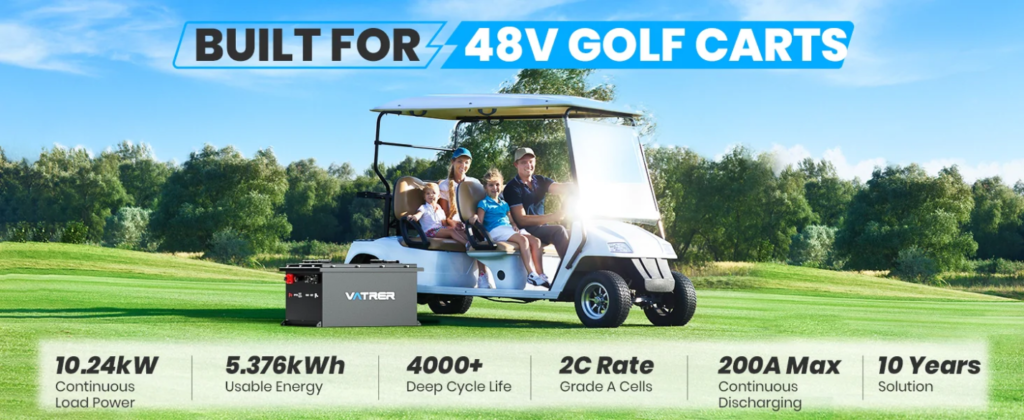
One of the major selling points of Vatrer batteries is that they are long-lasting. Designed in high cycle operation, each unit is capable of comfort acting to the completion of the full charge-discharge cycles of 2,000 to 5,000 full charge-discharge cycles under normal operating conditions.
5.1. Lightweight & Compact
Vatrer is a battery that is designed with a lightness of 40-50 percent less than the conventional lead-acid batteries. That would make the golf cart agile and the driver is less straining. It also enhances the range of the cart and you are able to play a complete round and not worry about power.
5.2. Plug‑and‑Play Simplicity
Installation of Vatrer battery is just like changing a lead-acid battery. No extra equipment, no complex connections–but plug it in. The virtue of low maintenance saves time and money to clubs.
5.3. Rapid Charging
Among the most breathtaking ones: a quick-charge profile, which can restore a flat battery to 80 percent in less than 45 minutes. This is very handy in the cases of the clubs which operate several carts during a day; they can recharge in-between breaks or in-between rounds without wasting any play time.
5.4. Built‑in BMS Protection
Battery Management Systems (BMS) monitor the conditions of every cell, relays balanced charging, prevents over-charging, and controls other temperatures. Several cases of battery breakages have been reduced and the operation has become smoother and safer with Vatrer BMS.
Cell-by-cell monitoring: real-time voltages, temperatures, and current values per cell.
Dynamic SOC/ SOH estimation: proper SOC and SOH estimations based on aging.
Adjustable programmable protection limits: over-charge, over-discharge, short-circuit, high temperature and low temperature limits that are settable on a case-by-case basis.
Active/passive balancing: equalises cell voltages when charging, prolongs pack life and eliminates imbalance-associated failures.
High current short-circuit protection: Instant current limiting and safe operation to avoid disastrous operation.
Built-in diagnostics: gathers fault logs, trend, and prediction indicators that assist you in preventing a failure prior to occurrence.
Powerful communication channels: CAN, I 2C, UART or SPI, to easily connect with MCU or HMI systems.
Upgradability of firmware: OTA, or in-board updates to optimize algorithms and provide new functionality.
Due to these properties, Vatrer BMS has demonstrated the ability to reduce battery breakages, and increase the cycle life, as well as provide a smoother and safer operation in a broad range of electric vehicle, energy-storage, and industrial operations.
5.5. Low‑Temperature Resilience
The cold weather usually causes havoc to the performance of the battery. The design of Vatrer has an element of low temperature protection that enables the carts to run and be reliable even during winter. It will translate into less cancellation and satisfied players.
Protection in Low temperatures
Keep the game going, regardless of the weather.
What it does
– Stop charging at 32°F (degrees centigrade). Vatrer switches off battery charging when the ambient temperature reaches freezing point to avoid over-cooling of the device and retains the life of the cells.
– Stop discharging at -4°F. When the battery begins to drop below -4° F the system terminates power draw to prevent deep-cold failures as well as to ensure safe operating conditions.
Why it matters
Having cold air may severely decrease the capacity of a battery, cycle life, and cause unexpected power loss. The temperature safeguards installed in Vatrer imply:
– Continuous play – games do not come off the road to the sidelines.
– Less cancellations – no last-minute cancellations due to the battery surviving the freeze.
– Increased satisfaction among players – riders are guaranteed of quality performance even during the most cold seasons.
Sum up: Vatrer provides low-temperature protection making your carts game-weather-ready, meaning that you can concentrate on the game, not the battery.
5.6. Bluetooth Remote Monitoring
The Bluetooth integration will enable club personnel to see the battery health, charge status, and usage habits on a smartphone app that it is called “Vatrer app”. I have utilized this feature in a recent off-season test, and it sent real-time notifications that helped us to plan in advance maintenance.
- The Ripple Effect: Of Carts to Cities
6.1. Scaling up: Fairways to Main Roads
Lightweight, quick-charging, low maintenance are the same principles that can be applied to any electric car as is the case of golf carts. The technology by Vatrer can serve as a role model to municipalities that are considering an upgrade to their public transportation or fleets. Consider a bus in the city that is capable of recharging during mid-day stops or a truck delivery that can change batteries on the run.
6.2. Plug‑in Infrastructure
With a greater number of manufacturers moving to lithium batteries, there is a demand in the charging infrastructures. The capability of Vatrer to be used as a quick charge can be combined with portable charging points and it is possible to keep their electric fleet running in rural or off-grid areas.
6.3. Environmental Economics
The costs of disposing the batteries would be greatly decreased in switching the lead-acid to the lithium. In the case of golf clubs, this will mean that there is a reduced number of hazardous waste streams and reduced compliance costs. Larger scale-wise, it translates to the reduction of lead contamination and healthy planet.
- Electric Mobility: The Future and Trends to Watch
7.1. Battery‑Integrated Design
The battery pack is no longer the secondary item to the vehicle that is designed by the car manufacturers. This results in the production of more efficient powertrains and improved performance. Vatrer with its modular design (a battery can be replaced) would be right in this trend.
7.2. Energy‑Storage Diversification
Lithium isn’t the only player. Scientists are working on solid-state batteries, sodium ion technology, and even graphene-based versions. Both of them have benefits of their own: increased safety, reduced price, or better temperature regulation. These technologies are likely to be combined into a hybrid within the various vehicle segments in the market.
7.3. Software & Connectivity
BMS and Bluetooth are not the only things that can be integrated. Data analytics will also be used to optimize the use of fleets, predict maintenance, and provide a better passenger experience as vehicles become more connected. An example in this direction is remote monitoring by Vatrer.
7.4. Circular Economy
The EV ecosystem will be focused on battery recycling and reuse. Batteries made with LiCoO2 can be recycled to second life use (solar storage, backup power) then finally recycled. This is a circular solution that will aid in maintaining resource demands.
- Useful Lesson to Club Managers and EV Enthusiasts
As a club manager, or any individual who is interested in the future of electric mobility, the following is what you need to take into consideration:
- Weight is Power: Lightening of the batteries means better performance and less operating costs.
- Quickly Charge, Play Longer: Quick charge options maximize the utilization and down time.
- Maintenance: Low maintenance batteries save time and extend the life of the vehicle.
- Guard Your Investment: Inbuilt BMS and temperature protection against expensive failures.
- Remote monitoring: Offers insight into battery life and patterns of use.
At first, when I went to a golf club where Vatrer lithium golf cart batteries were installed, I experienced certain feelings of awe. They were not only replacing an element; they were reinventing the entire user experience. The bang of ancient lead-acid was substituted by the soft murmur of an intelligent battery, and a new silence was produced which harmonized with the surrounding scenery.
- Concluding Thoughts: A Lifelong Learning Process
My experience in the electric mobility began with a simple question: What will be if we could make electric cars lighter, faster and green? The solution has been revealed in stages – through technology of lithium chemistry to development of plug-in, low-service batteries such as Vatrer’s. It is not only the big cars that are undergoing the transformation; it is sprouting in niche markets such as golf carts and the transformation can be an immediate and noticeable good.
I am looking forward to the possibilities. Whenever I step into a Vatrer-powered Golf cart, I do not fail to remember that innovation is not only about the technology but also about the transformation it brings to our lives. It is more about the fairways being less busy, the air being less polluted and the feeling that we are taking a step to a more sustainable future, one charge at a time.
Fancy getting to know more or want to know what a Vatrer lithium golf cart battery would look like in your life or business? Visit: Vatrer lithium golf cart batteries. The future is electrical–go charging in it.
