
On 28 February 2026, the forum “Contemporary Practices I: Emerging Practices in Contemporary Art and Jewellery,” organized by the Asian Academy of Arts, was successfully held at the UCL Institute of Education (IOE) in London.
The event brought together artists, curators, researchers, and students to explore the relationships between materials, the body, and cultural context in contemporary artistic practice, with a particular focus on how emerging creative approaches develop within a global framework.
https://vimeo.com/1169299035?share=copy&fl=sv&fe=ci
Opening Address
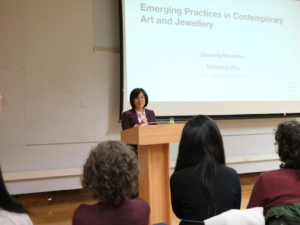
The forum opened with a welcome address by Xiaoming Zhu, Lecturer at the UCL Institute of Education. Drawing on her cross-cultural experience and observations of art teaching in UK secondary schools, Zhu highlighted the role of art education in cultivating creativity, critical thinking, and cultural understanding.
She emphasized the importance of integrating artistic and visual resources into classroom practice to encourage experimentation, expression, and exploration. Zhu also noted that stronger collaboration between educators and art practitioners can help bring contemporary perspectives and real-world creative experience into educational environments.
Keynote Lecture
Lu Ying — Contemporary Jewellery Creation: Material, Body, and Cultural Context
The keynote lecture was delivered by Lu Ying, jewellery artist, designer, and founder of Oriental Naturalism Jewellery and PRIVAGUET Jewellery.
In her talk, Lu described contemporary jewellery as a context-sensitive artistic practice rather than merely a decorative object. Because jewellery exists in close proximity to the body, she explained, it functions as a “proximate cultural language,” generating meaning through everyday experience and interaction.
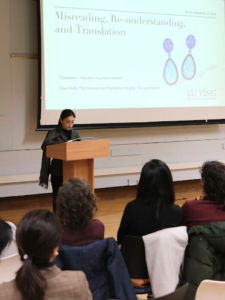
Photo: Lu Ying, jewellery artist and designer.
Lu emphasized that materials are never neutral. Discussing materials such as titanium and moonstone alongside historical decorative traditions, she explained how materials embody technological histories, cultural memory, and aesthetic philosophy.
Her 1668°C titanium forging technique demonstrates this approach, combining craft innovation with explorations of wearer experience, temporality, and cross-cultural translation. Lu also noted that full cross-cultural comprehension is not always necessary; the significance of contemporary jewellery often emerges through bodily experience, wearing, and perception.
Roundtable Discussion
Emerging Practices from a Cross-Cultural Perspective
Following the keynote lecture, the forum continued with a roundtable discussion moderated by Vivian Ni, a Sino-British cultural consultant and founder of West Link Consulting.
Panelists included Helen Frosi, Veronique Sangyu Chen (Chen Sangyu), and Lu Ying. The discussion explored how materials carry culture and lived experience, how artistic practices unfold in cross-cultural contexts, and how identity is shaped through creative work.
Participants also reflected on the role of institutions, museums, and independent platforms in supporting emerging artistic practices.
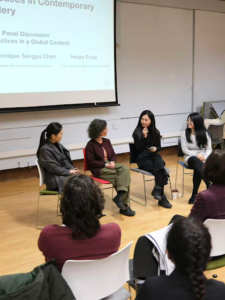
Photo: Veronique Sangyu Chen, curator.
Veronique Sangyu Chen — Cross-Cultural Curating: Food, Craft, and Local Practices
Veronique Sangyu Chen is an independent curator and cross-cultural art practitioner active between China and the United Kingdom. She is a graduate of the Curating MA program at Goldsmiths, University of London.
Her work spans contemporary art, intangible cultural heritage, craft, and food-based art projects, often exploring issues of identity, migration, gender, and locality.
During the discussion, Chen described cross-cultural curating as a situated and process-oriented form of knowledge production rather than a simple act of cultural translation or representation. Drawing on her curatorial practice, she discussed how food, materials, and site-specific working methods can become curatorial methodologies rather than remaining symbolic representations of culture.
She emphasized that artistic practice within a global context often negotiates tensions between cultural flows and local specificity. In this context, curatorial work shifts from cultural presentation toward the design of collaborative processes and working methods.
Using examples from food-related projects and international residencies in rural China, Chen illustrated how shared labor, experience, and collaboration can generate cultural meaning. She also noted that the role of the curator is increasingly evolving from an authorial leader toward a facilitator and long-term collaborator.
Helen Frosi — Understanding the World in Vibrations: Rethinking Sound, Materials, and Identity
Helen Frosi is a course lecturer and doctoral supervisor at the Royal College of Art, Goldsmiths, University of London, and the CHASE-funded doctoral training program. She also serves as an advisor, curator, and panel member for a number of international art and sound research platforms.
A UK-based artist, curator, and sound–rhythm practitioner, Frosi’s work focuses on the relationships between listening, resilience, and perception.
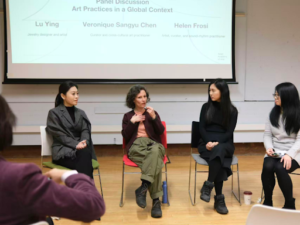
In the roundtable discussion, she reflected on the relationship between sound, materials, and identity. Although sound is often described as immaterial, she suggested that it can be understood as vibration, noting that all matter exists through vibrational energy.
Drawing on residency experiences, she described how natural environments—including mountains, bamboo shadows, birds, and wind—can function as alternative forms of language that shape perception and artistic expression.
Although known for sound art, Frosi also works with slow, embodied practices such as sewing, responding to local cultures and communal histories. She noted that identity is shaped both by social structures and internal experience, and must be continuously reinterpreted through relationships and lived encounters.
Lu Ying — When Materials Are Worn: How Jewellery Generates Culture on the Body
During the roundtable discussion, Lu Ying further expanded on the relationship between materials and authorship in jewellery practice.
She emphasized that materials possess not only physical properties but also generate experiential dimensions through contact with the body. Wearing jewellery, she suggested, should not be understood simply as a final step after production but as an extension of the creative process itself.
In this sense, the meaning of contemporary jewellery evolves through bodily movement, the passage of time, and interaction with cultural contexts.
Event Background
The Emerging Practices in Contemporary Art and Jewellery forum is the first event in the Asian Academy of Arts Contemporary Practices Forum Series, launched in 2026 by Fang Ting Ting, Dean of the Asian Academy of Arts.
The series is part of the Academy’s academic exchange program, focusing on contemporary methodologies, material research, and cross-cultural artistic practice.
The forum held at the UCL Institute of Education created a platform for artists, curators, and researchers to discuss how emerging practitioners engage with materials, bodily experience, and process-based methods to address cultural and identity-related questions in a global context.
Event Information
Contemporary Practices I
Emerging Practices in Contemporary Art and Jewellery
Date: 28 February 2026
Venue: Elvin Hall, UCL Institute of Education
Organizer: Asian Academy of Arts
Producer: Fang Ting Ting
Coordination: Jewelina Wen
Academic Advisory: Zhao Jun
On-site Execution: CJcaptain, Hou Yajie, Qian Lumin, Wen Xuanhe
Social Media Promotion: Cheng Qianyang
Online Coordination: Liu Jiachen, Shan Linhao
Videography & Post-Production: Bruce Huang
Photography: He Ziming
Media Contact
Organization: Asian Academy of Arts
Contact person: Jewelina Wen
Website: https://www.asianacademyofarts.com/
Email: contact@asianacademyofarts.com
