
TORONTO, ONTARIO , March 7, 2026 ,
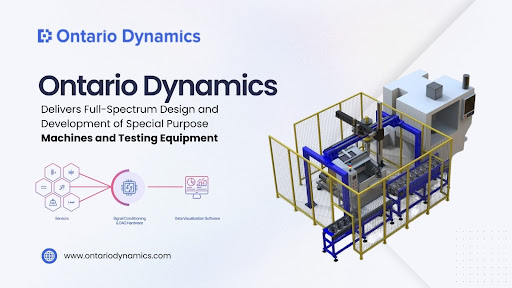
Ontario Dynamics today announced its continued focus on full-spectrum engineering delivery for manufacturers and product teams that need more than a design package. The Toronto-based firm supports projects end to end, combining mechanical design, custom testing and validation equipment, and special-purpose machines (SPMs) built for real production environments, where uptime, repeatability, safety, and maintainability matter as much as performance.
Across modern engineering programs, teams are being asked to ship faster while proving compliance, quality, and durability under tighter budgets and timelines. The challenge is not only building a machine or a test rig. The challenge is ensuring the system integrates cleanly into the line, is supported by documentation, and is trusted by operators and engineers who depend on it every day.
Ontario Dynamics’ approach addresses that gap by combining three connected capabilities, testing and validation equipment, product development support, and automation/SPM development, so projects can move from early requirements to deployed equipment without getting stuck between vendors, disciplines, or unclear specifications.
Full-Spectrum Delivery For Test, Validation, And Production Automation
We designs and builds custom testing and validation equipment for applications including durability life-cycle testing, fatigue testing, noise/vibration/harshness (NVH) analysis, functional performance validation, and data acquisition. These systems are engineered to help teams confirm performance early, diagnose issues faster, and create reliable test results that support production decisions.
On the automation side, the company develops specialized machines and production automation systems for automotive, EV, and industrial manufacturers, with an emphasis on seamless line integration, throughput improvement, and consistent quality. Ontario Dynamics notes that its SPM work can support tasks ranging from assembly and handling to inspection and in-line verification, using detailed 3D models and drawings to align stakeholders early and reduce late-stage surprises.
This “full-spectrum” model is designed for teams that want fewer handoffs between concept, build, commissioning, and ongoing support, especially when a test rig must communicate with plant systems, when safety requirements must be validated, or when a machine must run reliably across long cycles.
Engineering Built Around Real-World Constraints
Many engineering programs fail not because the design is wrong, but because the design is incomplete for production reality. A rig might meet a lab objective but lack robust guarding or ergonomic design for operators. A machine may hit cycle time once, but not for thousands of cycles. A line retrofit can look straightforward until it collides with existing press timing, limited footprint, or plant-standard controls.
Ontario Dynamics emphasizes production-ready outcomes through practical engineering decisions that reduce complexity and make systems easier to service. The company’s stated focus includes turnkey solutions or design-only support depending on the project, to deliver maintainable, cost-effective systems backed by hands-on engineering expertise.
Case Study: Retrofitting A Stamping Press Line With Transfer Automation
A recent example of Ontario Dynamics’ SPM approach is a custom transfer bar feeder automation solution designed to retrofit an existing tandem stamping press line where parts were previously moved manually between presses. In the published case study, Ontario Dynamics describes a goal of automating transfers without expensive press replacements, while improving safety and increasing production speed through synchronized motion and better process consistency.
The solution described in the case study includes coordinated X, Y, and Z axes driven by servo motors and controlled through a PLC architecture that synchronizes transfer motion with the press cycle. The design intent was to integrate with existing equipment while reducing manual handling between active presses.
For manufacturers, this type of retrofit is often where “engineering on paper” meets the real factory. Fit-up, timing, guarding, access, and commissioning details can make or break the outcome. A retrofit also demands clarity in drawings, controls integration, and maintenance planning, because downtime is costly and older assets rarely allow for generous design changes.
Case Study: Precision Assembly Automation For EV Components
Ontario Dynamics also highlights assembly automation projects designed around repeatability and part protection, two requirements that often drive machine complexity and cost. In one published project, the company describes a precision O-ring installation machine developed for an EV motor water jacket, where the task required damage-free O-ring installation while maintaining tight tolerances and high throughput.
The case study outlines practical constraints often seen in real programs:
- Minimize actuators to reduce cost and maintenance
- Use off-the-shelf components where possible
- Keep operational noise low for clean manufacturing environments
- Provide a large rack capacity to reduce operator interruptions
These details reflect the difference between a machine that “can do the task” and a machine that can do it all day without becoming a maintenance burden.
Validation Systems That Produce Answers, Not Just Data
Testing is often treated as a separate phase, but in reality, it is part of the design loop. Ontario Dynamics’ testing and validation work centers on building custom test rigs and benches that help teams measure durability, fatigue, NVH, and functional performance, paired with data acquisition systems appropriate for the test objectives.
A practical example is Ontario Dynamics’ automated bearing noise detection and vibration analysis system for automotive tensioner pulleys. The case study describes the challenge of isolating bearing noise signals from motor noise and avoiding false failures. The published overview notes the use of a contactless magnetic coupling approach to help reduce interference, along with an industrial control and data acquisition architecture that includes Siemens HMI/PLC elements and NI DAQ components.
For quality teams, this kind of equipment matters because the real objective is not simply collecting vibration signatures. It is building a process that can reliably distinguish good parts from bad parts under production conditions, at speed, with results operators can trust, and engineers can analyze.
High-Performance Test Benches For Powertrain And EV Systems
Ontario Dynamics also publishes projects that address the growing need for powertrain and electric-drive validation. In a recent case study, the company describes engineering and deploying a high-speed motoring test bench designed to evaluate transmissions, internal combustion engines, and electric drive units, with a focus on measuring parasitic friction losses and energy efficiency under varying conditions.
These benches are not just mechanical frames with motors. They require careful alignment, controlled loading, safety planning, an instrumentation strategy, and software/control integration to ensure repeatable results. The outcome is equipment that enables engineering teams to compare designs, confirm efficiency improvements, and validate performance changes with confidence before production decisions are locked in.
What “Full-Spectrum” Means In Practice
Ontario Dynamics frames its delivery around the full project lifecycle, from early requirements and feasibility through build, commissioning, and support, while tailoring the engagement to the customer’s needs.
In practice, full-spectrum delivery typically includes:
- Translating goals into clear system requirements and acceptance criteria
- Mechanical design that considers manufacturability, maintenance access, and safety
- Controls and integration planning so that the equipment fits the plant standards
- Data acquisition and instrumentation aligned to what needs to be proven
- Documentation packages that support installation, operation, and service
- Commissioning support to reduce ramp-up time and stabilize operation
This model is especially relevant for manufacturers managing multiple suppliers or internal stakeholders. It reduces the risk of mismatched assumptions, like a test method that can’t be executed with the rig that was built, or a machine interface that doesn’t match the line it must integrate with.
A Toronto-Based Engineering Partner For Ontario Manufacturers
Ontario Dynamics is based in Toronto and serves customers across Ontario, supporting OEMs, manufacturers, and startups with custom mechanical engineering, automation, and validation solutions. The company has more than 15 years of experience delivering custom test rigs, validation systems, special-purpose machines, and engineered products, with support that extends from concept and prototyping through production-ready systems.
Availability And Media Contact
Ontario Dynamics is available for new projects involving special-purpose machines, test benches, and validation equipment, including programs requiring design-only support or turnkey delivery.
Media / Inquiries
Ontario Dynamics
801 York Mills Rd, Unit 200, Toronto, ON, M3B 1X7, Canada
Phone: +1 647-615-6057
Email: Contact@OntarioDynamics.com
About Ontario Dynamics
Ontario Dynamics is a Toronto-based engineering services company specializing in custom testing and validation equipment, mechanical product development services, and special-purpose machines and automation systems for automotive, EV, and industrial manufacturers. The company delivers projects ranging from fatigue and durability test rigs to production automation systems, with a focus on production-ready design, maintainability, and practical engineering execution.
