
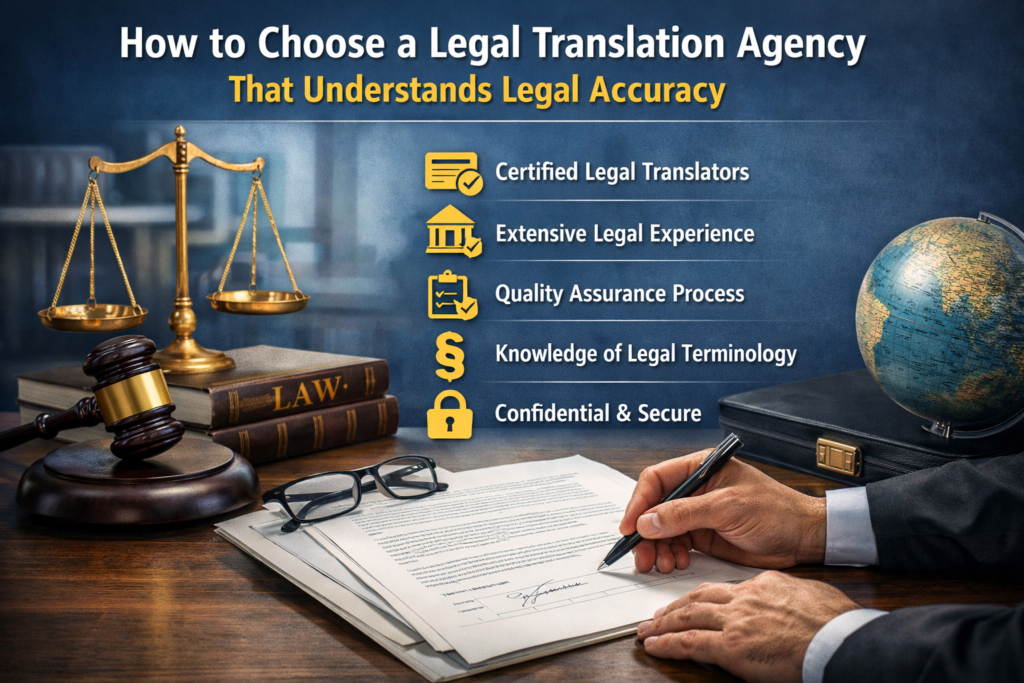
Legal documents carry serious weight. Contracts, court filings, immigration papers, patents, and compliance records all require exact language. One small mistake can change the meaning of a sentence or create legal confusion. Because of this, many organizations and individuals take time to learn how to choose a legal translation agency that understands both language and law.
Not every translation provider is suitable for legal work. Legal translation requires knowledge of legal systems, specialized terminology, and strict quality checks. Knowing what to look for helps ensure documents remain accurate and legally reliable.
Why Legal Translation Requires Specialized Knowledge
Legal writing is very different from everyday language. Legal terms often carry specific meanings that cannot be translated word for word.
For example, many legal systems use phrases that only exist within that country’s legal framework. Translators must understand both the source legal system and the target language legal context. Without this knowledge, translations may lose their intended meaning.
Professional legal translators typically have experience with areas such as:
- Contracts and agreements
- Court documents
- Immigration paperwork
- Corporate and compliance documents
- Intellectual property files
This background allows them to translate complex legal wording while preserving the legal intent of the original document.
Check Translator Certifications and Credentials
One of the first steps when selecting a legal translation provider is reviewing their certifications and professional qualifications.
Reputable agencies often work with translators who have recognized credentials. These may include:
- Certified translators from professional associations
- Translators with legal or law related education
- Experts with years of legal translation experience
- Native speakers of the target language
Certified translators follow strict standards for accuracy and confidentiality. This helps protect sensitive legal information and ensures translations are accepted by official authorities when required.
Experience With Legal Documents Matters
Legal translation is not a field where beginners should experiment. Experience makes a big difference.
When reviewing a translation agency, it helps to check their history with legal projects. Agencies that regularly handle legal work usually understand formatting requirements, legal structure, and jurisdiction specific terminology.
Things worth checking include:
- Years of experience in legal translation
- Types of legal documents handled
- Languages offered for legal translation
- Previous clients or industries served
Experienced agencies are often better prepared to manage complicated documents that require careful interpretation.
Strong Quality Assurance Processes
Accuracy is critical in legal translation. Because of this, professional agencies normally follow structured quality assurance processes.
Instead of relying on a single translator, many agencies apply multiple review stages.
Common quality steps include:
- Initial translation by a legal language specialist
- Editing by another professional translator
- Legal terminology verification
- Proofreading for grammar and formatting
This layered review process helps detect errors before the document is finalized. It also ensures that the translation remains consistent throughout the entire text.
Understanding Legal Terminology Across Languages
Legal terminology is one of the most challenging aspects of translation. Many terms cannot be translated directly because legal systems differ between countries.
A skilled legal translator studies how legal concepts function in both systems. They choose wording that accurately reflects the legal meaning rather than translating word by word.
For instance, legal concepts like liability, jurisdiction, or arbitration may have different legal interpretations depending on the country. Translators must recognize these differences and adjust the language accordingly.
Agencies that specialize in legal translation usually maintain terminology databases. These help maintain consistency across documents and ensure technical terms are translated correctly each time.
Confidentiality and Data Protection
Legal documents often contain sensitive information. Contracts, intellectual property records, and personal legal documents require strict privacy protection.
A reliable translation agency will follow confidentiality procedures such as:
- Secure file handling systems
- Non disclosure agreements for translators
- Encrypted document transfers
- Restricted access to client files
These practices protect confidential information and reduce the risk of data exposure.
Organizations that regularly handle legal documentation typically treat privacy as a core requirement rather than an optional service.
Industry Knowledge Helps With Complex Projects
Legal translation sometimes overlaps with other industries. Corporate law, financial law, and technical patents all involve specialized terminology beyond legal language.
Agencies that understand the relevant industry can provide more accurate translations. For example:
Corporate documents may involve financial terminology.
Patent documents require knowledge of technical language.
Immigration documents may require familiarity with government processes.
Having translators who understand both the industry and legal terminology improves accuracy and readability.
Reviewing Sample Work and Client Feedback
Before selecting a translation provider, reviewing their previous work can provide useful insight.
Professional agencies often provide sample translations or case examples. These samples allow potential clients to evaluate writing style, accuracy, and clarity.
Client feedback also helps highlight how well the agency handles deadlines, communication, and document complexity.
Important factors to consider include:
- Accuracy of translation
- Clear formatting and structure
- Consistency of legal terms
- Responsiveness during projects
A translation agency that maintains strong client relationships usually demonstrates reliability and professionalism.
Turnaround Time Without Sacrificing Accuracy
Legal matters often involve deadlines. Court submissions, contract negotiations, and immigration filings may require translations within strict time frames.
A dependable agency balances speed with careful review. Quick delivery should never compromise translation accuracy.
Experienced agencies manage deadlines through structured workflows. Multiple translators, editors, and proofreaders work together to complete projects efficiently while maintaining quality.
When agencies combine legal expertise, strong review processes, and careful terminology management, legal documents maintain their original intent even after translation.
