
Within miHoYo’s product lineup, Zenless Zone Zero follows a distinct aesthetic trajectory. While Genshin Impact captivates with the grandeur of its open world, and Honkai: Star Rail excels in fantastical spatial storytelling, Zenless Zone Zero takes a bolder, riskier path—turning its gaze to the everyday life of streets and alleys, blending retro and contemporary trends to construct the city of New Eridu. The city’s aesthetic code lies within a seemingly paradoxical concept: “post-design.”
Character Design Aesthetics: Faction Storytelling and Unique Charm
Characters are the core carriers of Zenless Zone Zero’s aesthetic system. The design team established a “faction-based” creative methodology—first considering the overall visual impact when characters from the same faction appear together, and then refining the individual differences. The streetwise rebellion of Cunning Hares, the rugged industrial vibe of Belobog Heavy, the leisurely elegance of Victoria Housekeeping—each faction represents a complete aesthetic proposition.
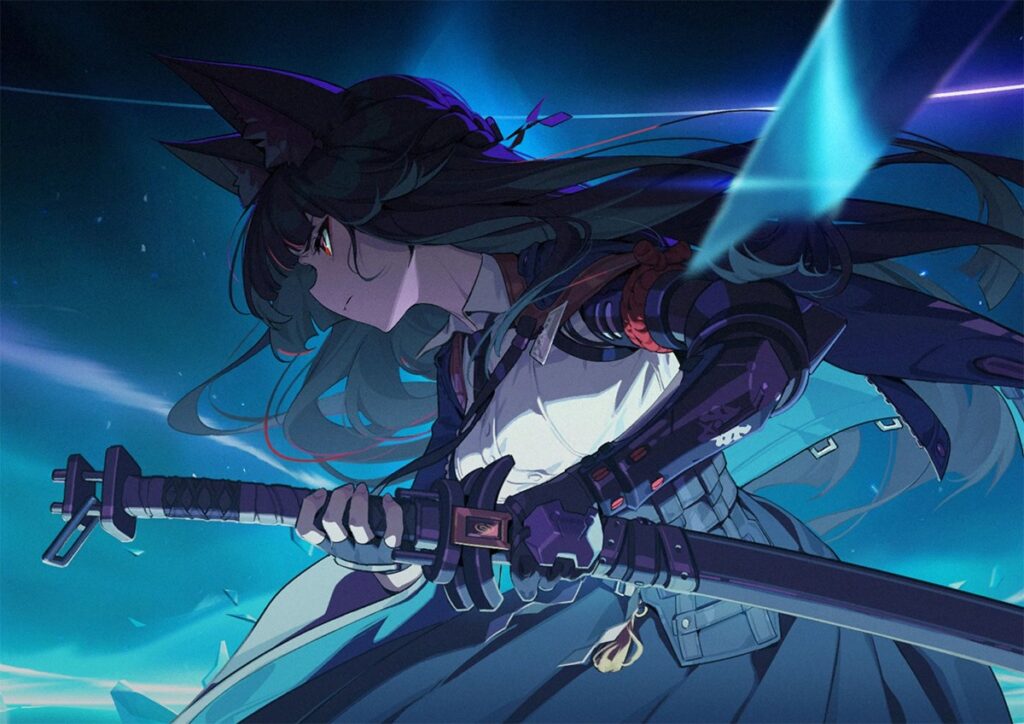
Even more groundbreaking is the unique design of the characters. Take Hoshimi Miyabi as an example. As the Section Chief of H.S.O.S.6, her design went through more than seven iterations before finally settling on a “compromise style between realism and fantasy.” This compromise is not a concession but a precise exercise in visual balance.
In the early seven design variants, the team experimented with high heels, removing hair accessories, and short skirts, ultimately choosing a long skirt to emphasize her competence and composure as the leader of Section 6. For the color scheme, black serves as the primary tone, complemented by white-blue contrasts and yellow-red accents. This maintains visual cohesion with the Section 6 faction while using subdued, low-saturation highlights to convey her calm and restrained personality.
Notably, Hoshimi Miyabi’s belt buckle is shaped like a “hand”—a visual metaphor for Section 6’s affiliation with the H.A.N.D. organization. This embedding of narrative symbols into costume details demonstrates the functional depth of character design. Such meticulous refinement brings Hoshimi Miyabi’s personality to its fullest expression. Fans, known as Proxies, have recreated her designs faithfully, and Zenless Zone Zero has released a series of Miyabi Plush and figurines, allowing this charm to extend into the real world.
Bangboo Design Aesthetics: The Everyday Charm of Cute Companions
As the game’s mascot, Bangboo’s design reflects Zenless Zone Zero’s focus on “micro-narratives.” These adult-knee-high intelligent machines have rabbit-like long ears and perpetually wide yellow eyes, making only an “enn enn” sound. They not only guide evacuees through the Hollows but also become an indispensable part of the everyday life in New Eridu.
The aesthetic significance of Bangboo lies in “decentralization.” They are neither heroes nor protagonists—they are the cogs that keep the city running: managing shops, helping with deliveries, and even venturing into the Hollows alongside Enforcers. Oh, and don’t forget—Bangboo needs to recharge too. Fans can even get ZZZ power bank featuring adorable Bangboo animations, bringing an immersive experience to mobile devices.
The design team created around 40 motion modules for a single type of Bangboo. Their bouncy animation perfectly applies the principles of squash and stretch from the “12 Principles of Animation.” This “overdesign” of side characters reflects a design philosophy rooted in equality, treating every element of the world with care and personality.
Visual Design: A Retro-Urban Street Runway
The visual language of Zenless Zone Zero centers on a deliberate “temporal displacement.” The game’s art direction draws heavily from the urban landscapes of the 1980s and 1990s, with classic stores, random street play, and exposed arcade-style architecture that is both functional and visually striking. Curves, stripes, and stylized lettering all project the bold personality of that era. Yet this isn’t mere nostalgia—producer Li Zhenyu blends it with Y2K aesthetics and contemporary street culture to create a “cartoon world that feels like a street runway.”
This mix-and-match approach is especially evident in the color design. In the Sixth Street of the main city, brightness and saturation are deliberately lowered, creating a “luxury gray” feel that recalls the rendering style of early 3D games. At the same time, street graffiti, posters, and neon signs pop with vivid complementary colors, producing a controlled visual chaos. Eastern and Western cultural elements coexist in a fascinating way—Oriental layouts in corner stores meet Western-style street graffiti, stone lions share space with anime posters—together weaving a sense of authentic “everyday life” in this fictional city.
The aesthetics of Zenless Zone Zero are a carefully crafted “accident.” It wraps the harshness of a post-apocalyptic world in the visual language of street fashion, gives characters soul through meticulously crafted animations, and softens the weight of heroes with the everyday lives of ordinary people. On the stage of New Eridu, whether it’s the flash of Hoshimi Miyabi’s blade, the sway of Bangboo, or the neon of Sixth Street, they all tell the same truth: even as the world teeters on the edge of collapse, life and beauty are still worth pursuing.
