
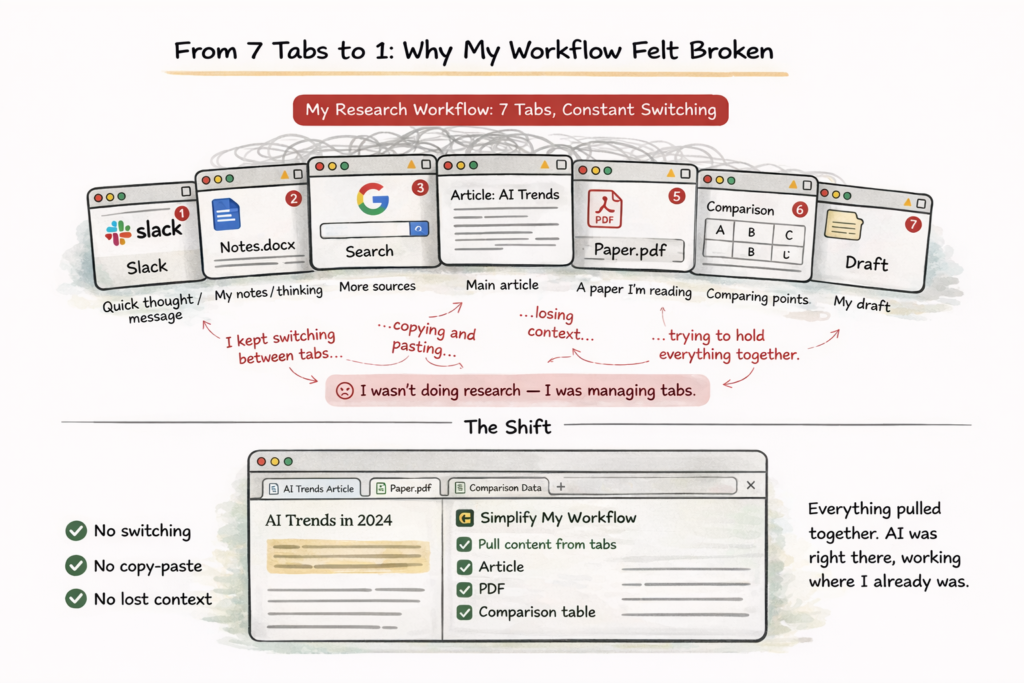
United States,27th march,2026-For a long time, my research workflow lived across multiple tabs — an article in one, a PDF in another, a few comparison pages, and a draft somewhere else. I kept switching between them, trying to connect everything, constantly stitching together pieces that never really belonged in the same place. At first, it felt normal, even productive, like this was how research was supposed to work.
But over time, I started to notice something else. It wasn’t just that things felt messy — it was that I was spending more time managing my workflow than actually thinking.
What I Was Actually Doing
Whenever I needed help from AI, the pattern became obvious. I would copy a paragraph, switch tabs, paste it into ChatGPT, explain what I needed, wait for a response, then copy the result back to wherever I was working. None of these steps were difficult, but repeating them over and over added up.
Looking back, this was the moment I started to see the problem more clearly. I wasn’t just doing research — I was constantly preparing context so AI could be useful.
What I Thought the Problem Was
At first, I assumed the issue was information overload. There were too many sources, too many ideas, too much to process, and AI was simply helping me move through it faster.
But that explanation didn’t quite fit.
The information itself wasn’t the problem — everything I needed was already there. The real issue was that it existed in separate places that didn’t connect.
What I Realized
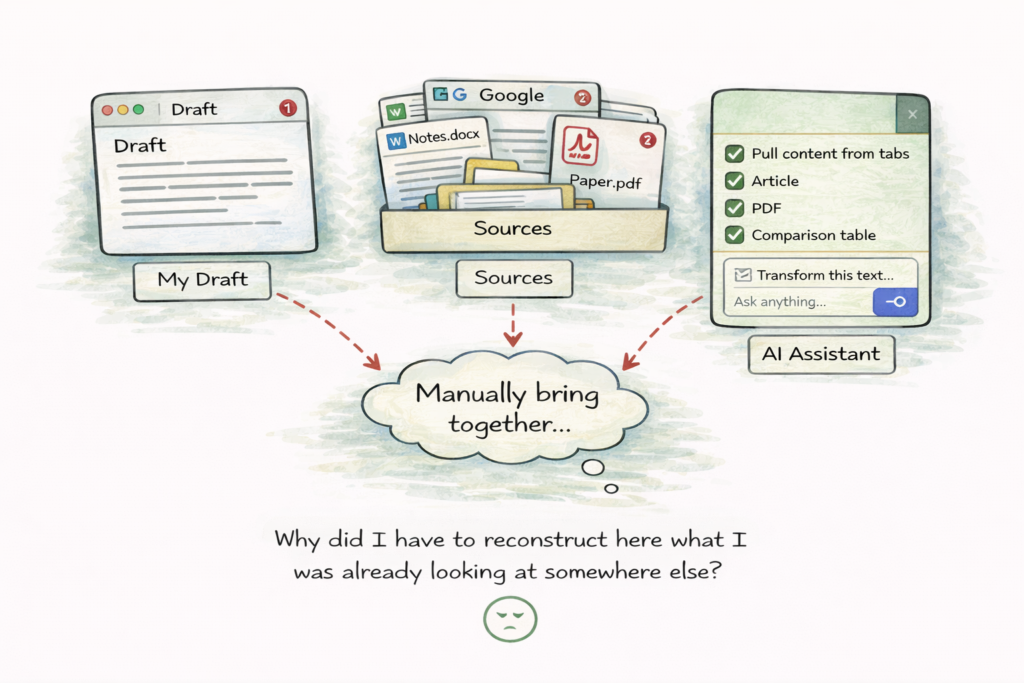
Once I looked at it more closely, the problem became clearer. My thinking was happening in one place, my sources were scattered across others, and AI lived somewhere else entirely. Every time I needed help, I had to bring all of that together manually.
That’s when the question changed for me.
Instead of asking how to get better results, I started asking why I had to rebuild context in the first place — why something I was already looking at had to be reconstructed somewhere else before it could be useful.
What Actually Changed
The shift didn’t come from a better model or a new feature. It came from something simpler: I stopped leaving my workflow.
I started using tools that bring AI directly into the browsing context — instead of forcing me to move context out of it. In my case, that meant using something like Clico, where I could work across tabs, pull in context, and trigger AI without ever switching environments.
At the same time, I started to notice this wasn’t just one tool. Others, like Merlin and Sider were already moving in a similar direction, making it possible to work directly on webpages and documents without constant copy-paste. Some approaches go even further — tools like Nexi, or even AI-native browsers like Dia, treat the entire browsing environment as context.
That changed everything.
Instead of copying, switching, pasting, and explaining, I could stay inside the flow of my work. I could pull context across tabs, interact with AI in place, and get output exactly where I needed it — without reconstructing everything each time.
From 7 Tabs to 1
Looking back, going from seven tabs to one wasn’t really about organization or discipline. It wasn’t that I suddenly became more focused or more efficient.
What changed was that I no longer needed to separate thinking from context.
Instead of managing multiple tabs as separate pieces, I could treat them as a single working environment — where context was already connected, and AI could operate across it. Tools like Clico made that shift possible, but what stood out to me was that this pattern was starting to appear more broadly: less switching, less reconstruction, and more work happening directly inside context.
Once everything I needed existed in the same place, the extra tabs simply stopped feeling necessary.
Contact details:
- Email: hey@tryclico.com
