
Introduction
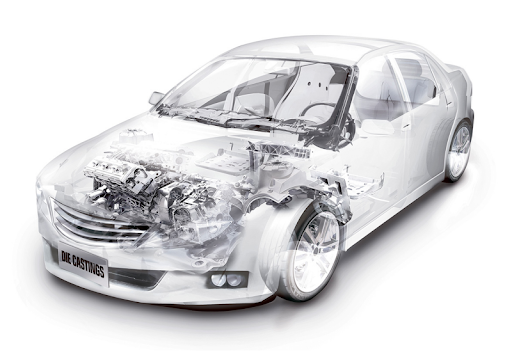
The automotive industry relies on a variety of manufacturing processes to produce high-quality components. Among these, casting methods such as sand casting and aluminum die-casting play a vital role. Both techniques have distinct advantages and limitations, making them suitable for specific applications within the automotive sector. This article explores the use of sand casting and aluminum die-casting in automotive parts, highlighting their differences and common applications.
What is Sand Casting?
Sand casting is a traditional and versatile casting process where molten metal is poured into a sand mold to create complex shapes.
Key Features:
- Versatility: Suitable for a wide range of materials, including cast iron, steel, and aluminum.
- Cost-Effectiveness: Ideal for low-volume production due to the affordability of sand molds.
- Complex Geometries: Capable of producing intricate designs and large components.
Applications in Automotive Parts:
- Engine Blocks and Cylinder Heads:
- Often cast using sand molds due to the complexity and size of these components.
- Provides durability and strength for high-stress applications.
- Manifolds:
- Exhaust and intake manifolds are commonly produced using sand casting to achieve precise airflow designs.
- Chassis and Suspension Components:
- Large and heavy-duty parts requiring high-strength alloys are frequently sand cast.
What is Aluminum Die-Casting?
Aluminum die-casting is a high-pressure casting process that injects molten aluminum into a steel mold, known as a die, to form parts with excellent surface finish and dimensional accuracy.
Key Features:
- High Precision: Produces parts with tight tolerances and smooth surfaces.
- Efficiency: Suitable for high-volume production runs.
- Lightweight Design: Aluminum’s lightweight nature enhances fuel efficiency in vehicles.
- Excellent Heat Dissipation: Ideal for components requiring thermal conductivity.
Applications in Automotive Parts:
- Transmission Housings:
- Manufactured using aluminum die-casting for lightweight and durable designs.
- Engine Components:
- Parts like oil pans, engine covers, and brackets benefit from the precision of die-casting.
- Electrical Housings and Heat Sinks:
- Essential for modern electric and hybrid vehicles.
- Wheels:
- Aluminum die-casting ensures strong yet lightweight wheels with excellent aesthetic appeal.
Comparison of Sand Casting and Aluminum Die-Casting in Automotive Parts
| Aspect | Sand Casting | Aluminum Die-Casting |
| Production Volume | Suitable for low to medium production volumes. | Ideal for high-volume production. |
| Dimensional Accuracy | Moderate; requires additional machining. | High; minimal post-processing needed. |
| Material Choice | Versatile; can cast ferrous and non-ferrous metals. | Primarily aluminum and aluminum alloys. |
| Cost | Low initial mold cost but higher per-part cost. | High initial tooling cost but lower per-part cost. |
| Part Size | Ideal for large and heavy parts. | Best for smaller, lightweight components. |
Factors Influencing the Choice of Casting Method
- Volume Requirements:
- Sand casting is preferred for prototypes or small production runs.
- Die-casting is more economical for mass production.
- Material and Strength Needs:
- Sand casting can use a wider range of alloys for high-strength applications.
- Aluminum die-casting is limited to non-ferrous metals but provides lightweight and corrosion-resistant parts.
- Part Complexity:
- Sand casting handles complex and large parts.
- Die-casting excels in producing parts with intricate details and thin walls.
- Cost Considerations:
- Sand casting molds are less expensive but wear out quickly.
- Die-casting dies have higher upfront costs but are long-lasting.
Conclusion
Both sand casting and aluminum die-casting play essential roles in the automotive industry, with each method suited to specific applications. Sand casting is ideal for larger, heavier parts and low-volume production, while aluminum die-casting excels in producing precise, lightweight components at high volumes. By understanding the strengths and limitations of these processes, manufacturers can optimize production efficiency and meet the diverse needs of the automotive market.
Dongrun Casting has 20000 square meters of facility houses and 200 production & test equipment, From quotation and tooling design to casting and finished machining, we can work with you at every stage. We serve a wide range of industries-from Fortune 500 corporations to small and midsize OEMs. Our products include Automotive&trucking, Electric Utility & Communications, Metering Systems, the Hydraulic Industry, Medical Devices, Lighting, Fuel and Gas Pressure, and Furniture parts.
More Details: www.dongruncasting.com
