
Launching an app in 2025 isn’t a coder-only sport anymore—it’s a founder’s sprint, and AI is the turbo boost. Gartner’s forecast, quoted by Forbes, says that by next year 70 % of all new enterprise apps will be spun up on low-code or no-code platforms—nearly triple the share in 2020. Translation: skip the six-month dev slog, ship your MVP in weeks, and keep your burn rate on life support.
This playbook shows exactly how scrappy founders are wielding AI app builders to jump from napkin sketch to live product—fast, lean, and with zero technical debt. Ready to put your idea in users’ hands before the copycats even file a Jira ticket? Let’s get moving.
Why AI-Built Apps Are the Rational Choice in 2025
When time-to-market decides survival, cutting compile-time drudgery isn’t a luxury—it’s basic math. A modern AI app builder compresses the riskiest phase of product development—the gap between concept and first user feedback—into a weekend sprint. That compression changes founder economics: every week you don’t pay a dev team extends runway and preserves equity.
The underlying shift is architectural. Large language models now sit inside no-code engines, turning plain-language specs into working UI components and serverless functions. An AI app generator doesn’t just scaffold screens; it predicts the data model, wires authentication, and even drafts unit tests. Paired with a quick cost sanity check—run one at estimation.ptolemay.com before you write a single ticket—you can decide in minutes whether the feature list justifies the spend.
This is why investors track builders, not headcount. The founder wielding a mobile app generator or app creator AI isn’t replacing engineers; they’re reallocating scarce talent from boilerplate to differentiation. In that light, choosing AI tooling isn’t a shortcut—it’s the only logically defensible path when money and momentum are finite.
How AI App Builders Actually Work — The Real Mechanics
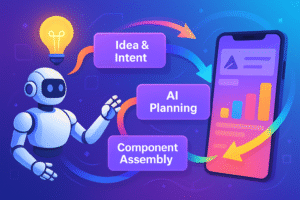
Under the hood, every AI app builder follows a disciplined, three-layer logic stack:
- Intent → Schema
You type “social login, spending dashboard, push alerts.” An embedded language model parses that request into a formal data schema and a state chart. It’s a glorified compiler: nouns become tables, verbs become endpoints. This is why a good ai app generator feels psychic—it’s mapping plain English to a domain-specific blueprint, not guessing.
- Schema → Components
The blueprint feeds a curated library of hardened widgets: auth flows, chart modules, payment forms. Instead of generating code token by token, the engine assembles proven parts and negotiates their contracts (props, events, hooks). That swap—from raw code to composable parts—is what lets a mobile app generator promise reliability without extra QA cycles.
- Components → Polished UI
Finally, a drag-and-drop canvas wraps the assembly in human judgment. Move a button, rename a field, drop a serverless function for edge cases—the platform records diffs as declarative metadata. Hit “deploy,” and the builder emits clean React/Flutter stacks plus CI scripts. An app creator AI isn’t magic; it’s an opinionated supply chain that turns text into tested software with one feedback loop instead of six.
The payoff is strategic: founders spend time on differentiation, not scaffolding. That’s why investors increasingly measure velocity in builder cycles, not sprint points.
Top 6 AI App Builders Side-by-Side
With the explosion of no-code and AI platforms, not all “AI app builders” are created equal. Here’s what actually matters: How fast can you launch? Who owns the code? What happens when you scale? Below—a side-by-side snapshot of the six real contenders founders are using in 2025. Use it to avoid the traps most product teams fall into when they just chase hype.
| Platform | Key Features | Pricing | Export/Ownership | Compliance/Region |
| Glide AI | Text-to-app, live data sources, custom actions, mobile/web, AI-powered formulas | Freemium (Pro from $60/mo) | No code export (data export only) | GDPR, SOC2 (US/EU) |
| AppMaster | AI project planner, backend & frontend, visual business logic, code export | From $41/mo, code export on Business plan ($110/mo+) | Full code export (Go, JS, SQL) | GDPR, ISO27001 (EU) |
| Builder.ai | Chat-based “build with AI,” marketplace of app “features,” human review, deploy to stores | Custom pricing (quotes from $2000/project) | No source code export, only binaries | GDPR, SOC2 (Global) |
| Adalo AI | Drag-and-drop, in-app AI actions (text/image), real-time DB, simple integrations | Free tier, paid from $36/mo | No code export, DB export only | GDPR (US/EU) |
| Jotform App Generator | Form-based app logic, mobile-friendly, prebuilt templates, AI text generation | Free tier, paid from $34/mo | No code export, data export only | GDPR, HIPAA (Global) |
| Apphive GPT | Conversational app builder, mobile-first, cloud functions, rapid prototyping | Freemium, paid from $20/mo | No source code export | GDPR (Global) |
Expert Take — Quick-Scan Verdicts
Glide AI is my go-to when a non-technical founder needs something in the App Store next week. It stitches live data to polished screens almost automatically. The trade-off is brutal, though: Glide keeps the source. Grow past the sandbox and you’ll be rebuilding on a real stack.
AppMaster sits at the other extreme. You get full code export in Go, JavaScript, and SQL, plus a slick visual logic editor. That freedom costs two things—time to learn the interface and a higher subscription if you want the fancy stuff. For founders who care about IP, it’s usually worth it.
Builder.ai feels like hiring a concierge dev shop: you chat, they assemble, humans QA the build. Perfect if you have budget and zero appetite for plumbing. Just remember, you’re paying premium rates and you’ll never own the codebase outright.
Adalo AI is the friendly Lego set. Drag, drop, publish—great for first-time builders or teaching product flow. But the minute you need granular security or heavy logic, you’ll hit the ceiling, and there’s no export hatch.
Jotform App Generator shines when the app is the form—think onboarding, check-ins, surveys. It nails mobile UX for data collection. Move beyond that scope and you’ll feel boxed in; complex business logic simply isn’t its job.
Apphive GPT is speed incarnate for consumer prototypes. You can tweak and relaunch in hours. The downside? Fewer integrations, a rougher UI, and limited ownership options. Great for testing an idea, less so for scaling a company.
Bottom line: pick the tool that matches your endgame—speed, ownership, or flexibility—but know exactly where the limits kick in.
FAQ: Building Apps with AI in 2025
Is there an AI that can build apps?
Wondering if a real AI can actually build your app idea for you? Yes—platforms like Glide AI, AppMaster, and Builder.ai use language models to turn your plain-English specs into working mobile or web apps. Most founders now start with these tools to build MVPs in days, not months.
How much does it cost to build an app with AI?
Trying to budget for an AI-built app? Expect to pay anywhere from $0 (with free plans) to $60–$150/month for pro tiers, with some platforms charging extra for code export or advanced features. Many solo founders report launching MVPs for less than 5% of traditional dev costs in 2025.
Can ChatGPT create an app?
Heard the buzz about ChatGPT and want to know if it can code your whole app? ChatGPT can generate code snippets, help design features, and even suggest architectures, but it doesn’t deliver a publish-ready app by itself. Most founders use ChatGPT alongside no-code AI app builders to fill gaps and speed up prototyping.
Can I make an app with AI for free?
Looking for a free way to ship your first AI-built app? Most leading platforms—like Adalo AI or Jotform App Generator—offer free plans with enough features for basic MVPs and demos. Founders often start free, then upgrade as the project or user base grows.
Which AI app builder is everyone using in 2025?
Curious which AI app builder is actually winning in 2025? Glide AI leads for internal tools and quick MVPs, while AppMaster is the go-to for founders who need full code export and more control. Builder.ai and Adalo AI are also popular with early-stage teams moving fast.
Is using AI copyright-free?
Not sure if AI-generated app code is automatically yours? Most platforms grant you rights to your app logic and design, but exported code may be subject to specific licensing. Always check the platform’s terms before going to market—especially if you’re planning to raise or sell.
Can one person build a mobile app using AI?
Thinking about solo-building your app with AI? Absolutely—one founder using a modern AI app builder can ship a working MVP in days, without writing manual code. Case in point: dozens of YC applicants now demo AI-built products as single-person teams.
Is it legal to clone an app design with AI?
Wondering if you can legally “clone” an app with AI tools? You can mimic features or flows, but copying unique designs or copyrighted content risks takedowns or legal action. The safe play: build on standard UI/UX patterns and add your own twist.
Conclusion
There’s no one-size-fits-all when it comes to AI app builders. If you’re looking for speed and want to test a market, platforms like Glide AI or Adalo AI can get you moving fast, but expect trade-offs around ownership and long-term flexibility. If you care about keeping your code and building for scale, AppMaster is the clear standout, but it comes with more complexity and cost.
Ultimately, the smartest approach is to treat these platforms as launchpads, not permanent homes. Use them to prove your idea and get real user feedback, but plan ahead for what happens if things take off. In 2025, founders who move quickly—and know where their tools’ limits are—are the ones setting the pace.
