
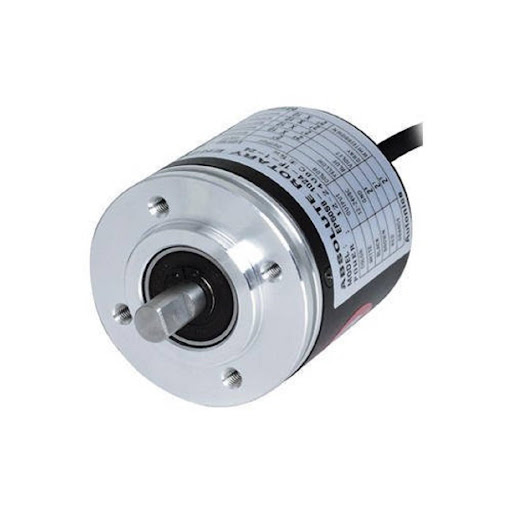
Encoders are one of the most important devices in modern automation and motion control systems. They act as “sensors of position,” ensuring machines move precisely the way they are programmed. Without them, robots wouldn’t know where their arms are positioned, CNC machines wouldn’t be able to cut materials accurately, and elevators wouldn’t stop at the right floor. Among the different types of encoders available today, the two most commonly used are absolute encoders and incremental encoders. While they both serve the purpose of tracking movement and position, the way they function and the data they provide are quite different. Choosing the wrong one can result in reduced efficiency, unnecessary costs, or even safety issues. That’s why understanding their differences is essential before making a decision.
What Are Encoders?
Encoders are electromechanical devices that convert motion—such as rotation, speed, or linear movement—into an electrical signal. This signal can then be read by a controller, PLC (Programmable Logic Controller), or computer system to monitor and control a machine’s operation. Essentially, encoders are the “eyes” of automation systems.
Imagine a robot arm assembling cars in an automotive plant. For the arm to weld in the right spot every time, the system needs precise information about the arm’s position. That’s where encoders come in. They constantly report whether the machine is in the correct position, moving at the right speed, and following the intended path.
There are many types of encoders, including linear, rotary, magnetic, and optical encoders, but the most popular categories in industry are absolute encoders and incremental encoders. Both provide position-related data, but the way they report and process this information is very different.
What Are Absolute Encoders?
Absolute encoders provide a unique digital output for every single position of their shaft or movement. This means that if you rotate the encoder shaft to a certain angle, it will output a distinct binary code or number that represents that exact position. Even if the system loses power, an absolute encoder will “remember” its position once power is restored.
This memory capability is what makes absolute encoders so valuable. Unlike incremental encoders, which need to “relearn” their position after a restart, absolute encoders do not require re-homing. For example, in an elevator, if power suddenly goes out, the absolute encoder will still know which floor the elevator is on when power returns. This makes them highly reliable in applications where safety, accuracy, and continuous monitoring are critical.
Absolute encoders come in two main types:
- Single-turn absolute encoders – Record position within one full revolution of the shaft.
- Multi-turn absolute encoders – Record not just one revolution, but also track how many complete turns the shaft has made. These are especially useful for large machines that move in multiple cycles.
What Are Incremental Encoders?
Unlike absolute encoders, incremental encoders don’t directly tell you the exact position of the shaft. Instead, they generate a series of electrical pulses every time the shaft moves. The system counts these pulses from a reference point (called a “home” or “zero” position) to determine movement and position.
For example, if the encoder produces 1,000 pulses per revolution (PPR), then rotating the shaft one full turn will send 1,000 signals to the system. If the system counts 500 pulses, it knows the shaft has rotated halfway. However, if the power is lost, the encoder loses its reference, and the system must reset or re-home to find its position again.
This makes incremental encoders less suitable for safety-critical systems but highly effective in applications where speed monitoring and relative movement tracking are the main goals. For example, conveyor belts, motor feedback loops, and packaging machines often rely on incremental encoders because they are fast, simple, and cost-effective.
Absolute vs. Incremental Encoders: Key Differences
The difference between absolute and incremental encoders lies mainly in the way they process and deliver data. Here’s a breakdown:
| Feature | Absolute Encoders | Incremental Encoders |
|---|---|---|
| Position Output | Provides unique, absolute position value | Provides relative position via pulses |
| Power Loss Handling | Retains position after shutdown | Loses position and requires re-homing |
| Accuracy | Very high – outputs exact position | Depends on pulse counts, cumulative errors possible |
| Cost | More expensive | Budget-friendly |
| Setup | No homing required | Homing required after restart |
| Best Applications | Robotics, CNC, elevators, medical devices | Conveyors, motor feedback, packaging machines |
In short: absolute encoders = precision and memory, while incremental encoders = speed and affordability.
When to Use Absolute Encoders
Absolute encoders are the better option in situations where safety, reliability, and accuracy are essential. Some examples include
- Robotics—Robots performing delicate tasks (like assembling electronics) need exact positioning at all times. Absolute encoders ensure they don’t lose track even if the power fails.
- Elevators—To prevent accidents, elevators must always know their current floor. An absolute encoder ensures position memory even after blackouts.
- CNC Machines—In computer-controlled milling and cutting, a loss of position data can result in wasted material or dangerous errors.
- Medical Equipment—Machines like MRI scanners or surgical robots require extremely precise movements that can’t risk losing reference data.
Simply put, if the application cannot afford to lose track of position, then absolute encoders are the right choice.
When to Use Incremental Encoders
Incremental encoders are best when relative position and speed monitoring are more important than absolute accuracy. Some examples include:
- Conveyor Belts – Tracking movement and speed of items without needing exact “position memory.”
- Packaging Machines—Ensuring high-speed operation and product counting at a lower cost.
- Motor Feedback Systems – Monitoring rotation speed to optimize motor performance.
- Budget-Sensitive Projects – When you don’t want to spend extra money on an absolute encoder.
If your system can easily re-home after restart and doesn’t require position memory, then incremental encoders are more cost-effective.
Advantages of Absolute Encoders
- Position Retention – Retains exact position after power loss.
- High Precision – Outputs a unique code for every position, reducing cumulative error.
- Safety and Reliability – Suitable for mission-critical applications.
- No Homing Needed – Saves time during machine startup.
Advantages of Incremental Encoders
- Lower Cost – More affordable compared to absolute encoders.
- Simple Design – Easier to integrate into many systems.
- Fast Response – Can track high-speed motion efficiently.
- Widely Available – Common in many industries due to cost-effectiveness.
Final Thoughts
When comparing absolute encoders vs. incremental encoders, the choice depends on what your application needs most: precision and memory or speed and affordability.
- If your machine cannot afford to lose track of its position (e.g., elevators, robotics, CNC, medical devices), choose absolute encoders.
- If you just need fast, affordable, and reliable movement or speed tracking (e.g., packaging, conveyors, motor control), go with incremental encoders.
By carefully weighing accuracy, safety, cost, and application needs, you can make the right decision that ensures long-term performance, reliability, and efficiency.
