
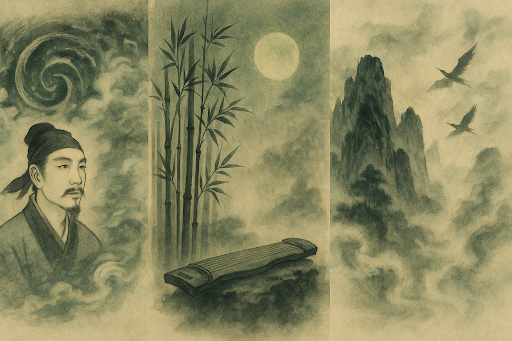
note: the article is written by Jiahao Shen, an independent history researcher from the Postgraduate program of World History and Philosophy at King’s College London. The essay is part of the trilogy on Wei-Jin Medieval China Metaphysical Confucianism. The Chinese characters at the original essay have been removed for the layout purpose.
The aristocracy class in the Han Empires, which had underwent the epochal process of consolidation and institutionalization during the long-term political and societal stability and continuity, tragically at the waning stage of the empire faced the severe crisis from the two interrelated aspects of the irreconcilable internal ruptures inside the aristocracy groups, and the extensive and harsh political oppression as the result from the steady degeneration and disintegration of the political orders and ethics, and particularly onto the aristocracy group that with the fundamental beliefs and dedicated practices of the Confucian morality.
Accompanied with the great sufferings and distresses, the scholar elites as the most central and essential stratum of the aristocracy class, and most relevant for those kept upholding the Confucian idealist mind, they were forced to yet deliberately choose to greatly withdrawal from the vigorous and committed political participation to instead devoting themselves to preserve and develop their inner idealist virtue and mind that significantly began to deeply and wholly connect and embody with the simultaneously progressive forming philosophical conceptualization of the absolute universal order and principle.
The Wang Bi as the philosopher that under the period when the collapsed political order passed through the relative recovery and thus entered the phase of growing stability under the Cao-Wei sovereignty, pioneered the first systematic formation of the philosophical world that centered on the codification of the absolute universal principle that in its entirety grounded into the establishment of the conceptualization of the ultimate natural order.
Across the varied origins of the aristocracy groups that formed and systematized gradually and substantively during the prolonged Han eras, the intellectualization and bureaucratization of the group was the indispensable and underlying premise to firmly secure the continuous and lasting status as the aristocracy class. In accordance with that essential condition, the consolidating and institutionalizing scholar-elites demonstrated the strong drive to cultivate their distinctive intellectual identity. Such propensity became remarkably more apparent in the upheaval time of political decays and oppression. The scholar-elites with the idealist Confucian mindset zealously sought to define themselves as the truthful embodiment of the pure moral virtue and integrity, and such collective group moral identity and consciousness further advanced to the deepen philosophical investigations onto the ultimate foundational principle of determining and forming the true moral virtues that are asserted to be hold exclusively within the group.
The compelled and sorrowful retreat from the committed political engagements and involvements of the scholar-elites, however, paradoxically further reinforced the power status of the scholar-elites, and in fact such condition did apply to the aristocracy class in general. Concurred with the sweeping disintegration of the Later Han Empire that shortly followed the wake of political deterioration, the aristocracy class naturally assumed the central and leading role with the primary responsibilities of safeguarding and sustaining the relevant local communities and clan structures.
When the Cao-Wei sovereignty in general restored the political order, at least in the partial degree by unifying the North and the massive conflicts were largely avoided in relations with the southern regimes, it carried the clear intention to reimpose the authoritarian ruling and reaffirm the full dominance of the centralized imperial authority with the full reincorporation of the aristocracy class. But it could not truly convince the aristocracy class, notably for the scholar-elites whose collective traumatic memory of enduring the earlier political oppression lingered in abundance, and their power and authority had further fortified and entrenched at the time of lacking centralized political order.
Therefore, philosophical construction of the ultimate natural order by the Wang Bi was not only the perpetuation and crystallization of the distinctive identity and belief on the pure moral virtue and relevantly the pursuit of the universal principle behind from the scholar-elites, but meantime the sincere and solemn assertion for reforming the political order primarily through the reconfiguration of the relations between the imperial authority and aristocracy power that with the defining focus on the moral and order authenticity and purity, and the true tranquility that completely aligned with the fundamental and ultimate natural order.
Draw essentially and extensively from the Daoism, Wang formulated the singular and universal principle for guiding and governing all the existences.
All that existed were originated from the nothingness… It is the beginning of all things…The Way, devoid of all forms and names, is that by which all things come into beings.”
The ultimate order, or The Way, is the foundation to all things. And its absoluteness and transcendence means it cannot be determined by any concrete and recognizable names and forms.
Dark and obscure — a sigh for the deep and the distant. So deep and distant that it cannot be seen. Yet from it do all things arise; and through them it may be glimpsed, and its truth discerned.
The Way, being formless and actionless, brings forth and sustains all things.
Subtle and unceasing, as though scarcely there, yet thereby do things attain their truth. Being one in essence with the Way. Thus it is said: they are in accord with the Way.
All things have their mother nature, whereby their form is preserved… The fundamental worth lies in the mother nature, yet the mother nature itself has no noble form.
Though the deepness and vastness of the ultimate order cannot be directly observed and precisely defined, its fundamental and all-encompassing connections and antecedent to all the things, its essence can be truly revealed and understood as it is rooted into the intrinsic reality of all things.
The Earth guards its form; virtue may not exceed what it can bear. Heaven is content with its figure; virtue may not transcend what it can cover. Not even Heaven and Earth can ever exceed the principle limitations associated with them.
The Way follows Nature, and thus Heaven draws from it. Heaven models itself upon the Way, and Earth follows Heaven. Earth models itself upon Heaven, and Man therefore takes it for his pattern. Thus, He that keep to the One and and rule thereby, this is called the True Lord.
All things are begun from the void; all motions are arose from stillness.
Though all things move and act as once, in the end they return to the void and
stillness. This is the utmost depth of all being.
From the ultimate order, every subsequent order has been completely predetermined, and all the elements will absolutely but naturally follow the respective order with the predetermined conditions for achieving the fundamental harmony.
The harmony signifies the absolute tranquility, as even the movements of the things do exist, they will eventually follow the ultimate order to back to the original stillness and voidness.
The indication was given that the established relation between the aristocracy class and imperial authority at the post-age of political disillusionment had been ultimately preordained. And even the temporary change of directions would eventually return to the true form of relation.
Heaven and Earth follow the Nature, neither acting nor fashioning. All things govern themselves. Therefore Heaven and Earth are by principle without benevolence. He that is benevolent must seek to establish, bestow, and transform the things, and show favour and work deeds. Beings will lose their true nature in the course of being established and transformed, and they will fail to wholly endure under the favor and deed. Should beings endure not in completeness, they are unfit to fulfill their appointed bearing.
All things take Nature as their essence; thus they may be followed, but not forced. They may be traversed, but not grasped. Each thing hath its constant nature; to contrive and tamper with it lead surely to ruin. Each thing moves forth and back, and to seize and hold it bring the loss.
If the true order is followed and preserved, all things will sustain their own orders that predetermined by the ultimate order and fully aligned with their natures. However, any unnecessary interventions and artificial manipulations will corrupt and ruin the predetermined natural order that inherently rooted into the things.
Therefore, when wisdom arises, great falsehood is born.
When purity and stillness are forsaken, and restless desires are pursued, and when humility is cast aside, and authority is exalted, then are things thrown into disorder, and the people are led astray. Thus when authority can no longer restrain the people, and the people can no longer endure its might, shall order above and below dissolve in ruin — and Heaven’s retribution shall surely come.
The wisdom defined there refers to the particular ideas and actions that by essence contradicts and undermines the ultimate natural order.
In term of the political discourse, the philosophical conceptualization of the ultimate natural order and the idealized world under its order stood as the powerful and decisive opposition and resistance to the re-introduction of the authoritarian centralized imperial ruling. Such ruling nature was bluntly exposed as the total entanglements and complete alienation from the true ultimate order.
Moreover, the eternal changelessness and harmony as the core aspects of the ultimate natural order symbolized the belief on the constant presence of the scholar-elites as the core part of the aristocracy class, and their lasting crucially leading role in sustaining the true authentic order.
The Sage unites his virtue with the virtue of Heaven and Earth. In the midst of Heaven and Earth, all is vast and boundless, yielding wholly unto Nature.
The Sage comprehends the utmost of Nature, and gives free course to the nature of all things.Therefore he follows but doth not act; he yields but doth not impose. He removes what leads to delusion, and casts away what gives rise to confusion. Thus the heart is untroubled, and the nature of things attain itself.
Beholding through return to the purity, the heart of Heaven and Earth is revealed. Contemplating it on the auspicious day, one can perceive the utmost vision of the Ancient King.
On the status of sage, he will be in the full unity and integration with the nature, and thus attaining the full awareness and comprehension of the nature essences, and accordingly to embody into the wholehearted practice of the pure idealized morality.
The discussions and examinations on the sage was not only the creation of the idealized model for the imperial ruler, but in the equally essential way the self-devotion from the scholar-elites to approach the perfection of the status of idealized morality.
If one discerns things with intentional clarity and insight, things will in turn compete to respond in kind, and if one regards things with intentional distrust, they will also compete to respond with mistrust…Then do all things lose their natural course, and the people are as those bereft of hand and foot…Thus the Sage, in regard to the world, is ever yielding and gentle, with his heart holding to no master. He blends his heart with all under Heaven, and his will goes not toward any single end.
Instruments of power are the tools by which a state may prosper. Yet only by following the nature of things, and not by applying punishment to governorship. When the tool is unseen, and all things find their proper place, then is it the true instrument of the state’s prosperity.
Formless and shapeless, soundless and echoless, therefore can it pass through all things, and go whithersoever it will.
The formless and the nameless, it is the fount of all beings…Hence may the Ancient Way be grasped and followed, to wield the beings of this day.
By truly understanding and integrating into the essences of nature, the varieties of the hypocritical and distorted alternations onto the nature through the fabricated actions imposed on the multitude of things will be entirely omitted. The operations and processes of the things will be bounded completely with their inherent nature of order.
Practically, the self-willed renunciation of the authoritarian ruling, and correspondingly the full acknowledgment and honoring of the largely independent status of the scholar-elites that deliberately kept the ambiguous and cautious distance with the centralized politics, were the earnest restoration to the harmony of the ultimate natural order.
The ultimate natural order also perfectly aligns with the ancient world, and hence the ancient way should serve as the paramount guide for leading the actions into the current moment. The concept of ancient world in essence stands as the envisioned inner idealized world for the scholar-elites.
To behold the Way of the world through the hearts of the people, this is to understand the Way of all under Heaven. For the Way of the man, whether in reversal or harmony, in auspice or calamity, does follow the same path.
To cause one not to know the divine and the sacred as divine and sacred — this is the utmost of the Way.
The Sage reveals not what he knows of himself, but exercises power through brilliance and might.
Under the status of the sage with the complete comprehension and integration to the true nature, the ultimate natural order will be essentially understood and practiced through the unification of the people’s heart. Yet it will occur entirely without the stimulation of any awareness from the mass society to parallel with the ultimate principle of the nature.
Under Wang’s philosophical framework of ultimate natural order, the idealized Confucian morality will be enacted utterly in the passive and unconscious manner. The pureness and eternity rootedly embedded in that ultimate natural order demand all the ideas and actions to be returned to the original pure state and regarded that as the utmost and supreme mission.
The philosophical view on the heaven and universe during the Han period was merely applied in the relatively unrefined way, which any major visible changes on the nature will be taken as the expressions of heaven willingness, and the people and and society would need to take actions and perform properly and actively to conform the will of heaven. Such plain and direct philosophical system indeed greatly motivated the scholar-elites at that time to actively and passionately engage and immerse into the political affairs, and striving for the meaningful changes as paved by the will of heaven, and through the course implementing their ideals in the strongly proactive way.
The Wang’s philosophical system of ultimate natural order landmarkedly escalated and systematized the conception of heaven and universe with the metaphysical construction of the ultimate natural order. But within that ultimate natural order, the principal mission of the scholar-elites was enacted in the completely reversal way. The active political engagements were primarily discouraged, and the pursuit of the idealism rested in the inner philosophical and aesthetic search for the purity that consistent with the ultimate natural order.
All men forsake the root of life and prize the trivial and the ornate adornments, there the Sage said I alone would be set apart from the multitude.
With the formation of new belief on the philosophical system of ultimate natural order, the distinctive identity of the scholar-elites transformed radically to purposefully and fully return to the inner self and to the external relations with the foundational principle of non-action and non-intervention.
Earnestly to seek to perfect the skill, and to deepen the practice; yet all his striving is but a journey return unto emptiness and non-being.
But the meaningful changes and reforms were never strictly prohibited, but they had to be performed with the exceptional prudent, and with the premise of complete understanding of the ultimate natural order prescribed as the absolute obligatory condition.
For the actual necessary and meaningful political engagements, the particular spiritual and meditative condition that with the philosophical wisdom of the true understanding needed to be constantly presented, which in that condition the particular object and affair needed to be completely forgotten and only the ultimately true meanings would be preserved with the new gains of the fundamentally authentic substances during the process.
In the short life of the Wang Bi, he had never been entitled with the important political duties and positions even under the time when the political atmosphere was in his favor. The incoming of oppressed governance from the Sima family further obstructed the possibility and his death was shortly followed.
But his essential philosophical framework of the ultimate natural order soonly evolved into the paramount creed and identity of the scholar-elites. Arose from there, the further continuously developing philosophical belief and the corresponding conducts overall outlasted and transcended any particular targeted political pressures and interventions from the imperial authority in the approximately next four centuries.
Assertively, the emergence and constitution of the philosophical conceptualization of the ultimate natural order symbolized the new formative phase of the aristocracy class that continuously centered by the scholar-elites.
These newly transitional groups of scholar-elites, with the substantial consolidation of their power status, which the particular degree of semi-independence was able to be secured over eras, and with their uniquely marked identity, developed the increasingly obscure relations and tensions with the central politics that also endured the radical transformations through the time.
Through the historical lens of these transforming scholar-elites, the alternative possibility of understanding and interpreting the Medieval China might be plausible. And the philosophical system of ultimate natural order, constantly stood as one of the core ideological and intellectual foundations for them.
