
Search is changing faster than most law firms realize.
For years, SEO was the main way attorneys competed for visibility online. You wrote blog posts, optimized keywords, earned backlinks, and tried to rank on Google’s first page. That model still matters—but it is no longer enough on its own.
Today, clients are increasingly using AI tools like Google’s AI Overviews, ChatGPT, Bing Copilot, and voice assistants to find legal information. Instead of clicking links, they’re getting summarized answers. Often, only a few firms are mentioned by name.
This shift introduces a new concept that law firms cannot afford to ignore: Generative Engine Optimization, or GEO.
In this blog, we’ll break down the difference between GEO and SEO, explain how AI search actually works, and show what truly drives visibility for law firms in this new environment.
Understanding Traditional SEO for Law Firms
Before comparing the two, it’s important to understand what SEO is designed to do.
Search Engine Optimization focuses on helping your website rank higher in traditional search results. The goal is to appear on page one when someone searches for terms like “divorce lawyer near me” or “business litigation attorney.”
SEO for law firms typically includes:
- Keyword research and on-page optimization
- Writing blog posts targeting specific legal queries
- Improving page speed and mobile usability
- Building backlinks from other websites
- Optimizing Google Business Profiles
This approach works well when users are clicking links and browsing multiple results.
But AI search changes how results are delivered.
How AI Search Is Different From Traditional Search
AI search engines do not work like classic search engines.
Instead of showing ten blue links, they generate a summarized answer using multiple sources. These systems scan content, assess credibility, and synthesize information into a single response.
Here’s the key difference:
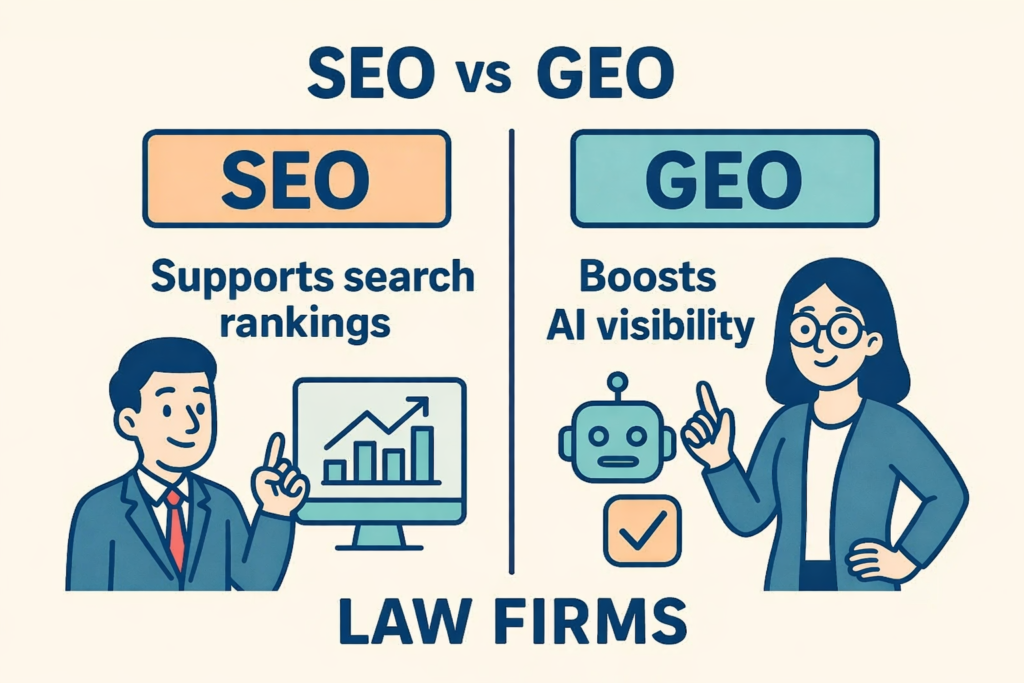
SEO helps you rank.
GEO helps you get referenced.
When an AI tool answers a legal question, it may cite a law firm, quote its explanation, or recommend it implicitly. If your content isn’t structured or written in a way AI understands, you may be invisible—even if you rank well in traditional search.
This is where GEO comes in.
What Is GEO and Why It Matters for Law Firms
Generative Engine Optimization focuses on optimizing content so AI systems can easily understand, trust, and reuse it in generated responses.
GEO for law firms is not about gaming algorithms. It’s about clarity, authority, and usefulness.
AI systems look for:
- Clear explanations of legal concepts
- Demonstrated expertise and real-world experience
- Consistent, trustworthy information
- Content that directly answers user questions
If your website reads like generic SEO content written only for keywords, AI tools may skip it entirely.
GEO vs SEO: The Core Differences
Let’s simplify the comparison.
SEO is designed for search engines.
GEO is designed for AI systems.
SEO prioritizes keywords, metadata, and backlinks.
GEO prioritizes meaning, structure, and authority.
SEO aims to drive clicks.
GEO aims to drive inclusion in AI answers.
This doesn’t mean SEO is obsolete. It means it is no longer sufficient by itself.
The firms that win visibility going forward understand how these two approaches work together.
Why Law Firms Are Especially Affected by AI Search
Legal search is highly sensitive.
AI systems are cautious about misinformation, especially in areas like law, health, and finance. This means they rely heavily on trusted, authoritative sources.
If your content:
- Lacks depth
- Avoids clear answers
- Is overly promotional
- Doesn’t show expertise
AI engines may avoid using it entirely.
That’s why GEO for law firms requires a different mindset than traditional marketing content.
What Actually Drives Visibility in AI Search
Let’s talk about what really matters.
1. Clear, Direct Answers to Legal Questions
AI systems favor content that answers questions immediately.
For example, instead of writing a vague introduction, your content should directly explain:
- What the legal concept is
- Who it applies to
- What the risks are
- When someone should speak to a lawyer
Short paragraphs and clear language help both humans and AI understand your message.
2. Demonstrated Legal Expertise
AI tools look for signs that content is written by professionals, not content farms.
This includes:
- Attorney bylines
- Mentions of real legal scenarios
- Jurisdiction-specific explanations
- Consistent legal terminology
GEO rewards firms that explain the “why,” not just the “what.”
3. Structured Content That AI Can Parse
AI doesn’t read like a human. It scans.
Using headings, subheadings, bullet points, and logical flow makes your content easier for AI to extract and summarize.
Avoid large blocks of text. Keep paragraphs short. Each section should focus on one idea.
This is a foundational principle of GEO for law firms.
4. Trust Signals Across the Web
AI systems don’t rely on your website alone.
They also look at:
- Mentions of your firm on reputable sites
- Consistency across directories
- Reviews and citations
- Thought leadership content
This means your visibility depends on your broader digital footprint, not just blog rankings.
5. Intent-Focused Content, Not Keyword Stuffing
Traditional SEO often encourages targeting dozens of similar keywords.
AI search cares more about intent.
If someone asks, “Do I need a lawyer for a DUI first offense?” the AI wants a clear, accurate explanation—not a page stuffed with variations of “DUI lawyer.”
GEO for law firms prioritizes intent clarity over keyword density.
Where SEO Still Matters
Despite all this, SEO is not dead.
SEO still helps with:
- Local discovery
- Long-tail search traffic
- Website health and usability
- Foundational visibility
Think of SEO as the base layer.
GEO builds on top of it.
Without solid SEO, AI may never find your content. Without GEO, AI may never use it.
Common Mistakes Law Firms Make With AI Visibility
Many law firms assume that ranking equals visibility.
That’s no longer true.
Some common mistakes include:
- Writing generic legal blogs with no original insight
- Avoiding direct answers to avoid “giving away free advice”
- Over-optimizing for keywords instead of clarity
- Ignoring author credibility and experience
AI favors helpfulness over hesitation.
How Law Firms Should Adapt Their Content Strategy
To win in AI search, law firms need to adjust how they approach content.
Start by asking:
- Would this answer satisfy a real client’s question?
- Does this explain the issue clearly enough to be quoted?
- Does this reflect real legal experience?
Content should educate first and market second.
This mindset shift is at the heart of effective GEO for law firms.
The Role of Thought Leadership in GEO
AI systems value original perspectives.
Publishing content that explains legal trends, recent changes, or practical implications helps position your firm as a trusted source.
This includes:
- Explainers on new laws
- Commentary on court decisions
- Practical guidance for specific situations
These are the types of insights AI engines are most likely to surface.
Local Visibility and AI Search
Local SEO still matters, but AI changes how local results appear.
Instead of listing ten firms, AI may recommend two or three.
To be included, your firm must show:
- Clear practice focus
- Location relevance
- Consistent online presence
- Strong authority signals
This is where SEO and GEO overlap most closely.
Measuring Success in a GEO World
Traditional metrics like rankings and traffic are no longer the full picture.
New indicators include:
- Being cited in AI answers
- Brand mentions without clicks
- Increased branded searches
- Higher quality inbound inquiries
Visibility now includes influence, not just impressions.
The Future of Law Firm Search Visibility
AI search is not a trend. It’s the direction search is moving.
Clients want fast, clear answers. AI delivers that.
Law firms that rely solely on outdated SEO tactics will slowly disappear from these new discovery channels.
Those who invest in clarity, authority, and usefulness will stand out.
That is why GEO for law firms is becoming essential, not optional.
Final Thoughts: GEO vs SEO Is Not a Choice
This is not a battle between two strategies.
SEO and GEO serve different purposes.
SEO helps your content get found.
GEO helps your content get used.
Law firms that combine both will dominate visibility in AI search.
Those that ignore this shift risk becoming invisible—even if their website still ranks.
If your firm wants to stay relevant in the age of AI-driven discovery, now is the time to rethink how you create and present legal content.
Because in the future of search, being the best answer matters more than being the top link.
