
During Ethereum discussions, many analysts ask whether ETH remains a solid investment or if alternatives could deliver stronger returns on a $1,000 stake. Ethereum’s network continues to exhibit deep liquidity, high daily usage, and institutional interest in staking and Layer-2 activity.
Yet questions about its scalability have grown as newer ecosystems and specialized tokens emerge. Investors are already pivoting into early-stage tokens like Remittix, which have 30x potential, tying price growth to real-world payment utility and adoption.

Ethereum Remains Powerful, but Can It Still Deliver Outsized Returns?
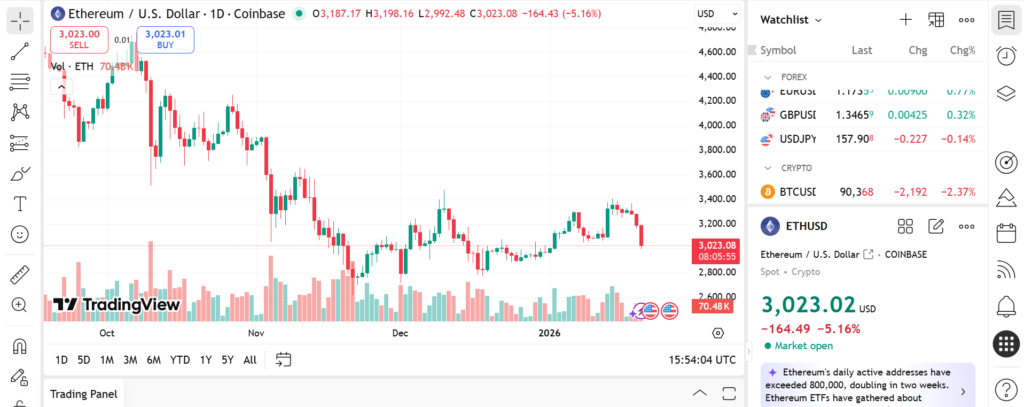
Ethereum remains one of the most established tokens in crypto. Ethereum is currently trading at $3,023, has a market capitalization in excess of $365 billion, and has a 24-hour volume of $27.2 billion. Institutional activities, such as ETH accumulation and staking, reflect ongoing interest.
Despite these advantages, there are concerns among investors regarding whether Ethereum will continue to deliver significant returns. Upgrades such as Fusaka and scalability enhancements are expected to make transaction volume and fees less cumbersome.
Nevertheless, it has been contended that most economic activities have moved to Layer-2 solutions, which are not beneficial to ETH holders.
Analyst views vary as some forecast modest upside within current technical ranges, while others emphasize structural competition and fee dynamics that might limit ETH’s relative growth. The takeaway for investors is that Ethereum, while still a core blockchain asset, faces debate about how much growth remains priced in versus longer-term structural shifts in the sector.
Why Remittix May Offer A Better 30x Potential Alternative
Remittix offers a contrasting growth narrative tied to specific utility rather than broad network status. It aims to become a global crypto-to-fiat payment hub, focusing on real financial flows and direct payment use rather than general smart contract volume.
Remittix’s positioning at the intersection of crypto, payments, and global remittance, a $19 trillion market, gives it a framework for use beyond speculation. Its design supports merchants, users, and developers with wallet services, fiat rails, and API tools that tie token use to actual financial activity.
Community confidence is reinforced by CertiK audit verification and a #1 ranking on CertiK Skynet, which supports transparency and security for holders.
Market engagement also shows building momentum. Remittix has sold over 701 million tokens at $0.123, raising over $28.8 million and approaching $30M raised, which triggers broader exchange reveals. Holders also benefit from structured rewards like a 15% USDT referral program, which enhances participation and network growth.
Importantly, the Remittix Wallet is now live on the Apple App Store, with Google Play support following, enabling secure asset management and positioning users ahead of PayFi adoption.
The Remittix platform will officially launch on 9 February 2026, bringing full crypto-to-fiat tools that can drive adoption and real usage. These developments show why some see Remittix as the next big altcoin in 2026, with 30x potential and why investors compare it to larger assets like Ethereum when considering growth opportunities.
The Core Features Fueling Remittix’s 30x Growth Thesis:
- Tackles the $19 trillion payments market with real-world solutions
- Direct crypto-to-bank transfers in 30+ countries
- Utility-first token with real transaction volume
- Deflationary tokenomics with growth potential
- Mass-market appeal


Ethereum Stability vs. Remittix Growth: Where Does $1,000 Work Better?
With Ethereum holding structural value as a major blockchain and investment token, it still offers exposure to core crypto activity. Market data shows ETH retaining key support levels and continued staking interest, suggesting it remains relevant and resilient despite volatility.
Yet for a strategic investor asking whether their $1,000 could be better invested in an altcoin with 30x potential, Remittix presents a compelling alternative tied to specific utility and measurable ecosystem growth. Its combination of strong audit verification and a scheduled platform rollout on 9 February 2026 makes it stand out.
For investors weighing Ethereum’s deep market presence against the growth prospects of altcoins, Remittix is the type of early-stage crypto investment that may offer significant asymmetric returns while solving real financial problems.
Discover the future of PayFi with Remittix by checking out their project here:
Website: https://remittix.io/
Socials: https://linktr.ee/remittix
Frequently Asked Questions
Is Ethereum still a solid investment for long-term holders?
Ethereum remains a solid investment due to its strong liquidity, institutional interest, and dominance in smart contracts and DeFi. However, many analysts believe its large market cap may limit the chance of extreme upside compared to smaller altcoins.
Why do some investors believe Remittix has 30x potential compared to Ethereum?
Remittix is gaining attention because it links token growth to real-world payment utility rather than network size alone. Its focus on crypto-to-fiat transfers, remittance infrastructure, and PayFi adoption gives it asymmetric upside potential as an early-stage project.
What upcoming developments could drive Remittix adoption and growth?
Remittix is approaching a major PayFi platform launch on 9 February 2026, alongside expanding exchange listings and wallet adoption. With CertiK verification, deflationary tokenomics, and real transaction use cases, Remittix positions itself for long-term growth beyond speculation.
Disclaimer:
This article is for informational purposes only and does not constitute financial advice. Cryptocurrency investments carry risk, including total loss of capital. Readers should conduct independent research and consult licensed advisors before making any financial decisions.
All market analysis and token data are for informational purposes only and do not constitute financial advice. Readers should conduct independent research and consult licensed advisors before investing.
