
Abstract
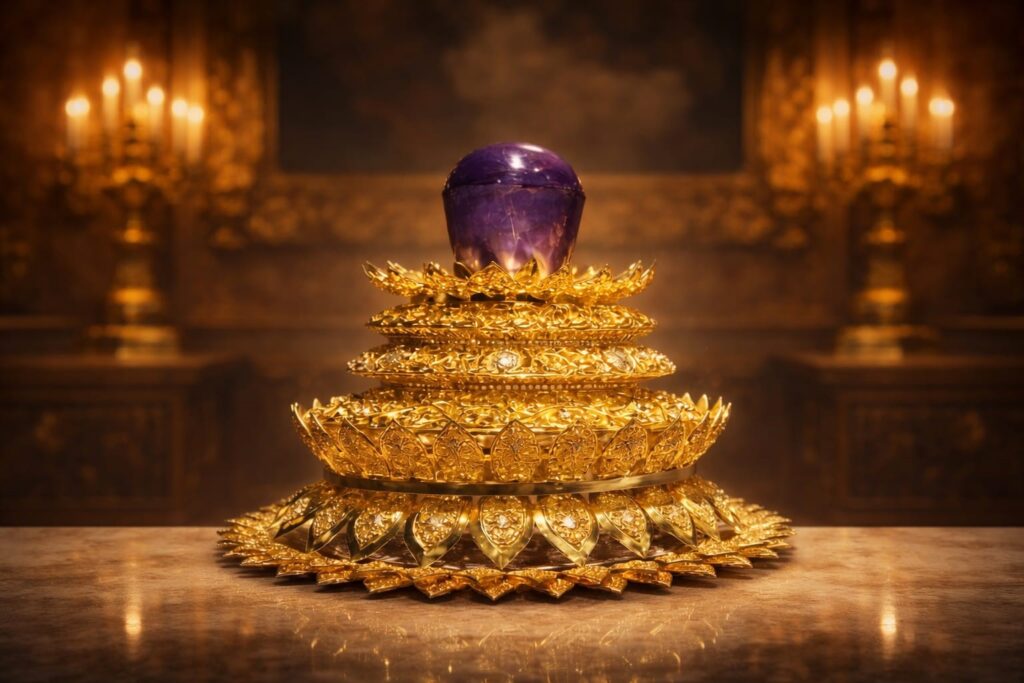
The Star of Pure Land is documented in international media and certified by the Gemological Institute of America (GIA) as the world’s largest known natural purple star sapphire. Weighing an unprecedented 3,536 carats (707.2 grams or 1.56 lb), this exceptional corundum specimen represents a statistically significant occurrence in gemology and mineralogy, challenging long-standing assumptions regarding the maximum size and optical viability of gem-quality corundum.
Recovered from the gem-bearing gravels of Sri Lanka, the Star of Pure Land provides a rare and well-preserved example of extreme crystal growth within a Pan-African geological context. Unlike most corundum specimens of comparable mass—which commonly become opaque, highly fractured, or optically inactive—this sapphire has retained sufficient translucency to display a clearly defined six-ray asterism visible across the cabochon surface. The coexistence of extraordinary size, natural purple coloration, and stable optical phenomenon places the specimen in an exceptionally rare category.
This article presents a museum-grade, scientifically grounded gemological study intended for professional audiences, advanced collectors, and institutional readers. Focus is placed on mineral identification and classification, the physical mechanisms responsible for asterism, geological formation conditions, laboratory verification, and the specimen’s significance as a reference-grade phenomenal gemstone. Particular attention is given to its relevance for museum education, mineralogical documentation, and the global scientific record. Considerations of commercial valuation are intentionally excluded. Supporting documentation and verification media are available through the official project archive.
- Identification and Classification
1.1. Mineralogical Identity
The Star of Pure Land is identified as a natural sapphire, a gem variety of corundum with the chemical composition aluminum oxide (Al₂O₃). Corundum crystallizes in the trigonal crystal system and possesses a Mohs hardness of 9, placing it among the most mechanically durable natural gemstones. These intrinsic properties make sapphire suitable not only for jewelry use but also for long-term scientific study and museum exhibition. The classification of the Star of Pure Land is defined by a combination of mineralogical purity, crystallographic integrity, and optical viability that clearly distinguishes it from common abrasive-grade corundum.
1.2. Color Origin and Geochemical Rarity of Natural Purple Sapphire
The specimen exhibits a distinct and saturated purple coloration, a hue that occupies a narrow and unstable chromatic interval between red (ruby) and blue sapphire. In corundum gemology, purple is widely regarded as a transitional color state, requiring an exceptionally precise geochemical balance during crystal growth. While pure corundum is colorless (allochromatic), the coloration of this sapphire results from trace-element substitution within the aluminum lattice.
In this case, the purple hue arises from the combined influence of chromium (Cr³⁺), the chromophore responsible for the red coloration of ruby, and a charge-transfer interaction between iron (Fe²⁺) and titanium (Ti⁴⁺), which produces blue sapphire coloration. The simultaneous presence of these chromophores in stable proportions is inherently rare, particularly in large crystals. Maintaining such elemental equilibrium over the growth of a specimen exceeding 3,500 carats—without the development of muddy tones or disruptive color zoning—represents an exceptional geological condition rarely preserved in natural corundum.
1.3. Morphology, Lapidary Strategy, and Optical Optimization
The gemstone has been fashioned as a round double cabochon, measuring approximately 66.46– 67.87 mm in diameter with a depth of 71.17 mm. This lapidary choice is both scientifically and optically significant. A cabochon cut is the only cutting style capable of revealing asterism in corundum, as the phenomenon depends on the interaction between incident light and oriented rutile inclusions within the crystal structure.
The decision to employ a double cabochon—convex on both the upper and lower surfaces—is particularly critical for a star sapphire of this scale. This configuration maximizes weight retention from the original rough while allowing light to enter from the rear of the stone, enhancing internal illumination of the body color and increasing contrast in the star figure. The substantial depth of the cabochon, exceeding 70 mm, intensifies the visual strength of the optical phenomenon; a shallower or flatter cut would likely have diminished saturation and reduced the clarity of the star. Precision in dome height, symmetry, and alignment with crystallographic axes has ensured the full expression of asterism without optical distortion.
- Optical Phenomenon: Six-Ray Asterism
The defining feature of the Star of Pure Land is its well-defined six-ray asterism, a classic “phenomenal” optical effect produced by internal crystal structure rather than surface reflection. The star is generated through a volumetric interaction between incident light and microscopic inclusions distributed throughout the body of The Star of Pure Land gemstone, making it an intrinsic and stable optical property of the crystal.
2.1. Mechanism of Star Formation (Exsolution Process)
The asterism arises from dense networks of exsolved rutile (TiO₂) needle inclusions, historically referred to in gemology as “silk.” These microscopic needles formed during the slow cooling of the corundum crystal over geological timescales. At high temperatures, titanium was initially held in solid solution within the corundum lattice. As cooling progressed and thermal stability decreased, the lattice could no longer accommodate the titanium, causing it to precipitate as discrete rutile crystals.
Crucially, these rutile needles are not randomly oriented. They align precisely along the three equivalent horizontal crystallographic axes of the trigonal (hexagonal) crystal system, intersecting at 60-degree angles. When illuminated by a single point light source, each oriented needle set reflects light as a linear ray; together, the three sets produce a coherent six-rayed star centered on the cabochon dome.
The sharpness and symmetry of the star indicate that this exsolution process occurred slowly and without significant disturbance. Rapid cooling, tectonic stress, or chemical instability would have produced short, fragmented, or chaotic inclusions, resulting in diffuse or broken asterism rather than a crisp, well-defined star.
2.2. Girdle-to-Girdle Visibility
Visual examination and documentation indicate that the asterism in the Star of Pure Land remains visible from girdle to girdle across the entire cabochon surface. In gemological terms, this signifies a continuous and homogeneous distribution of rutile silk throughout the full crystal lattice. Such complete star coverage is uncommon, particularly in stones of extreme size.
Many large star sapphires display interrupted, wavy, or partial stars caused by growth zoning, localized titanium depletion, or structural discontinuities within the crystal. In contrast, the uninterrupted girdle-to-girdle visibility observed here reflects a remarkably stable growth environment, maintained consistently over the extended geological period required for the formation of a crystal exceeding 3.5 kilograms in mass.
2.3. Optical Stability at Extreme Scale
Maintaining a sharp, centered, and symmetrical star in a gemstone of this magnitude requires an exceptional convergence of conditions: crystal homogeneity, low fracture density, precise inclusion orientation, and long-term geochemical stability. In very large corundum crystals, internal stress and compositional variation commonly disrupt optical coherence, degrading or entirely suppressing asterism.
The preservation of strong optical performance at this scale places the Star of Pure Land in a rare class of reference-grade phenomenal gemstones. Its asterism is not only visually striking but also scientifically informative, offering insight into the upper limits of crystal growth, inclusion organization, and optical preservation in natural corundum.
- Rarity Considerations
The Star of Pure Land represents an exceptional convergence of three independent rarity factors:
- Extraordinary size for a natural star sapphire
- Natural purple coloration, a minor subset of sapphire production
- Strong, centered six‑ray asterism of high optical integrity
Individually, each factor is uncommon; their coexistence in a single natural specimen elevates the stone to record‑class phenomenal status.
- Geological Formation:
The Sri Lankan Orogeny The Star of Pure Land originates from the localized gem deposits of Sri Lanka, historically known as Ceylon, and was recovered from alluvial “illam” gravels—secondary gem-bearing sediments derived from the island’s ancient metamorphic core. These gravels are sourced primarily from the Highland Complex, a geologically significant terrain formed during high-grade metamorphism associated with the Pan-African orogeny approximately 550–600 million years ago. This tectonothermal event produced some of the world’s most gem-fertile crustal environments and is fundamental to Sri Lanka’s long-standing reputation as a premier sapphire locality.
4.1. Star Sapphire Genesis
Star sapphires form under high-temperature metamorphic conditions, where aluminum-rich protoliths undergo recrystallization to produce corundum. Within such environments, slow and prolonged cooling is essential. As temperatures decline, titanium initially dissolved within the corundum lattice becomes unstable and exsolves as rutile (TiO₂) needles, orienting themselves along crystallographically controlled directions. This process gives rise to the fine, coherent rutile silk required for asterism. Rapid cooling or tectonic disturbance would disrupt this alignment, preventing the development of a stable star.
The exceptional mass of the Star of Pure Land sapphire—exceeding 700 grams—suggests crystallization in a volatile-rich environment, potentially pegmatitic or skarn-related, where fluid availability and chemical mobility allowed for sustained crystal growth. Formation likely occurred at depths of approximately 10–20 kilometers under granulite facies conditions, where elevated pressures and temperatures facilitated slow, uninterrupted crystallization over geological timescales.
4.2. Sri Lankan Geological Context and Preservation
Sri Lanka’s metamorphic terranes are globally recognized for producing large, well-formed corundum crystals, fine rutile silk suitable for asterism, and stable internal structures that resist destructive deformation. The geological environment of the Highland Complex provides a rare combination of factors conducive to the preservation of optical phenomena even in very large crystals. Following its formation, the Star of Pure Land was liberated from its primary host rock through prolonged weathering and transported into alluvial gravels. Its survival as a coherent, optically intact crystal indicates exceptional mechanical integrity, as most corundum of comparable size fractures or degrades during erosion and fluvial transport.
4.3. The Purple Sapphire Anomaly
While Sri Lanka is best known for blue star sapphires, natural purple star sapphires of this magnitude are exceedingly rare. From a geochemical perspective, their formation requires a delicate and sustained balance of chromophoric elements. Chromium and iron must be present in sufficient quantities to generate the purple hue, while titanium must be abundant enough to produce dense rutile silk without inducing excessive cloudiness or opacity. These processes are often geochemically competitive. Elevated titanium concentrations can obscure body color, while fluctuations in chromium or iron can shift coloration toward red or blue zoning. The Star of Pure Land represents a rare “Goldilocks” scenario in which transparency, color saturation, and silk density reached near-perfect equilibrium. This convergence of conditions explains both the rarity of the specimen and its importance as a reference example of extreme gemquality corundum formation.
- Scientific Verification and Documentation
In an era defined by advanced gemstone treatments and increasingly sophisticated synthetic reproduction, independent laboratory verification is the essential standard for scientific credibility—particularly for record-class specimens. For extraordinary gemstones, institutional acceptance depends not on claims, but on transparent, third-party documentation produced under internationally recognized protocols.
5.1. Scientific Role of Gemological Institute of America (GIA) Certification
The Star of Pure Land is certified by the Gemological Institute of America (GIA), whose reports are widely regarded as the global benchmark for impartial gemological assessment. GIA certification establishes a defensible chain of scientific evidence and confirms several critical aspects of the specimen under standardized laboratory conditions.
First, the report verifies species identity, identifying the stone as natural corundum and classifying it specifically as a natural star sapphire. This confirmation excludes the possibility of laboratory-grown material, composite construction, or alternative mineral simulants.
Second, the report documents the absence of treatment, stating that there are no indications of heating. This finding is mineralogically significant. Heat treatment—commonly employed to enhance color or clarity in corundum—typically dissolves or disrupts rutile silk at temperatures exceeding approximately 1,600 °C, permanently destroying asterism. The presence of a strong, coherent star in an untreated specimen of this size confirms that the optical phenomenon is entirely natural and preserved in its original geological state.
Additional report details—including round double-cabochon cutting style, purple coloration, semitranslucent to opaque transparency, precise measurements (66.46–67.87 × 71.17 mm), and a recorded weight of 707.20 grams—further establish the specimen’s physical identity in reproducible terms suitable for long-term reference.
- Museum and Institutional Significance
From a curatorial perspective, the Star of Pure Land belongs to a rarefied class of documented “phenomenal” gemstones that function as permanent records of Earth’s geological processes. Such specimens are not valued solely for rarity or scale, but for their capacity to preserve and communicate complex mineralogical information across generations.
6.1. Comparative Scale and Reference Status
With a recorded weight of 3,536 carats, the Star of Pure Land far exceeds the mass of all previously recognized star sapphire reference specimens. It is nearly nine times larger than the Star of Lanka (393 carats) and substantially surpasses historic icons such as the Star of India (563.35 carats) housed at the American Museum of Natural History, as well as the Star of Bombay (182 carats) held by the Smithsonian Institution.
While these earlier stones remain culturally and historically significant, the Star of Pure Land establishes a new upper boundary for natural star sapphire formation—particularly within the rare purple color variety. Its documented scale redefines expectations regarding the maximum achievable size of semi-translucent, optically active corundum and positions the specimen as a new benchmark within the global gemological record.
6.2. Educational and Scientific Value
As a reference-grade specimen, the Star of Pure Land serves as an exceptional educational tool. Its scale allows observers to directly visualize crystallographic principles that are typically confined to microscopic or diagrammatic representation. The six-rayed star provides a macroscopic expression of hexagonal lattice symmetry, illustrating the relationship between atomic structure, inclusion orientation, and optical phenomena.
In an instructional context, the specimen supports teaching across multiple disciplines, including asterism mechanics, trace-element color formation, and the effects of crystallographic orientation on light behavior. Moreover, the stone challenges prevailing geological models concerning growth limitations in gem-quality corundum, suggesting that under optimal pressure, temperature, and chemical conditions, the natural limits of crystal growth may be significantly higher than those represented in existing museum collections.
6.3. Mineralogical, Historical, and Public Engagement Importance
Record-class gemstones occupy a unique position in mineralogical history, functioning as temporal markers that document the extreme boundaries of natural crystal growth and preservation. Such specimens are frequently cited in academic literature and serve as fixed reference points against which future discoveries are evaluated.
Beyond their scientific importance, phenomenal gemstones of verified scale and authenticity play a critical role in public engagement. By uniting mineralogy, geology, and cultural heritage in a single object, the Star of Pure Land enhances public understanding of Earth sciences and fosters appreciation for the deep-time processes that shape the natural world. In this capacity, it fulfills both an educational and interpretive role, bridging scientific inquiry and public curiosity.
Conclusion
The Star of Pure Land is more than an exceptional gemstone defined by carat weight; it is a geological singularity. The rare convergence of extraordinary mass, natural purple coloration, and a fully documented six-ray asterism distinguishes the specimen as a reference-grade example of phenomenal corundum. Such a combination is not merely uncommon—it represents an extreme expression of geological order achieved under highly specific and rarely sustained natural conditions.
Its certification by the Gemological Institute of America secures its position within the formal scientific record, ensuring that its identity, origin, and optical integrity are preserved through impartial and internationally recognized verification. This documentation transforms the specimen from an object of admiration into a permanent data point—one that can be reliably cited, studied, and contextualized by future generations of gemologists, mineralogists, and curators.
The significance of the Star of Pure Land lies not in commercial valuation, but in its contribution to mineralogical knowledge, educational outreach, and long-term institutional heritage. As a tangible record of the upper limits of natural crystal growth and optical preservation, it challenges existing assumptions within gemology and expands the boundaries of what is known to be possible in nature. In doing so, it warrants serious consideration by museums, academic institutions, and collectors committed to safeguarding Earth’s most exceptional and scientifically meaningful natural creations.
