
When people hear “CRISPR,” they often picture futuristic gene editing—dramatic changes to DNA and big headlines about what might be possible one day. But one of CRISPR’s most common uses is quieter and more down-to-earth: helping scientists answer a practical question that sits at the center of modern medicine:
Which genes actually matter for a disease—and which ones are just along for the ride?
A CRISPR screen is a way to test thousands of genes at once to see which ones change how cells behave under a specific condition—like exposure to a drug, a virus, or an immune attack. This work happens far from hospitals, but it can shape what eventually reaches them. Screens help researchers narrow a huge list of possibilities down to a smaller set of genes worth studying in depth.
In practice, scientists often run CRISPR screens to:
- spot genes linked to drug resistance
- find essential genes cells depend on
- identify weak points that could become future drug targets
Why “one gene at a time” is often too slow
For a long time, biology moved like this: pick a gene, change it, see what happens, repeat. That approach still matters, but it’s slow—and it can miss key answers when a disease involves many genes interacting at once.
Cancer is a good example. It’s rarely controlled by a single switch. It’s more like a network with backup routes. Block one pathway, and cells may reroute around it. If researchers test genes one by one, they might miss the genes that only matter in combination—or the ones that matter only under stress, such as drug treatment.
CRISPR screens change the pace. Instead of betting everything on one educated guess, researchers can test many genes in parallel and let the results point to the strongest signals.
What a CRISPR screen is, in plain English
The details can sound technical, but the logic is simple:
Give lots of cells different genetic changes, apply a challenge, and see which changes help cells survive—or cause them to fail.
Here’s the basic idea:
- A large group of cells receives CRISPR “instructions.”
- Each instruction targets a specific gene.
- The cells face a condition that matters—like a drug, infection, or other stress.
- Researchers measure which gene targets become more common or less common over time.
If cells survive a drug only when a certain gene is disrupted, that gene might be involved in resistance. If cells disappear when a gene is disrupted, that gene might be essential—at least under those conditions.
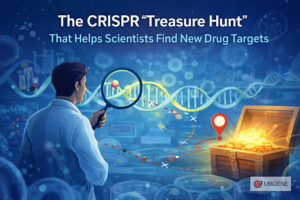
That’s why people sometimes call this a genetic “treasure hunt.” You’re looking for the few changes that really move the outcome.
What a CRISPR library is (and why it’s not the same thing as a screen)
To run a screen, researchers need an organized collection of targets. That toolkit is called a CRISPR library.
A crispr library is a large set of guide RNAs—short RNA sequences that direct the CRISPR system to a specific spot in the genome. Each guide is designed to target a gene (or sometimes a regulatory region). When thousands of guides are pooled together, researchers can test thousands of targets in a single experiment.
A simple way to keep the terms straight:
- Library = the menu of targets
- Screen = the full experiment that uses the menu
Libraries can be:
- Genome-wide (covering most genes)
- Pathway-focused (like DNA repair or immune signaling)
- Custom (built around a narrower question)
Some providers also publish educational explainers about how libraries and screens work—Ubigene is one example—alongside the broader scientific literature and methods papers.
How a screen works in the lab (without drowning you in jargon)
Every lab has its own details, but many pooled CRISPR screens follow the same backbone.
1) Deliver the library so most cells get one guide
Researchers usually try to set things up so each cell gets just one guide (or close to it). That matters because it keeps the results interpretable: when a cell changes behavior, there’s a clearer link to a single gene target rather than a messy mix of edits.
2) Apply a “pressure test”
Then comes the challenge. Depending on the research question, that might be:
- a cancer drug
- a virus infection
- low oxygen (hypoxia)
- an immune-cell challenge
- another stress that mimics disease biology
3) Count the guides using DNA sequencing
After the pressure test, researchers read out the results by sequencing the guide “barcodes” present in the cell population. This is usually done with next-generation sequencing (NGS), which can count many DNA fragments at once.
- Guides that drop out suggest the targeted gene was important for survival or growth in that condition.
- Guides that enrich suggest the targeted gene gave cells an advantage under that pressure.
For readers who want a more detailed, step-by-step overview of what a full screening workflow can include—from library preparation through sequencing and analysis—some technical summaries describe a complete crispr screen process.

This disrupts a gene at the DNA level so it no longer functions. KO screens are widely used to find essential genes or genes tied to drug resistance.
CRISPRi: turning a gene down
CRISPRi uses a modified CRISPR system that doesn’t cut DNA. Instead, it blocks gene activity—more like pressing on the brakes than removing the engine. This can be helpful when fully knocking out a gene would kill the cell, making it difficult to study.
CRISPRa: turning a gene up
CRISPRa boosts gene expression, allowing researchers to test what happens when genes are pushed higher than normal.
An easy analogy:
- KO = cut the power
- CRISPRi = dim the lights
- CRISPRa = turn the lights brighter
Positive vs. negative screens: two ways to find what matters
Screens also differ in what “signal” they’re looking for.
Positive screens: survivors stand out
Cells face a strong challenge—like a drug. Only some survive or thrive. Researchers study those survivors to find genes that may drive resistance or survival.
Negative screens: the missing pieces tell the story
Researchers track which guides disappear over time. If disrupting a gene causes cells to die or fall behind, that guide becomes less common. This approach is commonly used to identify essential genes and hidden dependencies.
Where CRISPR screens show up in real research
CRISPR screens aren’t a medical treatment by themselves. But they can guide the research that leads to treatments.
1) Understanding why therapies stop working
Drug resistance is a major problem in cancer care. Screens can help reveal genes that allow cells to escape treatment—information that can inform combination strategies.
2) Choosing better drug targets
Drug development is expensive and slow. Screens can help researchers focus on genes that cells truly depend on under certain conditions, instead of targets that only look interesting in a dataset.
3) Learning how viruses depend on host cells
Some screens aim to identify host factors a virus needs to infect or spread. That can point to possible antiviral strategies that don’t rely on targeting the virus directly.
4) Making sense of big genetic datasets
Modern biology produces long lists of “maybe important” genes. Screens help test which ones actually change outcomes, turning speculation into evidence.
The limits (and why screen “hits” aren’t the final answer)
CRISPR screens can highlight promising genes, but a “hit” is not automatically a drug target—and it’s not a headline-worthy medical breakthrough on its own.
Results can depend on:
- the type of cells used
- the experimental setup
- how well each guide works
- statistical noise in large experiments
That’s why responsible research treats screens as a starting point. Strong teams validate the most interesting hits with follow-up experiments, often in additional models and under different conditions.
Bottom line
CRISPR screens are one of the most practical tools in modern biology. They help scientists test thousands of genes in parallel, identify which ones matter under specific conditions, and make smarter choices about where to focus next.
If drug discovery is like navigating a dense forest, CRISPR screens are one way researchers find a path—without having to check every tree one by one.
