
Flooding a house or commercial building with water. One of the first things you want to do is dry it out as quickly as possible. The longer moisture remains in the walls, floors, and ceilings of a structure, the more damage it will cause.
That’s where a dehumidifier comes in handy. But not just any dehumidifier. Choose the correct dehumidifier and you can save time and money. Pick the wrong one and you might as well throw away your money on mold inhibitors and paint.
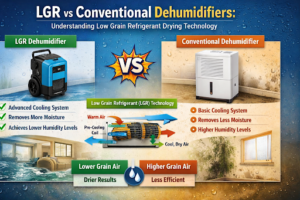
Right now there are two primary types of dehumidifiers used in the restoration industry. The standard conventional refrigerant dehumidifier. And the Low Grain Refrigerant dehumidifier, or LGR for short.
Both units look relatively similar from the outside. But internally these two machines work very differently. Understanding how they work and why can help homeowners, contractors, and restoration professionals pick the right tool for each job.
How Does a Conventional Dehumidifier Work?
Conventional dehumidifiers work off of a single-stage refrigerant cooling system. Air is drawn into the machine. That air flows across cold coils, removing heat and moisture. As the now cooled air continues through the dehumidifier it is then pumped back out into the room.
When ambient humidity levels are high, this process works fine. But there’s a catch. As the air in the room begins to dry out, the humidity level starts to drop. When it falls below 40-45% relative humidity, a conventional dehumidifier will lose its effectiveness. The coils aren’t cold enough to condense any more moisture out of the air. The unit will continue to run, but it will fail to keep removing moisture at the same rate.
For household purposes this is perfectly acceptable. Unless you live in South Florida you probably don’t need to bring down humidity levels any lower than that to feel comfortable. But when you’re drying out a flooded basement or carpet you need to go deeper. You need to push that humidity down into the 30% range.
The LGR Dehumidifier
Low Grain refrigerant dehumidifiers take it one step further. Instead of just a single cooling system, these dehumidifiers have a 2-stage cooling process. Also referred to as a pre-cooling loop or air-to-air heat exchanger. Moist air is drawn into the machine, but before it can reach the main evaporator coil it passes through a separate pre-cooler.
This first cooling stage drastically reduces the temperature of the air. Pre-cooling air before it reaches the main condensing coil puts you that much closer to dew point.
What is Dew Point?
The dew point is the point at which air has been cooled enough that it can no longer hold moisture in gaseous form. Once air reaches dew point, the moisture in the air will begin to condense out. By running the air through a pre-cooler first, the LGR unit is essentially squeezing more condensation out of each bucket of air.
In layman’s terms, a conventional unit will cool the air once. A Low Grain unit will cool the air twice. That 2nd stage is what gives LGR tech the advantage.
The Grain Factor
Low Grain Refrigerant refers to grains per pound of water. That is how LGR measures moisture in the air. One pound of air can only hold so many grains of water. Dry air has less grains. Humid air has more.
A conventional unit will typically drop air down to around 50-60 grains per pound. An LGR unit can lower that amount down to 30 grains per pound or less. That doesn’t sound like much of a difference until you’re wringing water out of wet walls. That 30-60 grain range is the difference between moisture lingering in your walls or being pulled out by your dehumidifier.
You see wood, drywall, insulation and even concrete hold onto moisture you can’t see. They will NOT release that moisture until the air is dry enough to accept it. By creating lower-grain air in the space, the dehumidifier creates a “pull” effect. Liquid is pulled out of wet materials and into the air where the dehumidifier can do its job. High grain air can’t pull moisture out of materials. That’s why professionals care about grain so much.
Works Great In Low Humidity
The biggest advantage of LGR dehumidifiers is that they can continue to work efficiently in low humidity environments. Standard units will begin to plateau as soon as relative humidity dips too low. LGR units will not.
This is crucial to understand because water damage mitigation is a marathon, not a sprint. The first few hours of any flood/damage event are easy. Humidity is high so any dehumidifier will pull a large volume of water out of the air. But after 24-48 hours the air begins to dry out. Conventional machines will slow their extraction rates considerably. An LGR unit on the other hand will continue to work at top efficiency.
Less downtime means your space will dry out faster. Faster drying time = less chance of mold. Mold can actually begin to grow within 24-48 hours on wet surfaces. By getting the humidity under 40% you can prevent mold spores from activating. LGR machines are designed to reach those lower levels and maintain those levels.
More Efficient
Let’s face it. If you’re renting a dehumidifier you don’t want to be left running for weeks on end. The longer your rental period, the more money you spend. LGR machines are more efficient at extracting moisture from the air. That means they reach target dry times faster than conventional units.
A unit that can dry a basement in 2 days instead of 5 not only saves you money on rental fees. It uses less electricity. Conventional machines that struggle to reach 40% humidity will run for days. Whereas many LGR units will hit that target in 1/2 the time or less.
For contractors that service multiple water damage jobs a year, that adds up to big savings. If you’re a homeowner dealing with a once every 5 year flood, it could mean the difference between affordable repairs and having to sell your house.
Where to use each?
LGR units are ideal for any job that requires deep and fast drying. Flood damage restoration, crawl space drying, mold jobs, new construction drying, and commercial water damage. These dehumidifiers have become the gold standard in professional restoration for reasons.
Conventional dehumidifiers still have their uses. Homeowners looking to manage humidity in basements, crawl spaces, bathrooms, and closets can all use conventional units. They’re cheap, readily available at most major hardware stores.
Think of it this way. If you only need to skim the surface, a conventional unit is all you need. But if you want to deep clean and dry an area quickly, spend the extra money on an LGR.
Moisture Control Guide Shows Real-Life Need for LGR Dehumidifiers Case Study: School remediation
Uploaded by the EPA, this case study details how traditional drying efforts failed due to “hidden” moisture located in structural cavities.
THE SETUP: An elementary school with several stories experienced a broken pipe. School officials used industrial fans (aka conventional drying) for three days with no success. The classrooms still smelled “musty.”
THE SCIENCE: School was built with “sandwich” walls (drywall taped over concrete block). Although conventional dehumidifiers removed moisture from surfaces in the room, they could NOT get low enough humidity to create enough vapor pressure to literally “pull” moisture out of the cavity between the drywall and the block.
THE “WORKING” SOLUTION: Switched to using LGR (Low Grain Refrigerant) dehumidifiers. Dropped humidity down to 30% (Less than 40 grains per pound of air). This created what’s known as a “vapor vacuum” that literally forced wall cavities to release their moisture without cutting down the drywall.
THE OUTCOME: Occupied in 48 hours rather than a $250,000 mold remediation project.
Working LINK: https://www.epa.gov/sites/default/files/2014-08/documents/moisture-control.pdf
Liquid dehumidifier FAQ’s
What are these “Grains” people keep mentioning?
In the restoration industry, we like to measure not only Relative Humidity (RH), but also Grains Per Pound (GPP). While RH varies depending on air temperature, GPP tells you exactly how much water your air is holding. A conventional unit gives up around 55 GPP. An LGR unit can essentially “squeeze” that air down to 30 GPP. It’s that extra dry air that creates enough vapor pressure to “pull” water out of dense materials such as hardwood floors or concrete.
Why can’t a conventional unit get below 40% humidity?
Physics. Cooling coils can only do so much. When air runs over the cooling coils in a conventional unit, if it’s not humid enough to condense into liquid on the coils, it won’t…. unless those coils are freezing. But if those coils get TOO cold, then the whole machine just turns into a giant ice cube. An LGR has what’s called a pre-cooling loop. This tiny loop of cooling coils precools your air before it ever hits the main cooling coils. That tiny cooldown allows your air to reach dew point MUCH quicker without freezing up the entire machine.
Can I just run an LGR as my basement dehumidifier?
Sure. But you don’t need to. LGR’s are industrial machines. They make more noise, take up more space and draw more power. For daily comfort or merely preventing that “damp” feeling, a conventional unit is just fine. But if you’ve experienced some sort of “liquid event” (flood / burst pipe), a conventional unit will not dry your house down quickly enough to prevent mold growth on your carpets OR dry out deep structural elements.
Do I need to seal the room for the LGR to work?
YES!!! This is where most people fail. If you crack a window, your LGR will attempt to dehumidify your entire neighborhood. To reach “Low Grain” levels, you must create a chamber that is closed off from the rest of your home. Close the doors, seal vents, and let that machine “scrub” the air inside that room.
Is wood harder to dry than drywall?
Far harder. Wood is hygroscopic. In other words it “likes” to absorb water. The Forest Products Laboratory found that wood reaches what’s called a “fiber saturation point” at which point it will physically swell. You need aggressive LGR drying power to shrink the wood back down to its “equilibrium moisture content” (usually around 10-12% indoors) to prevent permanent cupping.
Final Words
Low Grain tech revolutionized the restoration industry. Before their invention, you could run a conventional dehumidifier and dry a building, but it would take twice as long. Units would hit this huge wall of “sticky” humidity that they couldn’t pass. Leaving behind moisture that would grow mold and cause costly repairs down the road.
An LGR unit bypasses that wall. It dries deeper, faster and can do so more consistently than a standard machine. Both dehumidifiers have their place in restoration. Just know which one to use and when.
