
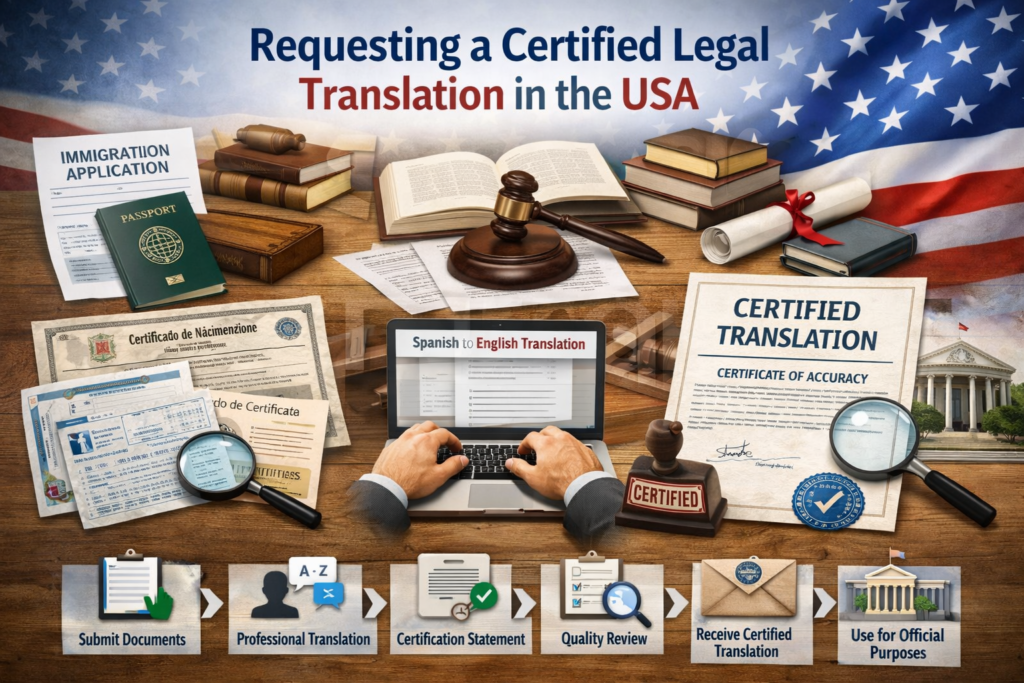
When dealing with immigration files, court documents, contracts, or official records, accuracy matters. Many government offices in the United States require documents that were originally written in another language to be translated and certified before they can be accepted. If you are unsure where to begin, understanding how to request a certified legal translation in the USA helps make the process simple and clear. Certified translations follow specific requirements and include a signed statement confirming that the translation is complete and accurate.
What Certified Legal Translation Means
Certified legal translation refers to translating official documents while meeting formal requirements used by authorities in the United States. A translator or translation agency prepares the translated document and attaches a signed certification statement.
This certification confirms three important points:
- The translation is complete
- The translation accurately reflects the original document
- The translator is competent in both languages
Government agencies, universities, courts, and immigration offices usually require this certification before accepting translated paperwork.
Common documents that often require certified translation include:
- Birth certificates
- Marriage certificates
- Divorce documents
- Immigration records
- Court judgments
- Academic transcripts
- Legal contracts
Each document must be translated carefully so every detail remains consistent with the original text.
Situations That Require Certified Legal Translation
In the United States, several institutions request certified translations before processing applications or legal matters. This requirement ensures officials understand the exact meaning of the original document.
Some of the most common situations include:
Immigration Applications
The United States Citizenship and Immigration Services requires certified translations for documents that are not written in English. Applicants submitting foreign birth certificates, marriage records, or identification documents must include certified translations with their applications.
Court Proceedings
Legal documents used in court must be translated precisely. Judges and attorneys rely on certified translations when reviewing evidence, statements, or international agreements.
Education and Academic Evaluation
Students who studied abroad often need certified translations of diplomas, transcripts, or certificates when applying to schools or professional licensing organizations in the United States.
Business and Legal Agreements
Companies working across borders may need contracts or corporate documents translated for compliance, partnerships, or legal review.
Documents Needed Before Requesting Translation
Before submitting a translation request, gather clear copies of the documents that need to be translated. Most translation providers require high quality scans or photographs so translators can read every detail accurately.
Prepare the following items:
- A readable scan or photo of the original document
- Information about the target language, usually English
- Any specific formatting requirements requested by the receiving authority
- A deadline if the translation is needed urgently
Providing complete information from the beginning helps the translation process move smoothly and avoids delays.
How the Certified Translation Process Works
Requesting a certified translation in the United States usually follows a straightforward series of steps. Understanding the workflow helps you know what to expect.
1. Submit the Document
The first step involves sending the document to a professional translation service. This is typically done through an online form or email.
2. Review and Price Estimate
The translation provider reviews the document and provides a quote. Pricing usually depends on factors such as:
- Word count
- Document complexity
- Language pair
- Delivery time
Once the quote is approved, the translation process begins.
3. Professional Translation
A translator fluent in both languages carefully translates the document. Legal terminology must be translated accurately to preserve the meaning of the original text.
4. Quality Review
Many providers conduct a second review to check grammar, terminology, and formatting. This step ensures the translation is complete and reliable.
5. Certification Statement
After the translation is finalized, a signed certification statement is attached. This statement confirms the translator’s qualifications and the accuracy of the translation.
6. Delivery of the Certified Translation
The completed translation is usually delivered as a digital file. Some services also provide printed copies if needed for submission to government offices or courts.
Information Included in a Certification Statement
A certification statement is an essential part of the translated document. Without it, many authorities may not accept the translation.
The statement generally includes:
- The translator’s name
- Confirmation of language competence
- A declaration that the translation is complete and accurate
- The translator’s signature
- The date of certification
Some institutions may also request contact information for verification purposes.
Tips for Choosing a Reliable Translation Provider
Selecting the right translation provider makes a significant difference in the quality and acceptance of the final document.
Look for these qualities when choosing a service:
Experience With Legal Documents
Legal translations require knowledge of legal terminology and formatting. Experienced translators understand how to handle official records properly.
Clear Certification Process
A reliable provider should clearly explain how certification works and what documentation will be included with the translation.
Confidential Handling of Documents
Legal and personal documents often contain sensitive information. A trustworthy service protects client privacy and handles files securely.
Accurate Formatting
Many legal documents require formatting that closely matches the original. Professional translators maintain the layout so the translated document reflects the original structure.
Reliable Communication
Good translation providers respond quickly to questions and provide updates during the translation process.
Common Mistakes to Avoid When Requesting Certified Translation
Many delays occur because small details are overlooked when submitting documents. Avoid these common issues to ensure the translation is accepted.
- Sending unclear or low quality scans
- Submitting incomplete documents
- Requesting translation too close to the deadline
- Forgetting to check the requirements of the receiving authority
- Using automated or informal translations instead of certified ones
Careful preparation prevents these problems and helps ensure the translation is accepted without complications.
Preparing Documents for Submission
Before submitting your translated documents to an authority, review everything carefully. Make sure the translated document includes the certification statement and that the names, dates, and numbers match the original document.
Keep both the original document and the certified translation together when submitting applications or legal paperwork. Many agencies review both documents side by side to confirm accuracy.
Understanding the steps involved in certified legal translation allows applicants, students, and professionals to handle official paperwork with confidence. When the translation follows proper certification requirements and is completed by qualified translators, institutions across the United States can process documents without confusion or delay.
