
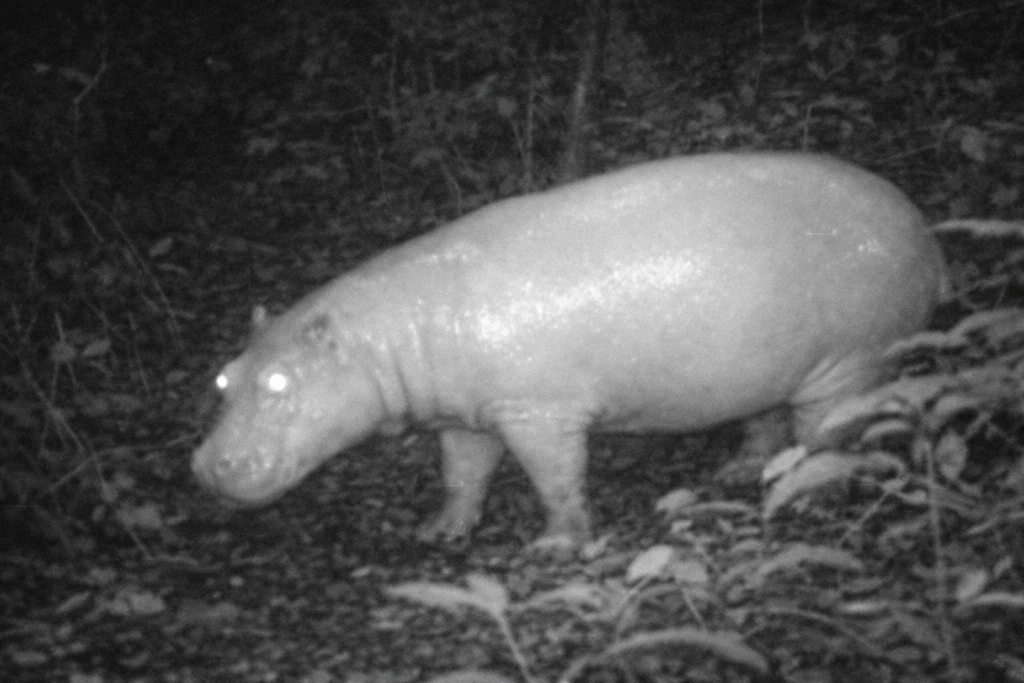
Rare “Phantom” Sighting Sparks Global Conservation Interest
Monrovia, Liberia – March 26, 2026 – Conservationists and wildlife officials have announced a historic discovery following the confirmed sighting of a rare albino pygmy hippopotamus in Liberia’s Sapo National Park.
The animal, now widely referred to as “Phantom,” was identified through camera trap footage collected in the park’s dense rainforest and swamp regions. Experts from the Liberian Forestry Development Authority and Fauna & Flora confirmed that the hippo is a fully grown adult exhibiting true albinism.
The animal shows a complete absence of melanin, giving it a white to light pink appearance without any visible pigmentation. Its pink eyes further verify that the condition is true albinism rather than leucism. The pygmy hippo’s natural reddish secretion, often called “blood sweat,” adds a slight tint while serving as protection against environmental factors.
Pygmy hippopotamuses (Choeropsis liberiensis) are already considered highly endangered, with an estimated population of fewer than 3,000 remaining in fragmented West African forests. This marks the first scientifically documented case of albinism in the species in the wild.
“This discovery is extremely rare and significant,” said John Konie Chief Park Warden at Sapo National Park. “Although lighter-colored hippos have occasionally been reported, a fully albino pygmy hippo has never been officially recorded before. While the animal appears stable, its condition increases risks such as sun sensitivity and greater exposure to threats.”
Background and Rare Sightings
Unusual pale hippos have been observed in the past, including a leucistic individual seen in Kenya’s Masai Mara in 2010 and another light-colored hippo spotted in Zimbabwe’s Zambezi region in 2025. However, those cases involved partial pigmentation rather than full albinism.
Due to the secretive behavior of pygmy hippos and their dense forest environment, sightings are already rare. This makes the confirmed appearance of an albino adult even more extraordinary.
Conservation Efforts
Sapo National Park remains one of the most important habitats for pygmy hippos in West Africa. Despite challenges such as habitat loss and human activity, the park continues to support a fragile but surviving population.
Following the discovery, park authorities have increased monitoring efforts in the area. Conservation groups are also working closely with local communities to ensure the safety of the animal.
Experts hope that the global attention around “Phantom” will help bring increased awareness and funding to protect endangered species and preserve critical ecosystems.
