
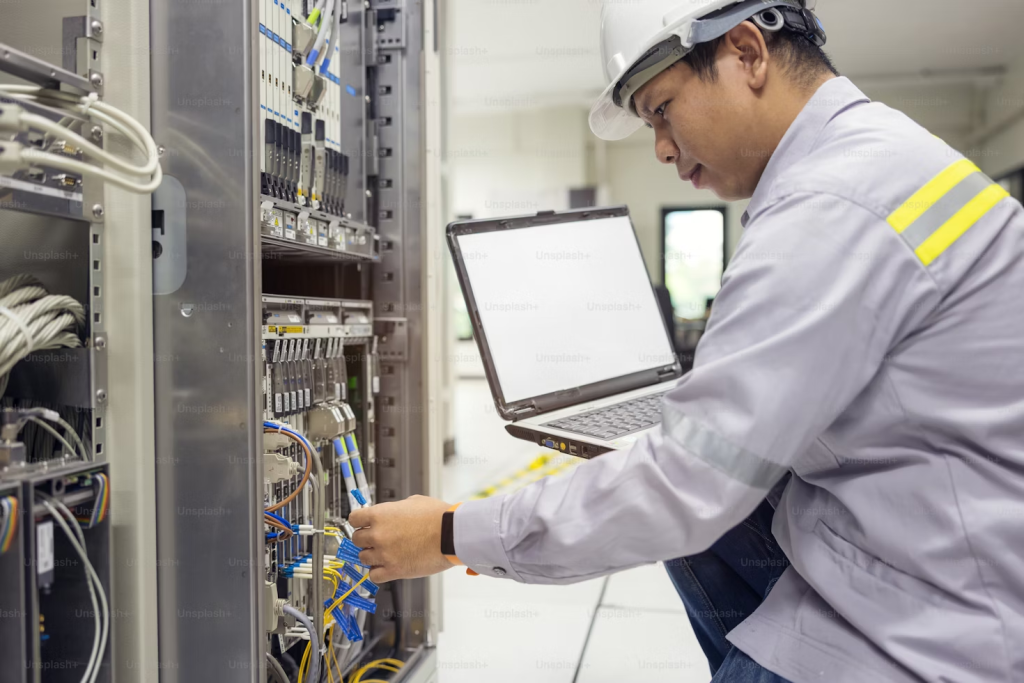
Data centers are the backbone of the digital world. In simple terms, the data center is a physical facility of an organization that houses its critical data and applications. Its design comprises a network of computing and storage devices that make data and application delivery possible. Unlike the old data centers, modern data centers not only work through physical servers but on virtual networks too. This transferred the applications across the physical infrastructure into a multi-cloud environment. In this modern era of technology, huge data exists which are connected through multiple data centers and the cloud. The data center has to communicate with these multiple sites, both physically and in the cloud.
Core Components of a Data Center:
The core components of a data center comprise switches, routers, storage systems, firewalls, services, and application delivery controllers. These components mainly store and manage critical data of the business and thus must be secured. Together this infrastructure provides:
- Storage Facility: Data is the modern world’s fuel and the data center’s storage systems have a pool of data.
- Networking: The network system connects servers (cloud and physical), storage, data center services, and external connectivity to the end user.
- Computing Resources: Servers are the engines of a data center. They help in processing, local storage, and network connectivity that drives applications.
Since data centers comprise computational and networking assets. To manage and maintain the data center’s assets and control activities like operations, performance, monitoring, and security of the system is necessary. This is done to ensure the full utilization and increase the efficiency of the data center. An IT configuration management database (CMDB) along with hardware tracking software is used by IT staff to track the data center’s configurations and assets. This way the assets and supporting infrastructure of the data center are accurately represented.
How Does a Data Center Operate?
To store, transfer, and access digital information, data centers are made up of real or virtual servers connected both internally and externally by networking and communication devices. Every server in a data center has a processor, memory, and storage capacity, but with greater power than a home computer. Software applications are used in data centers to cluster servers and divide the workload among them.
This has become more economical and efficient with the help of cloud computing, which can also simplify data center operations. Businesses have started adopting cloud computing to reduce costs on physical infrastructure and increase remote flexibility to obtain redundancy.
What Do Data Centers Do For Business?
Businesses are largely supported by data centers as they are designed to support a number of business activities such as:
- Sharing files and emails
- Applications for productivity
- Management of customer relationship
- Database and enterprise resource planning (ERP)
- Machine learning, artificial intelligence, and big data
- Communications, virtual desktop, and collaboration services
Why is Data Center Security Essential for Businesses?
Businesses that rely on data centers for even small operations such as sending emails must make sure that their data is safe. They must ensure that physical and network security is in place so the information contained in the system is protected from theft, damage, and viruses. There’s no business that is not even slightly connected to technology and data thus it becomes essential to secure data centers.
Data centers host data, applications, and services that firms use every day. Lacking effective security protocols can result in data breaches which leads to sensitive information leaks of a company or worse a customer. This has an adverse effect on a company’s reputation. Security integration in the infrastructure layer of the data center enables a fine-grained security approach and greater risk management when dealing with security threats.
Measures for Data Center Security:
Data center security measures include both physical and virtual security tools.
Physical Security:
physical security measures for data centers are dependent on the size of the center. Data centers with heavy IT equipment like servers, routers, switches, and cooling infrastructure come under physical infrastructure. They are mostly kept in a space and can easily be protected by locking the space. Badge access, alarms, and video surveillance are other measures that can be taken. One important consideration is protecting the equipment from fire. Chemical fire suppression systems must be installed in the storage space with sprinklers.
Virtual Security:
IT administration can manage data center services remotely now by abstracting data center servers, storage, and network. They can use multiple software to run data center operations virtually. Virtual security tools such as firewalls have intrusion prevention and detection features. IT managers can use this software to set policies of user identification to allow only authorized users to access the data center.
Challenges Faced by Data Center:
1. Businesses highly depend on data to operate:
Data stream disruptions have an effect comparable to power outages. As a result, companies have expected data center operators to operate at a high standard. Even if a data loss can end any kind of operation, data centers bear a disproportionately high cost of production loss due to the rapid growth of the digital economy and the widespread use of cloud services.
2. Constant Power Availability:
Choosing data centers that can meet uptime guarantees based on redundant power supplies, such as UPS and battery banks, is crucial for ensuring reliable power. On the other hand, inadequately observed machinery may cause expensive interruptions to redundancy plans. The data center utility operators can effectively mitigate equipment failure and ensure that the planning window is appropriate for operating and maintenance demands by incorporating online monitoring into their electrical assets.
3. Mitigating Risks:
It is essential that any equipment in the data center does not fail due to end-of-life calculations. Transformer and switchgear life must have a well-studied estimation. As a result, data center equipment should last longer than the transformer’s design life in most applications. However, in the absence of proper monitoring, the danger of failure is too great to be tolerated, which is why power equipment is frequently replaced well in advance of its electrical life. To extend the life of the assets, real-time monitoring can be leveraged to collect data.
Because data centers are essential pieces of infrastructure, their locations are carefully selected to guarantee the availability of well-planned power sources. In order to guarantee steady operations in the event of errors or malfunctions, many have contingency plans.
